Accelerating smart city development with a focus on putting people at the centre has therefore become an urgent requirement for realising the goal of turning Ha Noi into a smart city by 2030, with a vision to 2045.
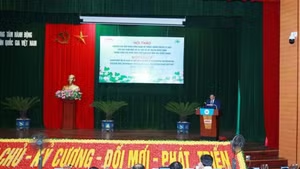
Recently, Ha Noi Chairman Vu Dai Thang signed a decision to establish the Smart City Development Coordination Council under the city’s Steering Committee for Digital Transformation.
The council will organise the implementation of tasks, solutions, and projects on smart city development identified in approved schemes and plans; regularly urge, inspect, and supervise progress and outcomes; promptly identify, synthesise, and propose solutions to remove difficulties, obstacles, and bottlenecks during implementation; and ensure close coordination, transparency, and clearly defined individual responsibility.
The Ha Noi Police are also taking the lead in finalising the scheme on Ha Noi smart city development to 2030, with a vision to 2045.
According to Lieutenant General Nguyen Thanh Tung, Director of the Ha Noi Municipal Police, the formulation and implementation of the smart city development scheme is of particularly significant importance.
This is both an inevitable requirement of the digital transformation trend and a concrete political task to translate the Party’s guidelines and the national digital transformation strategy into practice, while meeting public expectations for a capital city that is safe, convenient, humane, and sustainable.
The scheme is built on the Smart City 3.0 model, featuring a four-layer architecture comprising smart infrastructure, centralised data, digital platforms, and an application ecosystem, with the Intelligent Operations Centre (IOC) serving as the brain.
Priority will be given to addressing five key issues: flooding, traffic congestion, environmental protection, public security and order, and food safety.
By 2030, Ha Noi aims to operate a two-tier IOC system (at city and ward/commune levels), standardise data, and develop an open ecosystem, encouraging enterprises to participate in developing applications and services based on the city’s data and digital infrastructure.
At present, the biggest challenges in smart city implementation lie in shifting management mindsets from traditional approaches to those based on real-time data, and in improving the quality of human resources.
If grassroots officials are not properly trained and lack the habit of working with digital data, even the most advanced systems will struggle to operate effectively.
One of the sectors being prioritised for early progress in digital transformation and the application of smart city tools and solutions is urban planning.
Nguyen Trong Ky Anh, Director of the Ha Noi Department of Planning and Architecture, affirmed that digital transformation is an inevitable path, but it requires a change in mindset, from administrative procedures to proactive, data-driven approaches. Establishing a shared data repository, he noted, will have a major impact on planning and planning management.
In practice, according to Nguyen Truc Anh, Vice Chairman of the Viet Nam Urban Development Planning Association, Ha Noi’s planning data remain fragmented and inconsistent, leading to unscientific management.
This situation demands strong changes from authorities at all levels, ranging from inter-sectoral coordination to data disclosure and training officials to master technology.
Building a shared data repository, digitising documents, and applying artificial intelligence are strategic steps that will help enhance transparency and optimise resources.
For residents, the benefits include faster public services, intelligent traffic systems that ease congestion, timely flood warning systems, real-time environmental monitoring, and higher levels of safety and security.
As Nguyen Truc Anh analysed, a smart city requires not only modern buildings but also decisions grounded in evidence-based data. Data form the foundation for forecasting, serve as tools for measurement, and act as a voice for dialogue between authorities and citizens.
Residents are not merely beneficiaries but also active participants in supervision and feedback through digital platforms, helping to transform the city into a more humane and liveable space.
As Lieutenant General Nguyen Thanh Tung affirmed, implementing the scheme will lay the foundation for digital government, innovation, and sustainable development.
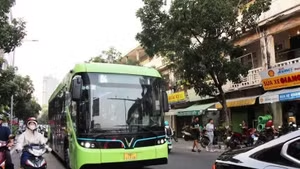
Ha Noi is accelerating its action plan towards 2030, focusing on key areas such as green transport, smart energy, waste management, and sandbox pilot mechanisms.
With strong leadership and a clear people-centred orientation, Ha Noi is overcoming difficulties, barriers, and entrenched perceptions to develop smart, effective, and sustainable urban governance solutions.