On June 15, at its fourth session (special session), the Ha Noi People’s Council approved the plan to implement a low-emission zone within the Ring Road 1 area, aiming to strengthen air pollution control and promote the transition to green transportation.
At the session, the People’s Council also approved 54 important resolutions, including regulations on policies to support the conversion of road transport vehicles from fossil fuels to clean energy and to encourage people to use public passenger transport.
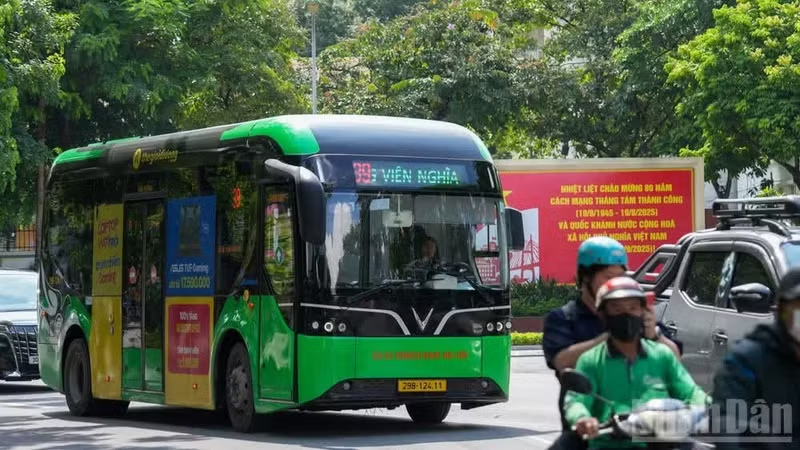
According to the approved resolution, the city will waive bus fares (excluding buses serving tourism businesses) for trips within Ring Road 1, effective from July 1, 2026 to June 30, 2027.
The Ha Noi People’s Committee stated that the policy of waiving bus fares aims to directly support groups significantly impacted by the roadmap to restrict fossil fuel-powered vehicles, as outlined in Prime Minister’s Directive No. 20, and the city’s plan to establish low-emission zones.
Ring Road 1 has been identified as an area where emission control measures and restrictions on fossil fuel vehicles will be implemented early. Therefore, residents, workers, or those who frequently travel within this area will be the first and most directly affected by the policy.
According to the Ha Noi People’s Committee’s explanatory report, the bus fare waiver is a support measure in the initial phase, contributing to reducing travel costs and facilitating a gradual shift in people’s habits from using private vehicles to using public transportation.
The free fare policy applies regardless of the type of bus route, based on the target group and scope of impact. Accordingly, passengers departing from the area within Ring Road 1 will benefit from a fare-free policy, even when using radial routes, routes connecting the city center with suburbs, and other areas of the city.
After one year of implementation, the city will conduct a comprehensive evaluation of the results, impact on people’s travel needs, public passenger transport volume, budget efficiency, and resource allocation, as a basis for considering adjustments, expansions, or improvements to the policy in subsequent phases.