With double-digit growth becoming an urgent requirement, tourism development is no longer solely about preserving and promoting heritage sites; it is also about unlocking unique economic resources and allowing culture to become a central driving force behind the former imperial capital’s next stage of development.
Heritage — a "gold mine" for growth
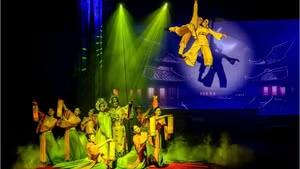
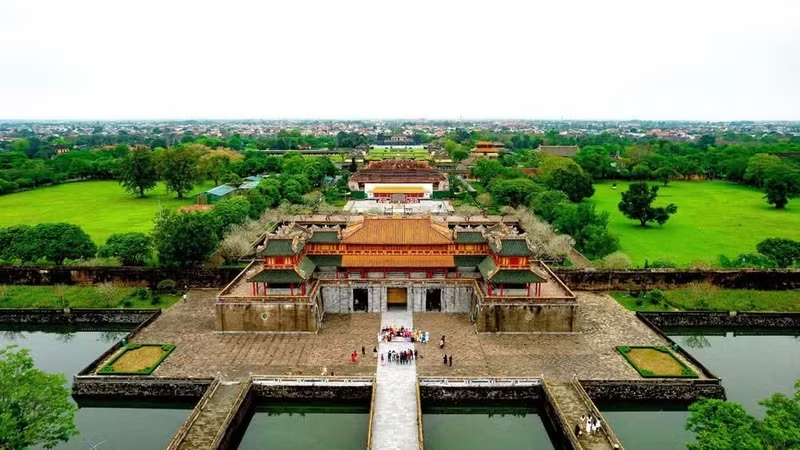
Final: As night falls over the former imperial city of Hue, streams of visitors continue to stroll leisurely along the ancient, moss-covered walls beneath the golden illumination of Ngo Mon Gate, Thai Hoa Palace, and Kien Trung Palace. The melodies of royal court music echo through the historic palaces, immersing visitors in the atmosphere of the past.
After experiencing the Imperial City by Night programme, Marie Laurent, a French tourist, said: “I have visited many heritage cities around the world, but Hue offers something truly different. It is not merely a collection of ancient monuments; it is a living cultural space.”
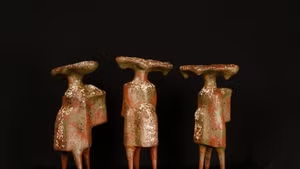
Few places possess such a rich combination of tangible and intangible heritage as Hue. From the Complex of Hue Monuments, royal court music, and the Nguyen Dynasty woodblocks and imperial archives to vibrant living traditions such as Hue folk singing, traditional festivals, imperial cuisine, craft villages, the Hue ao dai, and the cultural landscape of the Perfume River and Ngu Binh Mountain, the city boasts an extraordinary wealth of cultural assets.
Complementing this is a remarkable natural landscape stretching from the Chan May-Lang Co coastal area and the Tam Giang-Cau Hai Lagoon to the western forests, providing an exceptional foundation for high-quality cultural, ecological, and resort tourism.
Dr Cung Trong Cuong of the Hue Institute for Development Studies said: “Hue’s greatest strength lies not in the number of its monuments but in the depth of its culture. Visitors can experience history through multiple senses: seeing the architecture, listening to royal court music, tasting the cuisine, and engaging with local communities. That is something very few heritage cities in the region can offer.”
Final: In recent years, a range of offerings have all injected fresh vitality into the city’s tourism sector, including the Hue Festival, royal court performances, the pedestrian streets along the Perfume River, the Imperial City by Night programme, craft village experiences, and community-based tourism.
In 2024, Hue welcomed around four million visitors, generating nearly 8 trillion VND (304 million USD) in tourism revenue. In the first five months of 2026 alone, the city received almost 3.6 million visitors, with tourism revenue reaching approximately 8.3 trillion VND, an increase of nearly 70% compared with the same period last year.
However, many experts believe that Hue’s heritage “gold mine” remains underutilised. Visitors’ average length of stay remains relatively short, while spending levels are still modest. Although the city’s tourism products are rich in cultural value, they have yet to become diverse and substantial enough to extend visitors’ stays.
Hue’s tourism infrastructure also remains unevenly developed. The city lacks integrated high-quality service and entertainment complexes, has a limited pool of internationally qualified tourism professionals, and has yet to establish strong regional linkages.
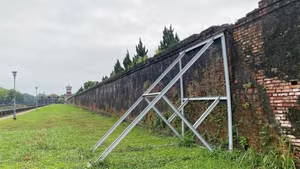
Meanwhile, the growing need to preserve and restore its extensive system of historical monuments requires substantial investment. These are the key challenges Hue must overcome if it is to transform its heritage assets into a genuine competitive strength in the new era.
Turning heritage into a driver of growth
Whereas Hue’s primary concern in the past was preserving its heritage, today’s challenge is to maximise the value of that heritage for sustainable development. At recent government meetings, Hue Chairman Nguyen Khac Toan affirmed that tourism and services will be among the city’s most important growth drivers in the coming years.
Hue aims not only to increase visitor numbers but also to maximise the economic value generated by every cultural product, every destination, and every tourism experience. This vision is now being translated into a series of major programmes and flagship projects.
Hoang Viet Trung, Director of the Hue Monuments Conservation Centre, said: “Our overarching objective is to transform heritage into a living cultural space. Programmes such as Imperial City by Night, changing-of-the-guard performances, recreations of royal court rituals, technology-enhanced visitor experiences, and interactive tourism products are gradually bringing heritage closer to the public.”
This is also the direction adopted by many of the world’s leading heritage cities. When heritage is presented through the language of technology, art, and immersive experiences, it can generate far greater economic value than traditional approaches.
According to Hue Vice Chairman Tran Huu Thuy Giang, Hue is expanding its tourism development across four key zones: the central heritage urban area, the Tam Giang-Cau Hai Lagoon, the Chan May-Lang Co coastal area, and the western ecological area. Together, these will provide the foundation for a more diverse tourism ecosystem while reducing pressure on the city's central heritage area.
At the same time, Hue is intensifying efforts to attract private investment. During the first five months of 2026, the city secured more than 19 trillion VND in newly registered investment capital. Numerous projects are being advanced in the tourism, services, and cultural industries, including high-end resort complexes in Chan May-Lang Co, eco-tourism developments around the Tam Giang Lagoon, cultural spaces along both banks of the Perfume River, international convention and exhibition centres, night-time entertainment quarters, and cultural innovation hubs.
Tran Thi Hoai Tram, Director of the Hue Department of Tourism, said that the city’s tourism sector is focusing on raising the quality of its offerings while increasing both visitors’ average length of stay and their spending. Heritage tourism, green tourism, community-based tourism, and experiential tourism will serve as the sector’s core products.