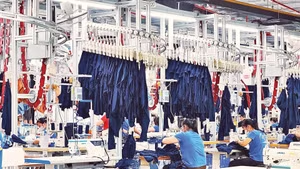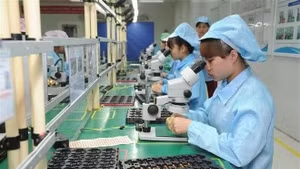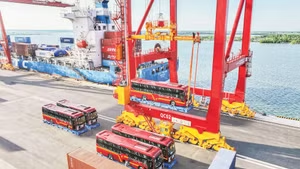
Ho Chi Minh City plans to attract 4.25 billion USD in investment into its export processing zones and industrial parks (IPs) in 2026, as part of efforts to shift its growth model toward high-tech, green and sustainable development, the HCM City Export Processing and Industrial Zones Authority (HEPZA) said on January 7.
According to HEPZA Director Bui Minh Tri, the strategy places equal emphasis on capital scale and project quality. The city aims to lift average investment intensity to 8–10 million USD per hectare, with a focus on high-tech, high-value-added and environmentally friendly industries.
The long-term direction is to transform export processing zones and IPs toward high, green and digital technologies. Tri mentioned that priority will go to smart manufacturing projects that use resources and energy efficiently and are well connected to global value chains.
In 2026, the city will step up implementation of a master plan to develop its export processing zones and IPs alongside the restructuring of key industries. The plan includes promoting high-tech manufacturing, eco-IPs, new-generation IPs and smart IPs, following approval by the municipal People’s Committee. The city will also pilot a number of special mechanisms and policies to support its development.
Tri described the move as strategic, aimed at modernising the industrial sector and aligning it with international standards. He expressed confidence that National Assembly mechanisms and resolutions will provide greater policy space for attracting investment, streamlining administrative procedures and mobilising social resources.
Administrative reform and digital transformation will remain key priorities this year. HEPZA aims to rank its industrial zone management units among the top five nationwide in the Public Administration Reform Index (PAR Index), the Department and District Competitiveness Index (DDCI), and the Digital Transformation Index (DTI). All administrative procedures processed through the national and city public service portals are expected to be handled on time or ahead of schedule.
Seen as a pivotal year ushering in the 2026–2030 development phase, 2026 highlights the need to sustain investor confidence and ensure a stable, transparent investment climate. The expansion of administrative boundaries has strengthened the city’s advantages in market size, industrial land, logistics infrastructure and the industrial–service ecosystem. As a hub for finance, trade, science, technology and innovation, export processing zones and IPs remain key drivers of industrial output and magnets for high-quality foreign direct investment, Tri said.
Economic experts noted that with strong advantages in location, workforce and infrastructure, Ho Chi Minh City is well-positioned to capture a new wave of investment. The city’s push to develop eco-industrial and smart IPs, in particular, is expected to support business expansion and long-term investment, while further improving transparency and accelerating the digitalisation of administrative procedures.