The difference between infrastructure enterprises, therefore, lies not in “hard infrastructure" such as capital or technology, but in “soft infrastructure” where discipline, integrity, and exemplary conduct are cultivated.
Maintaining discipline for enterprises
Entering 2026, the transportation infrastructure sector faces a pivotal acceleration phase towards the goal of completing 5,000 km of expressways by 2030. In this journey, the private sector is expected to continue playing a leading role, determining not only the progress but also the quality of key national projects. Pressure on time, resources, and legal risks forces many infrastructure enterprises to re-evaluate their development models and seek more sustainable governance foundations.
From the perspective of someone who has led the transportation sector for many years, former Minister of Transport Ho Nghia Dung, former Secretary of the Party Committee of the Ministry of Transport, believed that there is an often overlooked factor that determines the long-term viability of private enterprises: the Party organisation. “Just a small deviation in authority, procedures, or documentation can cause project delays, cost overruns, and even disputes. In that case, the damage is not only measured in money, but also in reputation and trust,” Ho Nghia Dung analysed, adding that in the context of overlapping policies and mechanisms, this is precisely the value that the Party organisation brings to private enterprises.
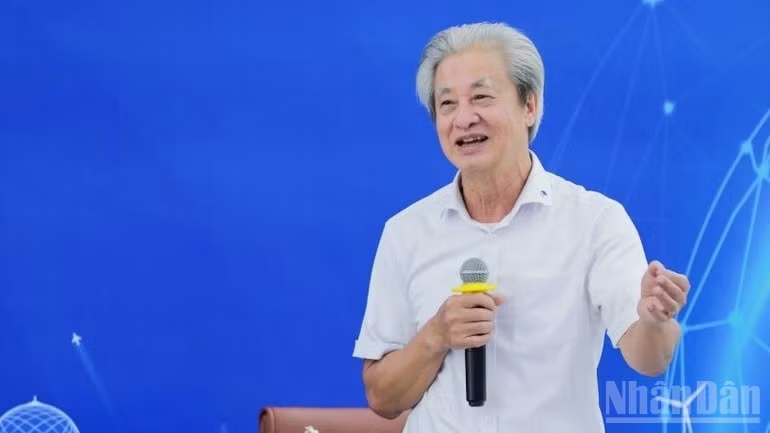
As an example of a typical model, Ho Nghia Dung recalled the acquisition of Hamadeco Company by Deo Ca Group in 2015. At that time, public opinion was concerned when Ho Minh Hoang, Chairman of Deo Ca Group, decided to pay double the price to complete the merger and aim for listing on the HOSE stock exchange. But the main goal that Deo Ca Group aimed for, according to Ho Nghia Dung, was not only the tangible values of Hamadeco, but also the long-standing Party Committee established in 1974, which brought together a team of disciplined, straightforward Party members with the distinctive characteristics of Central Viet Nam.
After taking over the Hamadeco Party Committee and implementing restructuring and transformation into Deo Ca Infrastructure Investment Joint Stock Company (HHV) in 2019, Deo Ca has implemented many key projects and completed its listing on the HOSE in 2022. This demonstrates the approach of considering Party organisation development as part of the long-term development strategy in private enterprises. More importantly, Ho Nghia Dung believed that Party building in private enterprises should not be merely a formality, but should be genuinely prioritised.
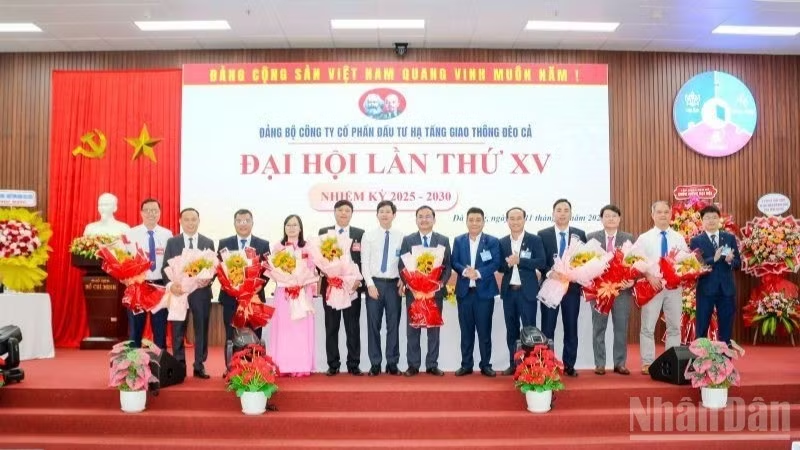
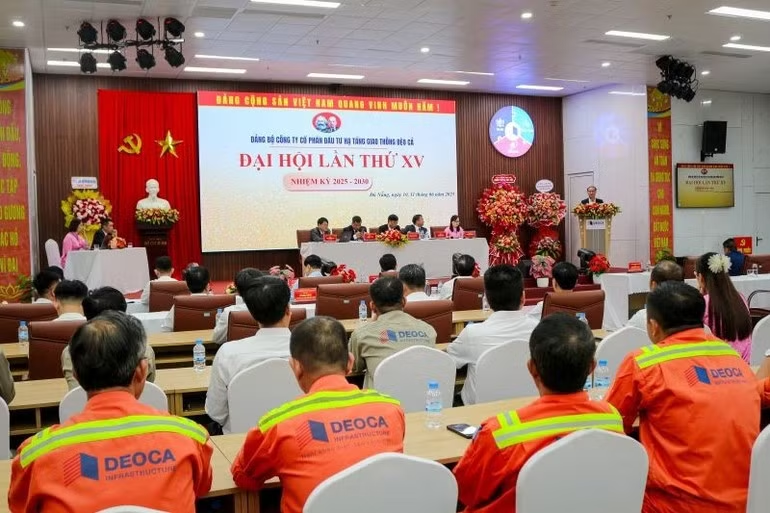
Since moving to its new “home”, the HHV Party Committee has continuously grown, with 174 Party members distributed across 7 subordinate branches throughout the country. With the support and favorable conditions provided by the head and leadership of the enterprise, the HHV Party Committee has achieved many positive results, contributing to helping the enterprise maintain its growth momentum, ensuring stable jobs and income for employees, and effectively carrying out Party building work.
Currently, Deo Ca Group has 217 Party members operating in two major Party organisations: the Party Committee of Deo Ca Group Joint Stock Company and the Party Committee of HHV Company. Playing a key political role, the Party organisations within Deo Ca Group participate in building and effectively leading production and business tasks, contributing to making Deo Ca a leading brand in the field of transportation infrastructure. In 2025, Deo Ca Group and its member units, including HHV Company, were honoured to receive the Third-Class Labour Order and commendations from the Prime Minister and the Ministry of Construction, recognising many outstanding contributions in the emulation of completing key national expressway projects.
According to Ho Nghia Dung, the core element for Party organisations to firmly establish themselves within private enterprises is the clear delineation of roles. While the Board of Directors and management are responsible for decision-making and implementation according to the law, the Party organisation focuses only on value orientation, disciplinary supervision, and risk prevention. “Only when this boundary is clearly established will coordination become advantageous. Conversely, if it is vague, the enterprise easily falls into a state of overlapping responsibilities and formalism,” Dung concluded, while recommending that private enterprises design a mechanism for coordinating Party organisations in a way that supports governance, avoiding the bureaucratisation of production and business activities.
Caring for the lives of workers is a measure of “Party spirit”
According to Ho Nghia Dung, Party organisations in private enterprises can form an internal “immune system,” helping to prevent wrongdoing and control negative practices. “In the field of transportation infrastructure, risks are not only technical or financial, but often arise in sensitive areas such as land acquisition, materials, environmental issues, or the acceptance and payment process. When the monitoring mechanism is not strict enough, ‘shortcuts’ hidden behind pressure to meet deadlines can put businesses in a legally passive position and damage their reputation,” Ho Nghia Dung pointed out.
Therefore, he believed that control must start from the root: records, authority, procedures, and individual responsibilities must be monitored throughout; tasks lacking legal requirements need to be promptly adjusted or temporarily suspended for completion, instead of “doing it first, then legalising it later”.
Evaluating the Politburo’s Resolution No.68-NQ/TW on the development of the private economy, the former Minister of Transport considers it an important foundation for reducing the burden of compliance, protecting those who do things correctly, and creating conditions for businesses to raise their governance standards. “Only when the State removes institutional bottlenecks can private businesses compete based on genuine capabilities, instead of through connections or circumventing the law,” he emphasised.
Returning to the story of Deo Ca, the way this company uses specific “measures” to assess the quality of its governance has been highly praised by many experts. Questions about the working environment, income, or discipline are no longer slogans, but have become tools to verify the effectiveness of the Party organisation through practical results for the workers. When welfare and discipline are significantly improved, “Party spirit” is no longer an abstract concept but transforms into a measurable and perceptible management capacity.
In 2015, some employees of HHV wondered whether the Party organisation’s activities would become merely ceremonial after transitioning to a private enterprise model. However, subsequent events showed that, alongside an increasingly improved working environment and income, the HHV Party Committee was also given favourable conditions to consolidate and develop both in scale and quality. Ho Nghia Dung recalled a meeting he had with the Chairman of Deo Ca Group with the HHV Party Committee. The question posed by the head of the enterprise was not about targets or slogans, but something very practical: Do Party members have a better working environment? Is their income more stable than before? And the answer from the Party members was: “Much better”.
For Ho Nghia Dung, that is the measure of “Party spirit” in the enterprise. When the interests of workers are improved, discipline is maintained, and values are consistently implemented, the Party organisation will truly become a support for management activities. From an institutional perspective, enterprises cannot bear the “costs” of a complex legal environment alone. Long-term projects can only be launched when the legal framework is transparent, less overlapping, and predictable.
Regarding Regulation No.296-QD/TW dated May 30, 2025, of the Central Committee on Party inspection, supervision, and discipline, private enterprises need to apply it as a disciplinary framework to prevent risks, while also creating a channel for timely reporting of emerging barriers that are “administratively” transformed into new procedures, causing difficulties for citizens and businesses.
Based on that experience, the former Minister of Transport suggested three “connecting points” for Party organisations to genuinely support businesses: establishing clear coordination regulations between the Party organisation and the Board of Directors and the Executive Board; setting up a risk prevention mechanism for each project to provide early warnings of sensitive areas; and considering the Party organisation as a channel for receiving internal feedback, protecting workers, preventing vested interests, and monitoring the “bureaucratisation” of investment and economic development procedures in the “new era”.
“To become a model of national enterprise, the private sector must view compliance as a competitive advantage. When transparent institutions are combined with strict internal discipline, businesses will contribute to the country not only with capital and technology, but also with courage and responsibility,” Ho Nghia Dung concluded.