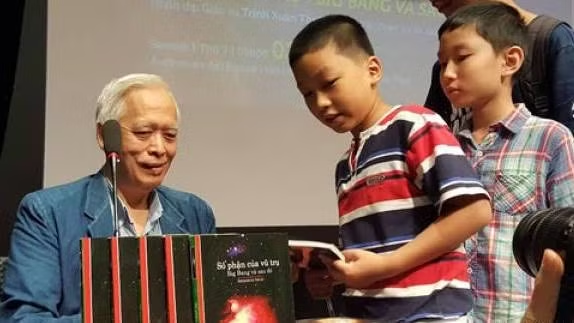
On the occasion of the release of two books entitled ‘The Destiny of the Universe – After the Big Bang’ and ‘Facing the universe’, he granted an interview to a Nhan Dan Weekly Newspaper reporter.
Attracted by science
Q: From what I know, you left Hanoi for Da Lat with your parents when you were six. Do you remember your childhood in Hanoi?
A: I still remember the ancient streets, Hang Dao, Hoan Kiem Lake and the Hanoi Opera House. I left Hanoi when I was six; and 45 years later in 1993, I returned to my hometown with French President Mitterrand on his visit to Vietnam.
Q: Why did you pursue astronomy?
A: Although I have an aptitude for literature, I was attracted by science, particularly physics. I admire Einstein, and his book ‘The World as I see it’ is my bedside companion. I studied in Switzerland and then received scholarships from three universities in the United States. I decided to come to Caltech where my idol Einstein lived and worked. It was also a holy city for astronomy.
Q: During the time you lived and studied in Caltech, did you have a passion for the beauty of the universe?
A: Yes, certainly. I have never regretted my decision to sacrifice my whole life for astronomy. I feel emotional when I see the image of a distant galaxy on the screen in the observation room.
I am always amazed at the beauty, harmony and unity of the universe. The universe is beautiful because it not only contains splendid objects such as rainbows, sunsets, star nurseries and spiral galaxies, but also has order.
We can enjoy the beauty of the nature and universe right around us like at Ha Long Bay. I really want to inspire and convey my knowledge of natural beauty, as well as share my happiness with others.
Becoming a conveyor of knowledge
Q: Why did you decide to teach at Virginia University?
A: I thought that by becoming a ‘conveyor of knowledge’, I could change readers’ outlook on the world, helping people to learn more about the human condition in the infinite and wide universe.
Q: One of your bestselling books is entitled ‘Infinity in the palm of the hand’ that you and the monk and astrophysicist Matthieu Ricard wrote. Could you explain the meaning of the title?
A: The idea for the book’s title comes from the poem ‘To see a world’ by British poet and philosopher William Blake, which reads “To see a World in a Grain of Sand - And a Heaven in a Wild Flower - Hold Infinity in the palm of your hand - And Eternity in an hour".
He has a rich intuition and imagination as well as a deep understanding of philosophy and the laws of existence; he can perfectly describe the universe in a grain of sand. I really like these lines of poetry and I used one to name my book.
Q: What are three questions reflecting your major concern?
A: 'How to live life; how to live in society; and what we can know', as Matthieu Ricard wrote in our book. In addition, I am interested in the universe and want to know where humans were born and learn about their role in the universe. Being a responsible scientist, I never want to do harm to others and make others suffer.
Q: In your book ‘Facing the universe’, in addition to your parts, numerous guests contribute their writing, including a monk, writer, scientist, philosopher, artist, agronomist and environmentalist. Why did you include them?
A: They all are my friends. Although they have different occupations, we share the human and harmonious beauty in the chaotic universe. The articles in the book reflect all issues in the life. For example, human unconsciousness will burn our land and if we want to exist, we have to protect the earth. Regarding love and compassion, the book will explain why individual matters are related to the universe.
By reading books, we can understand wisdom is a double-edged sword because people now have the ability to destroy the ecological balance of the planet.
Q: You always refer to the human condition in the universe through an easy to understand writing style which seems to dispel readers’ doubts about dry personality of scientists. Why do you write this way?
A: I want to convey my knowledge with others, particularly young Vietnamese people, with a deep ambition of helping the country’s astronomers keep pace with the world. I’ve had the chance to enjoy the beauty of the universe, so I want to share my happiness with others.
By understanding the human condition in the universe, we can understand ourselves because humans are just a blink in the evolution of the universe.
Q: Are you really a fan of writer Antoine de Saint Exupery, the author of the novella ‘The Little Prince’?
A: Yes, I really like him. He is not only a pilot but also a writer.
Q: Do you want to convey any messages to young Vietnamese?
A: All I want to say is, do not turn this green planet into an inhospitable place.
Thank you very much!

The book 'Facing the universe'