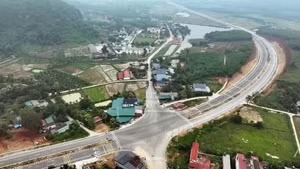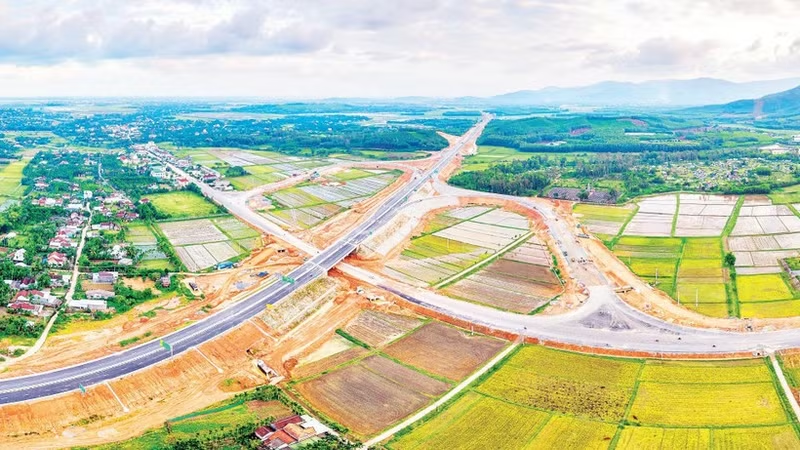
According to economic experts, the completion of these expressways not only shortens travel times from Cao Bang and Lang Son to Can Tho and Ca Mau, easing congestion and reducing traffic accidents, but also expands socio-economic space, boosts trade, and promotes the development of transit services and logistics.
A driving force for growth
According to the Ministry of Construction, throughout 2025, ministries, central agencies and localities commenced and inaugurated more than 560 projects, with a total investment exceeding 5.14 quadrillion VND. Of this, projects involving private-sector participation accounted for approximately 3.84 quadrillion VND (74.6%), while state investment totalled around 1.3 quadrillion VND (25.4%).
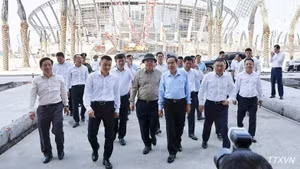
At the ground-breaking and inauguration ceremony for projects marking the 14th National Party Congress, Prime Minister Pham Minh Chinh stated that the socio-economic infrastructure projects recently launched and completed reflect the mindset, vision and aspiration of the Vietnamese people and nation to reach out to the open sea, delve deep into the earth, and soar into space.
He stressed that the first bricks had been laid for future projects with a long-term vision, embodying the unity of the Party’s will and the people’s aspirations, and carrying national stature.
“Beads of sweat, and even blood and tears; offices lit through the night; construction sites illuminated after dark and bustling by day, working tirelessly through holidays, these have crystallised into projects that shape national development and deliver tangible benefits to the people. Each road built today is not only made of concrete and steel, but also forged from trust, responsibility and the aspiration for development, affirming the determination of the Party, the State and the people to build a civilised and prosperous Viet Nam,” Prime Minister Pham Minh Chinh affirmed.
Each road built today is not only made of concrete and steel, but also forged from trust, responsibility and the aspiration for development, affirming the determination of the Party, the State and the people to build a civilised and prosperous Viet Nam.
~ Prime Minister Pham Minh Chinh
According to Minister of Construction Tran Hong Minh, these projects carry profound political and economic significance, as well as importance for national defence and security. They serve as a driving force for the next phase of growth, while creating new development space and fostering international integration.
The increasing share of private capital relative to state investment demonstrates the soundness of the Party and State’s policy on developing the private sector, as set out in the Politburo’s Resolution 68.
By comparison, during the 2001-2010 period, only 89 km of expressways were completed and put into operation nationwide; in 2011-2020, nearly 1,200 km were completed; and in just the past five years (2021-2025), the total length of completed expressways has exceeded more than twice the combined total of the previous 20 years.
Minh noted that this is the fastest development pace in the history of the transport and construction sector to date, helping to create a synchronous and modern national expressway network. The operation of more than 3,000 km of expressways stands as clear evidence of achievements in strategic infrastructure development and the determination to build a modern country.
By concretising the Resolution of the 13th National Party Congress, the 10-year Socio-Economic Development Strategy for 2021-2030 and resolutions of the National Assembly, Viet Nam has fulfilled the target of building 3,000 km of expressways nationwide by 2025, far earlier than previously forecast.
With a roadmap to expand the network to 5,000 km by 2030, the expressway system will form the foundation for national logistics development, promote suburban urbanisation and enhance the country’s international competitiveness.
Opening up new development space
According to Deputy Minister of Construction Le Anh Tuan, the 2021-2025 period can be regarded as the most severe stress test for transport infrastructure projects. The COVID-19 pandemic disrupted supply chains and forced many construction sites to adopt on-site production, isolation and living arrangements. When the pandemic temporarily subsided, the construction materials market faced shortages and price surges, driving up costs.
At the same time, adverse weather conditions, including prolonged and exceptionally severe floods across many regions, caused significant damage to projects.
“The value of reaching the 3,800 km expressway milestone goes far beyond simply connecting the two ends of the country. Beyond the figures themselves, the journey of building 3,000 km of expressways represents a revolution in management thinking, route development and connectivity. It has been a training ground forging the will and aspirations of the Vietnamese people, where speed, discipline and efficiency have become new standards,” Deputy Minister Le Anh Tuan said.
Cao Dang Hoat, Chairman of the Board of Directors of Dinh An Group, noted that for many contractors, achieving and surpassing the 3,000 km expressway target was almost unimaginable.
The north-south expressway has been completed in record time. A decisive factor behind this success was the central government’s early decision to split projects into large-scale contract packages, enabling the selection of contractors with sufficient capacity and experience, scientific construction methods and investment in modern technology.
Beyond road infrastructure, the period has also witnessed impressive transformation across other infrastructure sectors. Following thorough preparation, the railway sector has begun implementing major projects such as the north-south high-speed railway, the Lao Cai-Ha Noi-Hai Phong railway, and urban railway system.
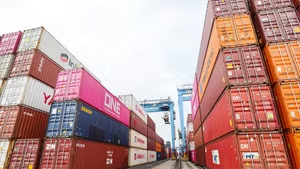
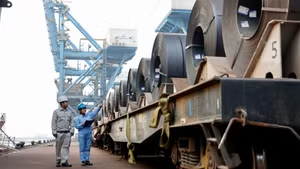
Thanks to well-planned and properly directed investment, during the 2020-2025 period, cargo handling capacity across the national seaport system increased by 1.3 times, from 730 million TEUs to around 900 million TEUs, helping to boost import-export activities and promote the development of the marine economy.
In the aviation sector, total capacity at national transport hubs rose from 92.4 million passengers per year to 155 million passengers per year, an increase of 1.6 times.
The 13th National Party Congress identified the development of a synchronous and modern infrastructure system, with transport infrastructure as one of the three strategic breakthroughs. During the past term, transport infrastructure has made a leap forward, with breakthroughs in thinking, institutions and implementation.
Expressways, seaports, airports and strategic transport corridors have been developed in a coordinated manner, creating spillover momentum for socio-economic development. Viet Nam has thus opened up new development space, laying a modern infrastructure foundation for long-term growth.
These achievements have formed a solid foundation to continue accelerating infrastructure development, striving to complete 5,000 km of expressways by 2030, as well as high-speed railways, modern seaports and aviation projects, propelling the country forward with greater confidence and aspiration than ever before.