
Given Bollywood’s exceptional influence on cultural life in India and in many regions around the world, these positive signals are expected to enhance tourism outreach, provided that Viet Nam proactively strengthens its capacity to welcome and effectively leverage such cooperation.
Viet Nam is becoming an attractive destination for Indian film producers. Following the success of the project “Love in Viet Nam”, the film “Silaa”, and several other projects continue to proceed with numerous scenes filmed in Quang Tri, Ninh Binh, Cao Bang, and Quang Ninh. In addition to creating appeal through visually rich cinematography, projects like “Love in Viet Nam” also integrate local cultural elements to offer audiences a fuller experience of Viet Nam’s living environment.
Compared with many international projects in previous years, which visited Viet Nam primarily for scenery while local personnel remained outside the production process, recent Indian projects have involved Vietnamese actors, helping shape the emotional rhythm and narrative flow of the film. The film crews have also agreed to produce a promotional clip about Vietnamese tourism to be screened before all showings in 1,000 cinemas across India.
Quang Tri is now drawing particular attention as the film crew of “Silaa” has selected Son Doong, Hang En, the Tu Lan Cave system, and Phong Nha Cave as primary filming locations. Unlike the period when “Kong: Skull Island” used Ninh Binh as a filming site but its promotional impact was not fully harnessed, this time Quang Tri is working closely with the Ministry of Culture, Sports and Tourism, the Phong Nha-Ke Bang National Park Management Board, and private enterprises to welcome the film crew in a more professional manner and maximise opportunities.
Recently, at the international conference titled “Ninh Binh — a strategic destination for tourism, cinema and luxury weddings”, many Bollywood directors and producers remarked that numerous localities in Viet Nam possess all the necessary conditions to become major film studios in the region. Ho An Phong, Deputy Minister of Culture, Sports and Tourism, also highlighted this potential, affirming that the selection of certain Vietnamese localities as filming sites by major cinema industries will help attract more international visitors, particularly from the Indian market.
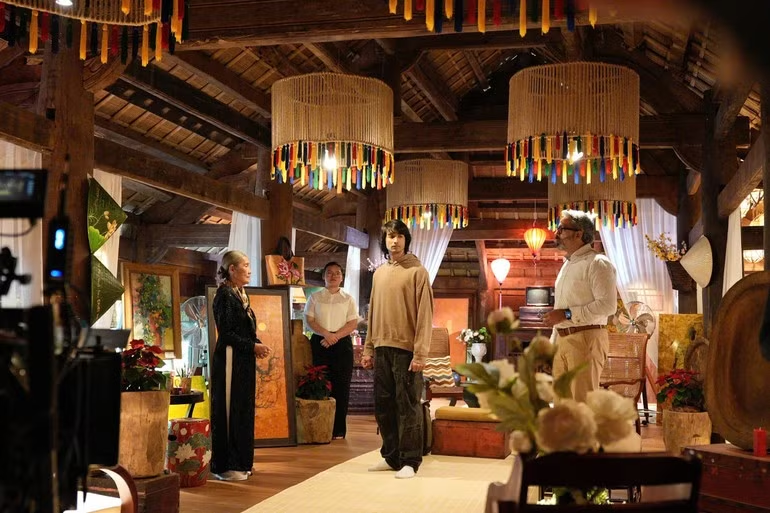
Many provinces and cities are actively preparing film-set infrastructure, tourism spaces, and supporting services to accommodate a new wave of film production. This also forms a long-term strategy that links cinema with sustainable tourism development. Deputy Minister Ho An Phong emphasised: “When scenes of Viet Nam appear through the refined visual language of Bollywood cinema, it represents one of the fastest, most effective, and most sustainable forms of promotion.”
According to Indian film experts, Bollywood produces around 1,500 films annually and enjoys a vast audience in South Asia, the Middle East, Africa, and parts of Europe. As such, each film produced in Viet Nam can be considered a large-scale media campaign that would be extremely costly if funded through traditional advertising budgets.
With distinctive natural landscapes ranging from caves, mountains, and rivers to cultural and historical heritage sites, Viet Nam possesses a rare advantage as a natural film studio for the region. Competitive production costs, a progressively more professional local workforce, and strong support from local authorities also enhance Viet Nam’s appeal to international producers.
Alongside opportunities, there remain considerable challenges that require Viet Nam to prepare systematically and with long-term vision. Specifically, incentive mechanisms for international film crews are not yet competitive compared with many regional countries; licensing procedures in certain locations remain time-consuming; and film-set infrastructure, production services and post-production facilities lack synchronisation. Some filming sites located within protected areas or heritage zones also have limited carrying capacity, necessitating strict supervision to prevent negative environmental impacts.
To fully capitalise on opportunities from foreign film projects while addressing current limitations, multiple solutions must be implemented concurrently. Firstly, the culture and tourism sectors need to collaborate to develop competitive incentive policies, including exploring tax rebate mechanisms or cost support for film crews similar to Thailand and the Republic of Korea, to create substantive appeal.
Nguyen Trung Khanh, Head of the Viet Nam National Authority of Tourism
After each film project, efforts to develop tourism products based on “film trails” remain insufficient compared with potential, resulting in gaps in communication effectiveness. These challenges should be viewed as motivation for closer coordination between the tourism and cinema sectors, from improving policy to developing products, in order to establish Viet Nam as an attractive and sustainable destination for international film crews and to create momentum for new tourism growth in the coming period.
Nguyen Trung Khanh, Director General of the Viet Nam National Authority of Tourism, remarked: “To fully capitalise on opportunities from foreign film projects while addressing current limitations, multiple solutions must be implemented concurrently. Firstly, the culture and tourism sectors need to collaborate to develop competitive incentive policies, including exploring tax rebate mechanisms or cost support for film crews similar to Thailand and the Republic of Korea, to create substantive appeal.
“At the same time, procedures for filming permits, use of technical equipment, access to heritage sites and protected areas must be simplified, transparent, and harmonised across localities to shorten preparation time and reassure international producers. Viet Nam also needs to develop infrastructure for the film industry, including modern studios, post-production centres, internationally standardised equipment warehouses, and a well-trained, professional technical workforce.”
Experts emphasise that for the tourism sector, localities whose landscapes are chosen for filming must proactively design tourism products based on “film trails”, develop thematic tours, check-in points, behind-the-scenes exhibitions and performance programmes associated with the film to extend media impact. Promotional campaigns should also be implemented synchronously, utilising actors, directors, and film crews as image ambassadors, while intensifying digital communication in key markets such as India, the US, and the Republic of Korea.
Another important solution is the focus on environmental and heritage protection, especially in sensitive areas such as caves, forests, and world heritage sites. Criteria on film-crew management, on-site supervision, waste treatment, and filming safety must be strictly applied to ensure sustainability and preserve landscapes in their original state.
It is necessary to establish an inter-sectoral coordination mechanism between the Ministry of Culture, Sports and Tourism, local authorities, tourism and cinema enterprises, and international partners to build a long-term vision. When cinema and tourism are strategically linked, Viet Nam can become both an attractive destination for international filmmakers and a powerful driver for promoting the country’s image, thereby contributing meaningfully to economic growth and spreading cultural values.