Preserving, restoring, and promoting the value of the historical site
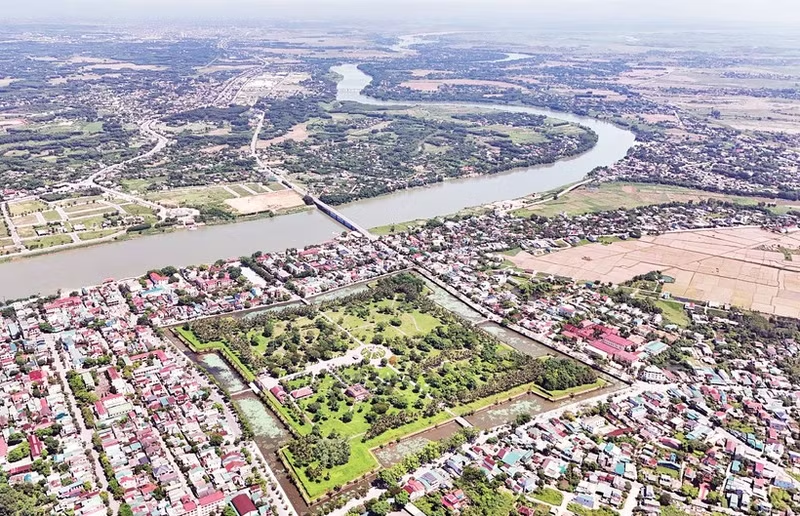
Truong Huu Hieu, Deputy Director of the Quang Tri Provincial Investment and Construction Project Management Board, said that the project aims to preserve, restore, and promote the value of the Quang Tri Ancient Citadel National Special Monument and memorial sites commemorating the 81-day and 81-night battle in 1972. This contributes to educating the patriotic spirit of generations of Vietnamese people, while also creating a highlight for peace tourism.
Hoang Dung (a veteran from Ninh Binh Province), upon returning to visit the Quang Tri Ancient Citadel National Special Monument, was surprised to see that the severely degraded areas caused by war and time had been restored. This time, the citadel’s foundation and outer embankment around the lake were reinforced; four sections of the perimeter wall were newly constructed in the same architectural style as the original. The roads within the citadel and the defensive roads around it were renovated. The Rear Gate and the Quang Tri Prison were also refurbished...
In particular, the Bo De School relic has been restored. This is one of the very few structures that survived from the summer of 1972. The school was built in 1959 with contributions from Buddhists and the people, with a two-story reinforced concrete structure and six classrooms. Throughout its 12 years of existence, the Bodhi School became a base for the revolution. A group of revolutionary fighters were secretly infiltrated into the school to carry out several important tasks at that time.
This included altering students’ academic records to lower their ages, making them too young to be drafted into the army, thus preventing them from being conscripted by the old regime; at the same time, selecting some students to send to the Ba Long war zone and then to the North for further training to return to serve when the country was independent and unified.
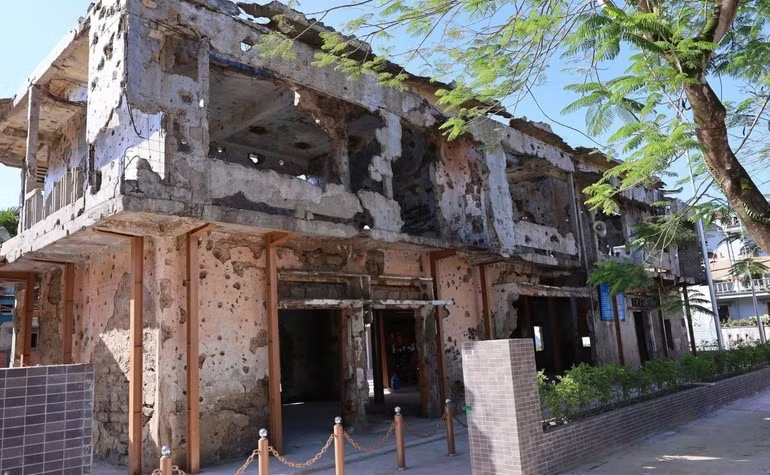
During the 81-day and 81-night battle in 1972, the school became the safest hiding place for soldiers crossing from the north to the south bank of the Thach Han River to enter the centre of the ancient citadel. Therefore, along with several other targets, the school suffered the brutality of war. American bombs and bullets rained down on the Quang Tri ancient citadel, melting even the steel, but the school still stood proudly as a vivid and powerful testament to the war for independence for the Vietnamese nation. Before restoration, the School had two floors, with bullet holes scattered around the walls and numerous large and small holes in the ceiling.
Truong Huu Hieu, Deputy Director of the Quang Tri Provincial Investment and Construction Project Management Board, said: Bo De School was renovated based on the principle of respecting the original elements to the maximum extent, limiting drastic intervention into the old structure. For the main item, the school building, the project focused on repairing, reinforcing, and strengthening against deterioration.
Steel support columns were placed at locations where walls, beams, and floors were at risk of failure, combined with supporting beams to increase load-bearing capacity while ensuring that the original architectural shape was not altered. The building’s surface was cleaned with specialised chemicals and sprayed with anti-mold and anti-algae agents... After many months of renovation, Bo De School is now clean, beautiful, and spacious again.
Another item that has been renovated is Long Hung Church located in Hai Lang commune. The church is built of reinforced concrete and is sturdy. In 1972, the church became a strong defensive position for the liberation army. This time, the project involves restoring, reinforcing, and strengthening the monument to prevent further deterioration; drainage ditches have been dug, and electricity has been installed.
Enhancing the status of peace tourism
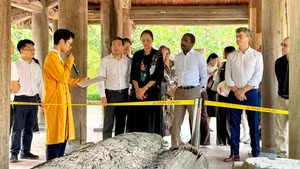
According to Le Minh Tuan, Director of the Quang Tri Department of Culture, Sports and Tourism: “The Quang Tri Ancient Citadel National Special Monument and other memorial sites have undergone many restoration and renovation phases since the country achieved peace. To date, the restoration work has been completed. This is an important destination for the Second Peace Festival organised by Quang Tri Province in 2026.”
In April 2025, the Prime Minister approved the task of developing a plan for the preservation, restoration, and rehabilitation of the Quang Tri Ancient Citadel National Special Monument and the memorial sites commemorating the 81-day and 81-night battle in 1972, covering an area of 454 hectares. This represents a major turning point in changing the mindset of monument management from preserving individual sites to a large-scale, interconnected monument space. The scope extends beyond the ancient citadel to neighbouring areas in the former Trieu Phong and Hai Lang districts. The main axis is the Thach Han River, connecting the satellite historical sites.
The Quang Tri Ancient Citadel, a special national historical site, and its memorial sites have undergone numerous restoration and renovation efforts since the country achieved peace. To date, the restoration work has been completed. This is an important destination for the Second Peace Festival organised by Quang Tri Province in 2026.
Le Minh Tuan, Director of the Quang Tri Department of Culture, Sports, and Tourism
According to Le Minh Tuan, the plan is divided into segments, including a core area that is strictly protected. The chain of satellite historical sites is closely connected to Bodhi School, Long Hung Church, and the battle positions held in 1972. The goal is to create a vibrant open-air museum, allowing visitors to experience history along the route from the Thach Han River bank to the ancient citadel, then through Bodhi School. This series of interconnected sites will allow visitors to visualise the ferocity of the war across the entire front, not just at a single point.
The space for commemoration and ceremonies, centred at the flower-releasing docks on both the north and south banks of the Thach Han River, is planned to be expanded to host major festivals such as the Lantern Festival. The green spaces surrounding the historical site will be renovated to build service infrastructure, parking lots, and thematic exhibition areas, avoiding overcrowding in the core area of the site.
Hoang Nam, Standing Vice Chairman of the Quang Tri Provincial People’s Committee, shared: “This meaningful project aims to prepare tourism resources to enhance Quang Tri's position on the international tourism map with a message of rebirth and love for peace. Each visitor, upon arriving here, will not only pay tribute to the past but also deeply feel the value of rebirth and the enduring aspiration for peace of the Vietnamese people.”