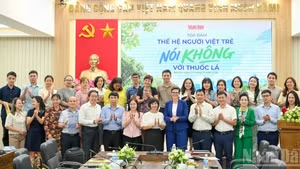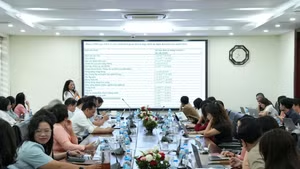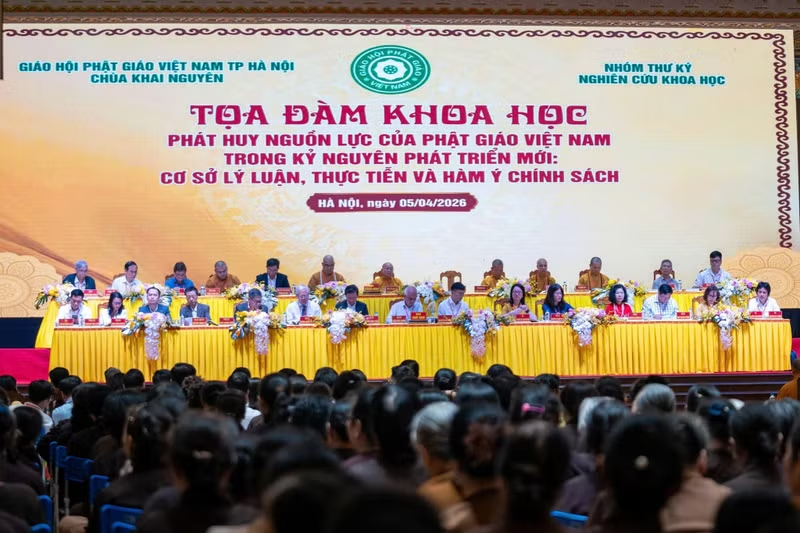
The seminar brought together a large number of senior monks, scholars, policymakers and experts from various fields, including religious studies, history, political science, public administration, cultural studies, sociology and development studies.
In his opening remarks, Most Venerable Thich Gia Quang, Vice President of the VBS’s Executive Council, emphasised that as the country enters a new era of development—with demands for renewing growth models, advancing digital transformation and improving the quality of human resources—the role and resources of Buddhism must be recognised in a more comprehensive, scientific and practical manner.
According to Venerable Thich Gia Quang, the seminar aimed to establish a serious academic forum to gather valuable, in-depth and practically meaningful insights, thereby providing an important basis for policymaking and guiding Buddhist activities in the coming period.
Associate Professor Dr Tran Duc Cuong, President of the Viet Nam Association of Historical Sciences and co-chair of the organising committee, noted that in the new development era—with its requirement for rapid and sustainable growth—conducting systematic and comprehensive research on Buddhist resources, from theoretical foundations to practical application and policy refinement, holds profound scientific and practical significance.
According to Dr Tran Duc Cuong, the papers submitted to the seminar approached the issue from multiple perspectives. These diverse approaches demonstrate that Buddhist resources are not confined to religious activities, but constitute an important component of broader social resources, capable of making meaningful contributions across various aspects of national life.
The organising committee reported receiving 45 papers from scholars, experts and religious dignitaries, of which 27 outstanding contributions were selected for presentation and inclusion in the proceedings.
Participants agreed that Buddhist resources extend beyond spiritual and cultural dimensions to include education, social welfare, community development and heritage preservation.
The seminar focused on three main pillars: economic resources, human resources, and science and technology resources. Participants stressed that mobilising Buddhist resources should be approached holistically—not only through financial mobilisation, but also through effective governance, organisation and the efficient utilisation of spiritual, cultural, human and intellectual assets.
The seminar served not only as an academic forum but also provided additional scientific and practical foundations for policymaking, proposing solutions to enhance the effective mobilisation of Buddhist resources in the time ahead. At the same time, the event contributed to strengthening connections between the VBS and research institutions, training centres and state management agencies.
In addition, the event reaffirmed Vietnamese Buddhism as a distinctive socio-cultural resource with an increasingly important role in the cause of national construction and development in the new era.