From large-scale book fairs to reading promotion activities in schools, homes, and residential areas, the foundation for a learning society is gradually taking shape.
Nurturing a reading culture
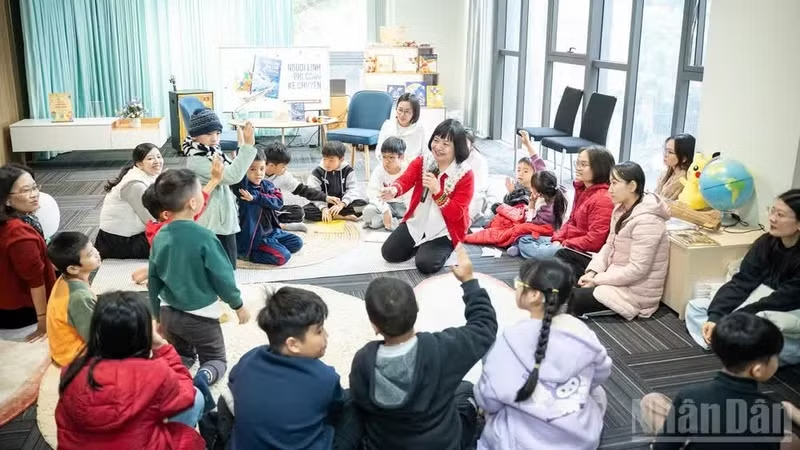
Every weekend, at the Bach Khoa residential complex (Ha Noi), the Reading with Children Club space is filled with lively conversations and laughter. Students enthusiastically take part in practising reading skills, identifying memorable details, discovering new words and interesting expressions in books, illustrating stories, and more.
Dr Nguyen Thuy Anh, founder of the club, shares that children are encouraged to write reflections, retell stories in their own way, or relate them to personal experiences. Some write about their family kitchen, some write letters to characters, others recount childhood memories. Such interactions make reading more vivid, unlocking the ability to appreciate literature while nurturing the inner lives of these young readers.
At Kim Dong Publishing House, the Reading Corner has recently hosted regular exchanges with authors, storytelling sessions, drawing activities, and handicraft workshops.
According to Vu Thi Quynh Lien, Deputy Director and Editor-in-Chief of Kim Dong Publishing House, bringing books closer to readers requires equal attention to content quality, presentation, and modes of access. Themed reading programmes on history, seas and islands, traditional culture, and life skills are delivered in various formats, helping books connect more closely with everyday life and become more relevant to readers, especially young people.
Beyond publishing houses, many localities have developed effective reading promotion models, such as competitions like Reading Culture Ambassador, Writing about My Favourite Book, and Youth with Reading Culture. Book streets and book roads in many provinces and cities are also playing an increasingly important role as community cultural spaces. In schools, the model of child-friendly libraries has been systematically developed and has been implemented nationwide, creating open spaces with flexible reading corners.
According to the Ministry of Education and Training, during the 2021–2025 period, the more than 2,100 child-friendly libraries have been expanded across 14 new provinces and cities, benefiting over 3.28 million students. In communities, initiatives such as parent bookcases, family lineage bookcases, apartment bookcases, and reading stations help strengthen bonds within families, across generations, and throughout communities, promoting learning from the grassroots level.
These initiatives show that when reading is organised flexibly, with creative approaches tailored to specific conditions, reading culture has greater opportunities to take root more deeply across all sections of society. However, reading models remain uneven across provinces and cities, with some still being implemented in a superficial or campaign-driven manner.
From pages to building a learning society
To make reading culture truly an integral part of social life, alongside diversifying reading promotion activities, it is essential to change perceptions and approaches. Many experts believe that Viet Nam Book and Reading Culture Day should be viewed as a “soft institution” of strategic significance, contributing to deepening knowledge, nurturing character, and fostering a lifelong learning mindset.
In recent years, many domestic publishers have taken proactive steps to seek high-quality manuscripts for publication and introduction to readers. Vu Thi Quynh Lien noted that Kim Dong Publishing House places strong emphasis on discovering new authors, sourcing new works and enriching the pool of quality manuscripts.
For many years, the publishing house has regularly organised writing contests and campaigns, while also nurturing emerging writers, thereby contributing to the sustainable development of Vietnamese literature. Drawing from its experience, Lien suggests that publishers should invest more in experiential, interactive, and exchange activities so that books can “live” within community life.
Dr Nguyen Thuy Anh emphasises that promoting reading culture cannot stop at campaigns or major events. What is needed is the development of in-depth reading activities suited to each group and context. For children, reading should be associated with enjoyment and personal experience, rather than becoming a compulsory task tied to grades.
According to experts, a major challenge today is to build a sufficiently strong “reading ecosystem” to sustain reading habits in the context of rapidly advancing digital technology. This ecosystem must begin within families, spread to schools, and be reinforced by the wider social environment.
Nguyen Chau Linh, Vice Chairwoman of the Business Book Council, stresses the need to ensure that reading goes beyond an individual activity to become a social capacity that nurtures individuals, businesses, and the nation. Families are where the first “seeds” are sown. In schools, if libraries become spaces for discussion and dialogue about books — with reading sessions, discussions, and reflections — then reading can become an enjoyable activity rather than a burden for students.
At the same time, regulatory bodies, publishers, the press and digital platforms need to coordinate effectively to create a healthy cultural environment that honours knowledge and values reading. When these three “pillars” function well, reading culture can thrive despite the intense competition from modern forms of entertainment.
On March 17, the Party Central Committee’s Secretariat issued Directive No. 04-CT/TW on strengthening the Party’s leadership over publishing activities in the new context (Directive 04), emphasising the guiding viewpoint of developing reading culture with readers at the centre and as the ultimate goal of publishing activities.
The directive sets the targets to strongly promote reading culture by 2030; establish cultural institutions; create spaces for reading, learning, and creativity within communities; and move towards building a nationwide reading movement.
Le Hoang, Director of Ho Chi Minh City Book Street Company, expressed that if Directive 04 is implemented effectively, it will bring about significant positive changes, strongly promoting reading culture within the community and elevating the reading culture of Vietnamese people to a new level. In the context of building a learning society, the role of reading culture becomes even more urgent, as such a society cannot be formed without reading habits and self-learning capacity.
Books are not only a means of transmitting knowledge but also a tool that helps individuals develop critical thinking, broaden their horizons, and enhance their adaptability in the face of rapid changes. When reading becomes a natural part of life and each individual finds joy and meaning in the pages of books, reading culture can develop sustainably and contribute to realising the aspiration of building a learning society.