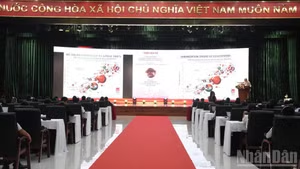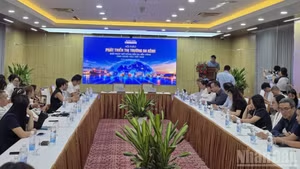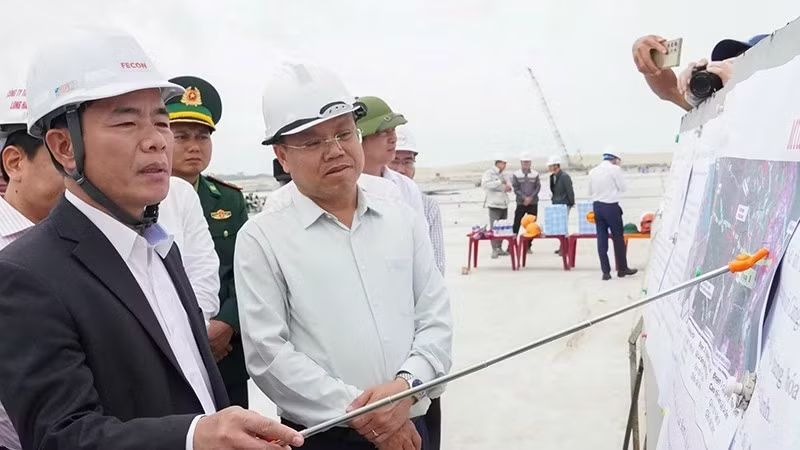
After July 1, 2025, Quang Tri Province entered a new development phase with an expanded area of over 12,700 km² and a population of nearly 1.9 million people. This comprehensive restructuring of development space towards integration aims to gradually transform Quang Tri into a multi-functional development centre of the North Central region. The Resolution of the First Provincial Party Congress, 2025–2030 tenure, identified: Rapid and sustainable development based on the strategic infrastructure pillar.
Increased connectivity, reduced costs
Recent development showed that Quang Tri is transforming from a medium-sized coastal locality into a multi-gateway development space in the North Central region, encompassing a sea area, deep-water ports, international border gates, the trans-Viet Nam highway, an airport, economic zones, industrial parks, and an energy corridor.
This multi-gateway structure enhances connectivity, reduces logistics costs, and increases attractiveness to global supply chains. The simultaneous convergence of seaports, international border gates, highways, and airports gives Quang Tri a rare infrastructure foundation in the North Central region.
This is a prerequisite for shifting its growth model from resource exploitation and traditional trade to high value-added industrial production and modern logistics services.
According to Nguyen Duc Tan, Director of the Quang Tri Investment, Trade, and Tourism Promotion Centre, Quang Tri's most outstanding feature lies in its “dual-axis, multi-gateway” transportation structure.
Besides the railway and National Highway 1, Quang Tri has a north–south expressway in the west directly connecting to Ha Noi and Ho Chi Minh City, and a coastal road in the east running the entire length of the province, thus shaping two parallel development corridors.
These strategic transportation axes act as “growth poles” where capital, labour, and technology converge and then spread to the surrounding areas. This also accelerates the flow of goods, reduces logistics costs, and enhances the reliability of the supply chain.
For export-oriented manufacturing businesses, especially in electronics, precision mechanics, or supporting industries, the ability to deliver goods on time is a key factor. Having two parallel expressways enhances Quang Tri’s flexibility, reduces dependence on a single route, and minimises disruption risks.
Along these expressways, the province has the opportunity to plan satellite industrial clusters, logistics centres, transshipment warehouses, and service urban areas to support production. This will create new development spaces, contributing to population redistribution and generating additional impetus for regional growth.
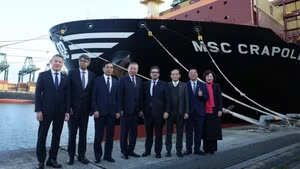
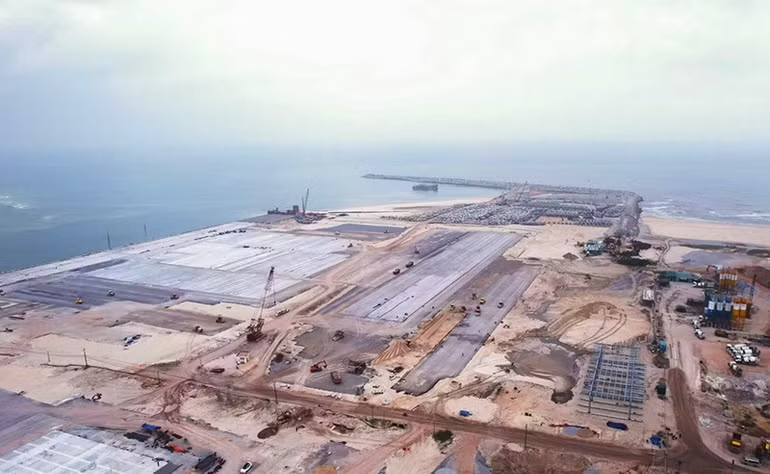
According to Nguyen Duc Tan, compared to other provinces in the North Central region, Quang Tri has two deep-water seaports, My Thuy and Hon La, forming a large-scale integrated port system capable of receiving ships with a tonnage of 50,000 to 100,000 DWT, expanding import-export capacity and cargo transshipment.
This is a particularly important strategic advantage in the context of global trade increasingly relying on large-scale maritime transport to optimise costs. The advantage of deep-water ports helps the province be proactive in import-export, reducing dependence on other major port centres, while creating a foundation for the development of large-scale heavy industry, energy, and processing.
These deep-water ports not only serve the province's import-export activities but can also act as a gateway to the sea for central Laos and northeastern Thailand. This opens up opportunities to form an international cargo transshipment centre and develop value-added logistics services such as bonded warehouses, processing–re-export, and regional distribution.
Thanks to this seaport system, the province can attract large projects that were previously limited by transportation infrastructure. In the context of restructuring global supply chains, the ability to accommodate large cargo ships and tranship international goods is an attractive factor for multinational corporations.
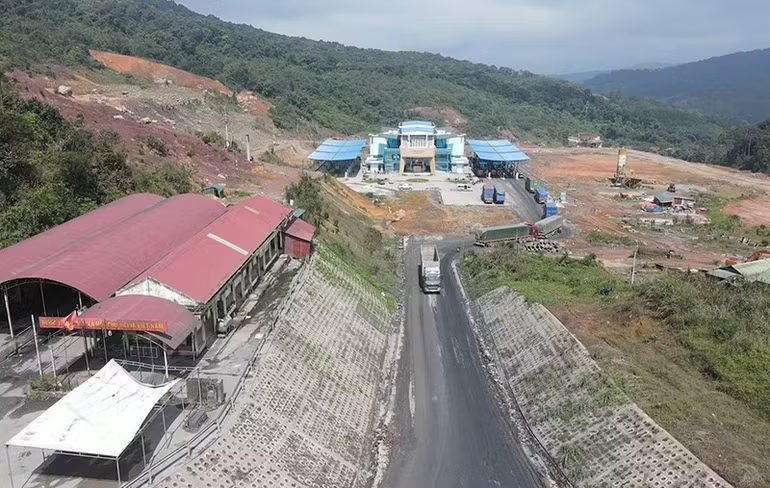
The three international border gates of Lao Bao (connecting to National Highway 9), La Lay (connecting to National Highway 15D), and Cha Lo (connecting to National Highway 12A) on the East–West Economic Corridor (EWEC) and the Parallel East–West Economic Corridor (Para-EWEC) form a trans-Asian connection axis encompassing Myanmar–Thailand–Laos–Viet Nam, shortening the distance from Thailand and Laos to the East Sea and creating a competitive advantage for Quang Tri in developing cross-border logistics.
In the context of the ASEAN Economic Community promoting trade liberalisation, the role of trans-Asian economic corridors is becoming increasingly prominent. This also suggests the possibility of forming a free trade zone linked to Quang Tri’s port and border gate system, opening up opportunities to attract cross-border projects and export production.
Along with the road and seaport systems, the airport structure includes two airports. The dynamic Dong Hoi Airport and the soon-to-be-completed Quang Tri Airport project form a dual-axis aviation system, enhancing accessibility for international investors, high-tech experts, cargo transport, and domestic and international tourists.
In particular, the potential for developing air cargo transport will support high-tech industries, electronics, cold chain logistics, and cross-border e-commerce.
The "two airports – two seaports – three international border gates" structure creates a multi-layered transportation network, increasing flexibility for investors in production and distribution, a groundbreaking factor.
Solid foundation for attracting foreign direct investment
According to Nguyen Van Phuong, Member of the Party Central Committee and Secretary of the Quang Tri Provincial Party Committee, the Resolution of the First Quang Tri Provincial Party Congress, for the period 2025–2030, clearly defines the goal of building Quang Tri into an energy centre of the North Central region. Along with transportation, the province identifies energy infrastructure as the foundation for new-generation industries and a competitive advantage in the green transition era; therefore, it will be invested in a long-term, sustainable manner.
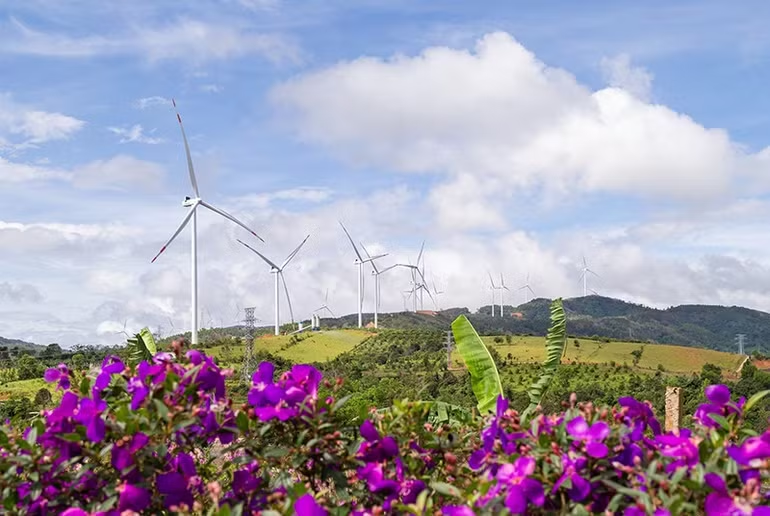
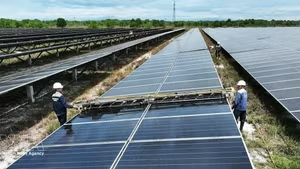
By early February 2026, the total generating and commercially operating capacity of wind and solar power projects in the province will reach 1,529.8 MW. The province aims to develop large-scale renewable energy and LNG projects to ensure a stable electricity supply for production and to meet the needs of industries requiring clean electricity.
In the context of the global shift towards a green economy and carbon emission reduction, Quang Tri's advantage in clean and stable electricity sources holds strategic significance. With abundant industrial land, competitive costs, clean energy sources, and an improved workforce, Quang Tri is aiming to attract high-quality foreign direct investment in the fields of logistics, renewable energy, supporting industries, and semiconductor materials.
Another fundamental factor is institutional reform and the investment environment. Quang Tri Province has been actively restructuring its administrative apparatus towards streamlining, strongly applying digital transformation, implementing a "one-stop shop" model for handling investment procedures, and especially upgrading the Investment Promotion Agency (IPA) to closely support and accompany businesses and implement "on-site" investment promotion activities.
The processing time for applications has been shortened, and the process is transparent, contributing to increased confidence among the business community. The development perspective based on open spaces, linking coastal areas, border gates, and mountainous regions, helps the province maximise its combined advantages after the merger.
According to Nguyen Van Phuong, Member of the Party Central Committee and Secretary of the Quang Tri Provincial Party Committee, practical experience shows that the new generation of foreign direct investment not only seeks investment incentives but also prioritises stability, connectivity, business confidence, and long-term prospects. Quang Tri is gradually asserting its position as a potential investment destination. Compared to other provinces in the North Central region, Quang Tri is located at the intersection of three strategic axes of the country: the North–South corridor; the East–West economic corridor; and the Central energy axis.
The convergence of these strategic economic corridors and a multi-gateway infrastructure system is opening up opportunities for the province to transform its geoeconomic advantages into new growth drivers, contributing positively to the country's goal of rapid and sustainable development by 2030, with a vision to 2045.