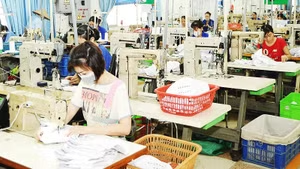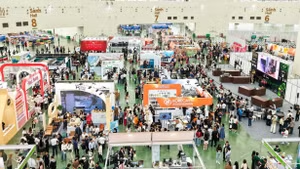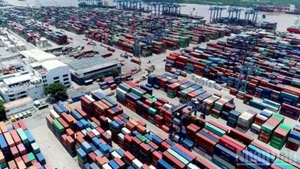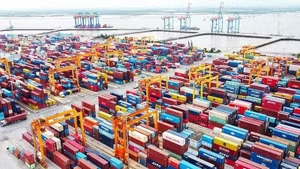
These enterprises make a major contribution to GDP (over 45%), create the majority of jobs (more than 60%), and serve as an important driving force for economic growth, innovation, and the development of the private sector. With such strength, SMEs are often described as the “backbone” of the economy.
Creating high value
Tu Hai Company Limited, based in Phuoc Thang Ward, operates in fishing, seafood processing, and fisheries logistics services such as ice supply and fuel provision. Dao Quoc Tuan, Director of the company, said that the firm currently purchases nearly 80% of the total duc (sillaginidae) fish output in Viet Nam, processes it, and exports it to Japan. From Japan, Tu Hai’s goby fish products are distributed worldwide, particularly to European and US markets.
In addition, sillaginidae fish bones produced by the company have become a unique product globally, especially in Japan, where they consistently hold 90% of the market share. Since 1992, the company has created jobs for more than 50,000 workers, providing stable incomes and secure livelihoods. Of these, 80% are local workers, while the remainder come from Dong Nai and provinces in the Mekong Delta.
After nearly 20 years of operation, Vung Tau Clean House Joint Stock Company has consistently received hundreds of long-term and seasonal contracts each year for industrial cleaning services, building care and maintenance of offices and workplaces, including major clients with annual contracts. Although it is a small enterprise within the SME community of Ho Chi Minh City, the company has created jobs for around 100–200 workers during peak seasons. “We started our business with the most practical services that residents, units, and enterprises need, such as industrial cleaning services. Reality has shown that we chose the right direction, as social demand continues to grow and the number of workers whose jobs are created by our company keeps increasing,” said Pham Thi Hao, Director of Vung Tau Clean House Joint Stock Company.
These stories demonstrate the growth and influence of SMEs on private-sector economic development. Nearly 600,000 other SMEs in Ho Chi Minh City have created substantial value, contributing to economic growth and affirming that the private sector is the “lifeblood” of the economy, as 98% of all enterprises in the city are SMEs and private businesses.
Zoning development areas
Economic experts affirm that the development of SMEs plays an important role in overall economic growth. SMEs are deeply embedded and widespread across all sectors of the economy.
Pham Van Triem, Chairman of the Ho Chi Minh City Small and Medium-sized Enterprises Association, emphasised: “The new Ho Chi Minh City currently has nearly 600,000 registered enterprises, with almost 400,000 actively operating. Total budget revenue is about 480 trillion VND, and around 4 million regular jobs are created across various sectors. Among them, SMEs are the ‘backbone’ of the regional economy, playing a key role in production, trade, services, supporting industries, and logistics. This is truly a strong business community, large in scale, resilient in internal capacity and expanding in the new era.”
In the new phase, the Ho Chi Minh City Small and Medium-sized Enterprises Association has identified a period of creation, innovation, linkage, and deep integration, with membership development as a strategic focus and a measure of the Association’s strength. To maximise potential and advantages, the Association has developed a development strategy for the 2025–2030 period. Accordingly, eastern Ho Chi Minh City will focus on in-depth development, building clusters of enterprises in logistics, supporting industries, tourism, and clean energy. Each year, the goal is to develop 300–500 new members, prioritising quality and effectiveness, while strengthening close ties with local authorities and industrial parks.
Western Ho Chi Minh City will develop through cluster networking, organising SME chapters in each industrial park, and integrating SMEs into domestic supply chains. The former Binh Duong area is expected to become the Association’s core industrial zone.
In central Ho Chi Minh City, strong development will focus on trade, services, finance, technology, and innovation, linked with the high-tech park, innovation centres and startup incubators, attracting young enterprises, startups, and FDI.
Bui Thi Thu Ha, Director of VietinBank, Ba Ria–Vung Tau Branch, said that as a member of the Association, VietinBank always allocates significant resources to support SMEs by simplifying procedures and facilitating access to bank credit. At the same time, the bank offers preferential product packages tailored for SMEs. VietinBank, Ba Ria–Vung Tau Branch, has restructured loans and maintained debt classifications for due loans to reduce pressure, while also supporting interest-rate reductions for SME clients. These practical measures and timely support from authorities and relevant agencies have helped the city’s SMEs gain greater confidence, expand development opportunities, and reaffirm their role as the “backbone” of the economy in the nation’s new era.