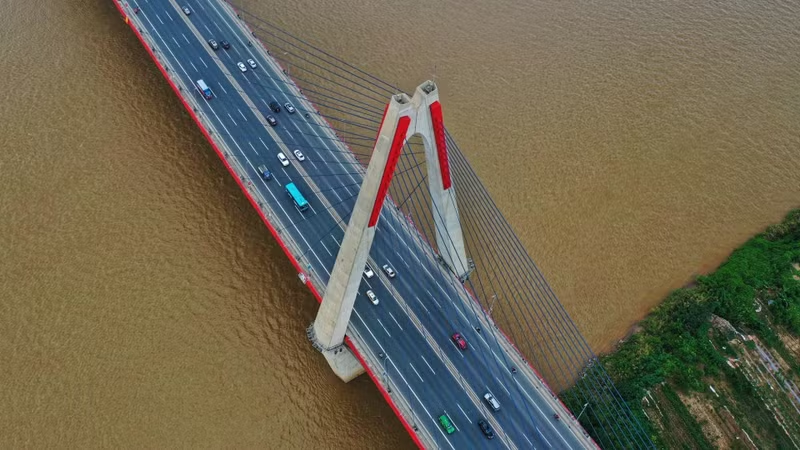
On the afternoon of March 28, at the first session of the 17th Ha Noi People’s Council, the 100-year Master Plan for the Capital was approved. According to experts, this plan marks a fundamental shift in development thinking. Whereas previous plans were largely short-term, spanning 10-20 years, Ha Noi has, for the first time, set out a 100-year vision aimed at long-term stability and sustainable growth.
Within this context, the “multi-layered, multi-tiered, multi-polar, multi-centred” development model is seen as a breakthrough, helping to restructure urban space, ease pressure on the core area, and form new growth poles.
One of the most notable aspects of this plan is its new approach to the Red River. Moving away from the traditional flood control approach, the plan embraces adaptation to nature, positioning the river as the central axis and the waterfront face of the capital.
The Red River has always played a central role in the formation and development of Thang Long - Ha Noi. Beyond depositing fertile alluvium, it has sustained communities and given rise to layers of cultural and historical value through riverside villages and heritage sites.
This depth of historical and cultural significance, combined with rare ecological and open-space assets, creates a distinctive advantage, making the river a natural development axis closely connected to residents and a foundation for shaping a modern, sustainable urban identity for the capital in the future.
According to Dao Ngoc Nghiem, Vice Chairman of the Viet Nam Urban Planning and Development Association, this is the first time that, in key strategic planning documents, the Red River is recognised not merely as a landscape element but as a central spatial axis and, crucially, a development symbol of the capital.
In practice, Ha Noi has expanded primarily to the south of the Red River, while the eastern bank has only gained significant attention since the early 21st century. This indicates that although the river’s potential has long been recognised, it has yet to be fully realised.
Under this plan, the Red River is placed at the centre of the urban structure, with a focus on developing open spaces, expanding green corridors, parks and alluvial grounds, both preserving ecosystems and creating public spaces for residents.
Nguyen Duc Hung, Deputy Director of the Ha Noi Urban Planning Institute, noted: “Riverside space will be restructured in a more open, accessible manner, with increased green areas, parks and alluvial grounds, both preserving the ecosystem and providing public space for residents. Development projects will be strictly controlled to avoid over-concretisation or the formation of monotonous real estate strips.”
According to Hung, if effectively harnessed, the Red River corridor will become a new growth driver, contributing to urban restructuring, expanding development space, and establishing Ha Noi as a green, modern capital with a distinct identity and international competitiveness.
Experts also point out that the Red River has unique characteristics shaped by its natural cycle of erosion and deposition. According to Dao Ngoc Nghiem, in the context of increasingly evident climate change, correctly recognising these characteristics is crucial, not only to ensure flood safety but also to guide riverside spatial development in an adaptive, sustainable and nature-sensitive manner.
Beyond its spatial significance, the Red River is also seen as a link between Ha Noi’s history, culture and future development. Along its banks lies a concentration of distinctive assets, from cultural heritage and traditional craft villages to historical sites and community spaces. These represent not only resources for economic and tourism development but also a “stream of memory” tied to the city’s identity.
Identifying the Red River as a new development symbol also requires a thoughtful balance between conservation and development, between preserving identity and embracing modernity. The Politburo’s Resolution 02 on developing the capital city in a new era emphasises a guiding principle of “civilisation, identity and creativity” as the foundation for building a modern capital while preserving its traditional core values.
With a 100-year vision, placing the Red River at the centre is not merely a spatial choice but a strategic decision. The river is not only an urban waterway but also part of an interregional and international system, one that demands a comprehensive approach connecting it to the Red River Delta and broader economic corridors.
However, to realise this vision, Nguyen Duc Hung stressed the need for coordinated mechanisms and policies, mobilisation of social resources, and, importantly, public participation.
As experts emphasise, planning can only succeed when people are placed at its centre and broad social consensus is achieved, because the Red River is not just a river, but is deeply intertwined with the history, culture and collective consciousness of the Vietnamese people.