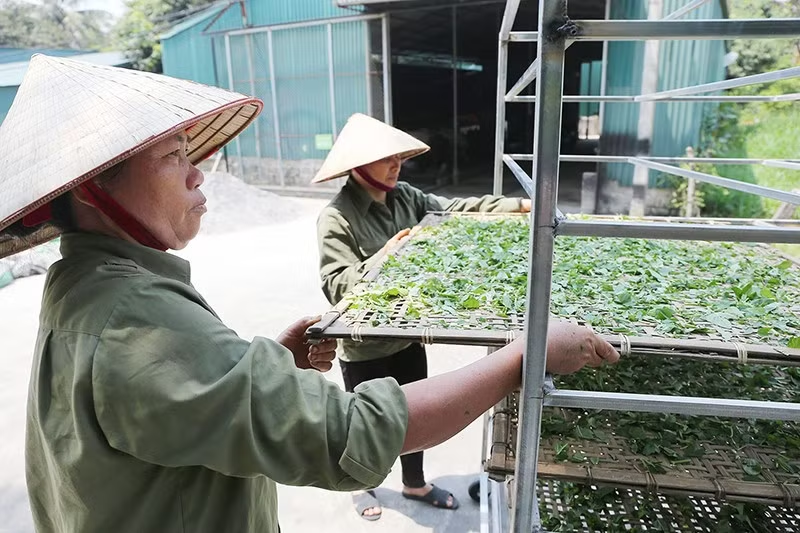
In Vietnam, the collective economy, with the core being cooperatives, has been established and developed for nearly 70 years, making important contributions to the cause of national liberation, national construction and defence.
According to statistics, there are currently 17.3 million households in rural areas, of which 9 million households have a low average farming area (Mekong River Delta 0.71 hectares, Red River Delta 0.22 hectares, and central coast 0.01 hectares). Due to limited capital and assets, farmers and individual households need to associate and cooperate, to organise production and business according to the collective and cooperative economic model for sustainable efficiency.
According to data from the State Bank of Vietnam, by the end of 2022, credit balances for individuals and households, including individual members of cooperatives, reached over 5.88 quadrillion VND, accounting for nearly 50% of the total outstanding credit balance of the entire economy, of which outstanding loans to individuals and households, engaged in production and business activities in agriculture and rural areas, was over 2.03 quadrillion VND.
However, despite being a priority object, as seen by the Standing Deputy Governor of the State Bank of Vietnam Dao Minh Tu, credit for cooperatives in the past was still limited. Statistics released by Deputy Director of the Credit Department for Economic Sectors (the State Bank of Vietnam) Pham Thi Thanh Tung, showed that up to now, more than 40 credit institutions are participating in collective economic loans,
By the end of 2022, outstanding loans reached about 6.5 trillion VND (down 12.45% compared to the end of 2021), with nearly 1,200 cooperatives and unions of cooperatives, having outstanding loans. Outstanding loans are mainly concentrated in the group of state-owned commercial banks, accounting for more than 70%, joint-stock commercial banks accounted for 19% and the rest are other groups accounting for 11%.
From international experience and practical operations, Tu also affirmed that for the cooperative model to operate effectively, capital sources, especially bank credit capital, need to be researched and reviewed.
It is also necessary to evaluate overall current credit mechanisms and policies for cooperatives, as well as the current status of credit granting activities for this type of cooperative, thereby finding legal gaps to continue to improve mechanisms and policies and propose solutions to improve the efficiency of capital supply and access to credit.
The Vietnam Bank for Agriculture and Rural Development (Agribank) also suggested the National Assembly study, supplement and amend the Law on Cooperatives 2012, following the new development situation and conditions, and increase the maximum capital contribution ratio of members to over 20%, to encourage the increase of mobilised capital sources for cooperatives, and supplement insurance policies for cooperatives and members, while at the same time, allocating medium-term and annual state budgets to support the development of collectives.
Meanwhile, Deputy Director of the Banking Strategy Institute under the SBV Pham Minh Tu suggested that to provide financial support for cooperatives to form and develop, the state can use tax policies and support basic investment in the development of cooperatives, transport infrastructure, electricity, water, and irrigation works or use part of the budget to create a system of financial support funds.
Cooperatives borrow funds from credit institutions in the form of mortgages (in which assets formed from loans are mortgaged) and loans, under effective production and business projects.
SBV Deputy Governor Dao Minh Tu also shared, that the SBV will review and propose perfecting mechanisms and policies on banking activities, creating conditions for expanding credit investment and increasing the accessibility of banking products and services, for the collective economic sector.
At the same time, it is suggested that credit institutions balance capital and focus credit for cooperative economic organisations and cooperatives operating in the fields of production, business, and priority fields, following the Government’s policy and production models, according to high-tech application value chains and value chains linked to innovation and digital transformation, under the provisions of law.