Starting with nothing but a pioneer spirit
When the war ended, tens of thousands of soldiers returned to schools and farms, while some entered the world of business with little more than bare hands. They faced countless hardships, yet it was precisely through these challenges that a generation of veteran entrepreneurs with steely resolve emerged.
After leaving the military, Le Van Kiem ventured into business even before the launch of the Doi Moi reforms in 1986, when the concept of “private enterprise” was still unfamiliar, facing numerous institutional and financial obstacles along the way
Beginning in animal feed production, he gradually built KN Holdings into a multi-sector corporation through the determination of a soldier and a bold, innovative mindset.
From real estate, services and infrastructure to renewable energy and high-tech agriculture, his pioneering influence can be seen across every sector in which he operates. “During wartime, soldiers fought to defend the motherland. In peacetime, they must contribute to creating national wealth and jobs, and sharing the fruits of development with the community,” Kiem said. He regards this principle as the guiding philosophy behind all of his company’s activities.
In recognition of his contributions to national development, businessman Le Van Kiem has twice been awarded the title of Labour Hero during the Renewal period. Now in his eighties, he continues to personally oversee business operations and pursue new projects, driven by the belief that as long as he remains healthy, he must continue working. “Out of gratitude to my country and to life itself, I will continue striving tirelessly and giving my utmost,” he said.
A commander who values discipline and compassion
Having spent 18 years in military service, veteran Nguyen Dinh Truong brought military discipline and sharp strategic thinking into the business world. He became known for his declaration: “If a company is making losses, hand it over to me.”
During his tenure at Viet Tien Garment Corporation, he established a management model based on discipline and meritocracy, refusing to grant special treatment to family members. This commitment to discipline became the foundation for building a company capable of withstanding market turbulence and elevating the reputation of Viet Nam’s garment industry internationally.
Behind this disciplined management style lay a deep concern for employees. His philosophy of taking care of the troops, from meals and living conditions to the long-term welfare of thousands of workers, was a continuation of the soldier’s spirit of leaving no one behind. In recognition of his outstanding contributions, he was awarded the title of Labour Hero during the Renewal period in 2007.
Even when confronted with the unprecedented challenges of the COVID-19 pandemic, his soldierly spirit shone through once again. Refusing to surrender to adversity, he worked with the leadership team to secure new orders and swiftly shifted production towards face masks for export.
Thanks to this flexibility, thousands of workers retained their jobs, and the company weathered the storm. For him, employees are a company’s most valuable asset and must be protected at all costs.
From a severely wounded veteran to the “king of seeds”
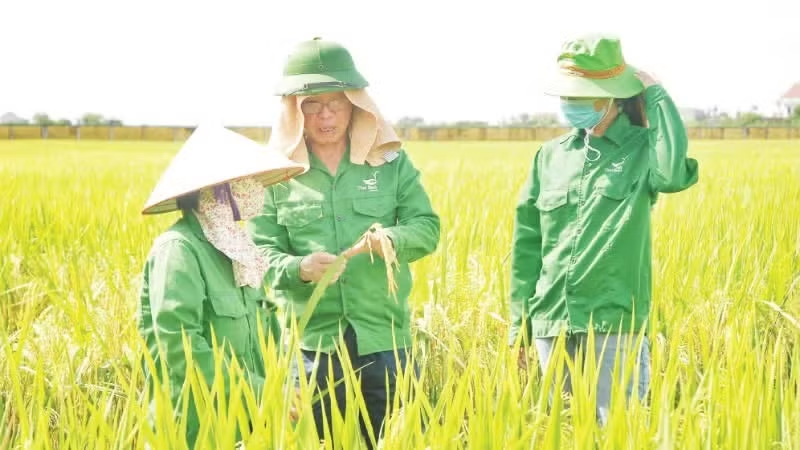
Tran Manh Bao, Chairman of ThaiBinh Seed Group, chose to serve the nation on a different front: agriculture.
Having survived the fierce battlefield of Quang Tri and years of international service in Cambodia, he returned to his homeland with a severe disability. Despite losing one eye and living with lasting injuries, he began his post-war career as a factory worker and later a caretaker at ThaiBinh Seed.
Armed with military discipline, a soldier’s determination and an unwavering commitment to self-improvement, the former caretaker steadily rose through the ranks and ultimately transformed ThaiBinh Seed into the leading seed enterprise in Viet Nam.
Under his leadership, the company has successfully developed dozens of nationally recognised crop varieties and made substantial investments in scientific research. It has established its own crop research institute, and now operates internationally accredited laboratories and maintains a modern seed-processing system.
Today, ThaiBinh Seed supplies rice seed to provinces and cities across the country, accounting for around 20% of Viet Nam’s rice cultivation area. Each year, the company coordinates production across approximately 8,000 hectares and markets nearly 30,000 tonnes of agricultural products, helping thousands of farming households improve their incomes.
Reflecting on his chosen path, Tran Manh Bao said: “Producing seed varieties means serving farmers. For a business to thrive, farmers must first enjoy better lives.”
For him, business development is not merely about profit; it is also about contributing to national food security and enhancing the global standing of Vietnamese agricultural products.
A generation of soldiers-turned-entrepreneurs
Inspired by these pioneering figures, the community of veteran entrepreneurs is now witnessing the rise of numerous large-scale private economic groups playing leading roles in key sectors.
Notable examples include Pacific Group, founded by Hero of the People’s Armed Forces Phan Van Quy, which has undertaken a series of major transport infrastructure, energy and logistics projects; and Hien Le Group, led by female veteran Nguyen Thi Bao Hien, whose diversified business model is built upon high technology and sustainability.
According to Le Van Kiem, Chairman of the Viet Nam Association of Veteran Entrepreneurs and Businesses, the association currently has nearly 16,000 members, representing tens of thousands of businesses, cooperatives and farms. Together, they create employment for almost 300,000 workers annually.
The Viet Nam Association of Veteran Entrepreneurs and Businesses currently has nearly 16,000 members, representing tens of thousands of businesses, cooperatives and farms. Together, they create employment for almost 300,000 workers annually.
Between 2023 and 2025 alone, member organisations generated combined revenues exceeding 768 trillion VND (30.6 billion USD), contributed more than 51 trillion VND to the state budget and provided employment opportunities for nearly 888,000 workers.
The veteran business community has also actively adapted to the demands of the modern economy by promoting the application of science and technology, digital transformation and innovation, expanding production linkages and export markets, and fostering a business culture founded on core values such as respect for the rule of law, integrity, fair competition, environmental protection and sustainable development.
These are the very qualities forged during military service that continue to demonstrate their value in the country’s new era of development.
Having achieved success in business, many veteran entrepreneurs have devoted significant resources to social welfare, honouring those who served the nation and supporting vulnerable groups. Tens of trillions of dong have been contributed towards building schools, hospitals and gratitude houses, assisting poor communities and supporting disaster-affected populations.
Perhaps the clearest example of this spirit of serving the people is veteran Le Van Kiem. He and his family have contributed trillions of dong to social welfare initiatives, supporting wounded veterans and the families of fallen soldiers. The family donated 500 billion VND to the national COVID-19 Vaccine Fund and, in 2024, provided a further 180 billion VND to build more than 3,000 homes under a programme aimed at eliminating temporary and dilapidated housing.
Whether in wartime or peacetime, soldiers have always been at the forefront. Today, entrepreneurs who once wore military uniforms continue to carry forward that spirit, writing new chapters in the march of patriotism and making vital contributions to the nation’s prosperity and the well-being of its people.