Renewed motivation to move forward
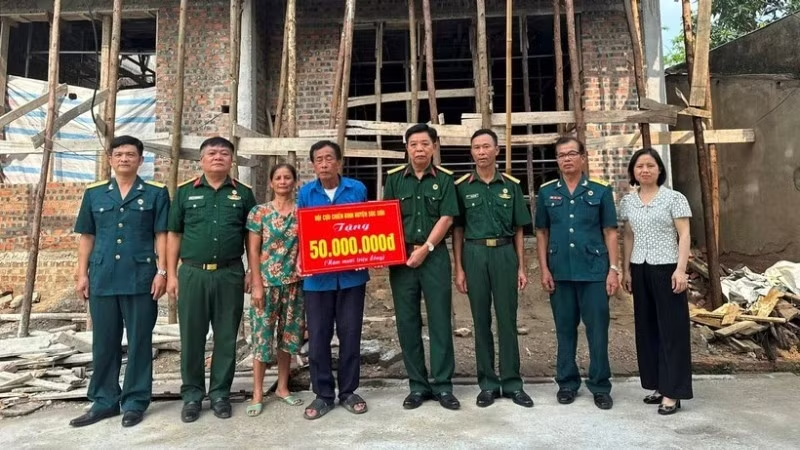
In the closing days of 2025 and the lead-up to the 2026 New Year, the joy of secure housing came to the family of veteran Phan Thi Long, in Quarter 5, Quang Tri Ward (Quang Tri Province), after many years living in a deteriorating temporary house. Construction began in August 2025 thanks to joint efforts by the Veterans Association, local authorities, and the family themselves.
After more than three months of construction, the 85 square metres house was completed at a cost of 225 million VND, of which the Provincial Veterans Entrepreneurs Association provided 60 million VND.
Nguyen Duc Truc, Chairman of the Quang Tri Provincial Veterans Entrepreneurs Association, shared: “This support is not merely material assistance, but a reflection of affection, responsibility, and gratitude from veteran entrepreneurs to comrades still facing hardship.”
In the new, spacious home, Long expressed her gratitude to the Veterans Association and local authorities. For her, the house not only helps stabilise the family’s life but also provides added motivation to strive ahead and raise her children and grandchildren to adulthood.
In response to the nationwide movement to eliminate temporary and dilapidated housing launched by the Prime Minister, since June 2025 the Viet Nam Veterans Association Central Committee has rolled out an emulation movement across the organisation, identifying it as a key political–social task closely linked to improving members’ living conditions.
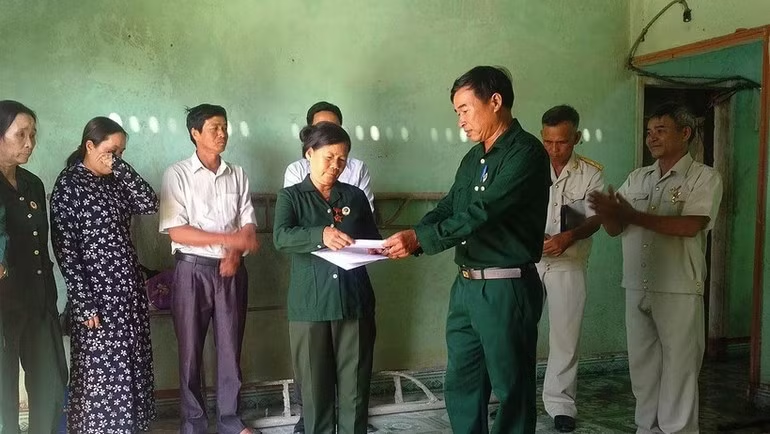
This work is embedded within the broader framework of the Party and State’s social welfare programmes, particularly sustainable poverty reduction and new-style rural development.
According to consolidated reports from 34 provinces and cities, by October 2025 Veterans Associations at all levels nationwide had eliminated 8,922 temporary and dilapidated houses for veterans and policy beneficiary families, mobilising total resources of over 535 billion VND, exceeding the annual plan by 54.3% (target: 5,781 houses).
Each house received direct support ranging from 60 to 80 million VND, supplemented by volunteer labour from members, building materials, counterpart funding from families and localities, bringing the average total value to between 150 and 250 million VND per house. The movement has contributed to reducing the poverty rate among association members.
In many localities, the number of poor veteran households has declined by 15–20% each year; numerous communes and wards have essentially eliminated poor veteran households or reduced the rate to below 2%, contributing to new-style rural development. A notable feature of the movement is the active involvement of veteran entrepreneurs and businesses.
Labour Hero Le Van Kiem alone has donated 180 billion VND, while the Viet Nam Association of Veteran Enterprises and Entrepreneurs has contributed nearly 200 billion VND to building houses for disadvantaged comrades, enabling many localities to meet their targets for eliminating temporary housing ahead of schedule.
Veteran-run enterprises have also created jobs and provided capital support, helping members stabilise their livelihoods.
By the end of 2025, through preferential credit sources, internal funds, and veteran enterprises, tens of thousands of veterans and their children had jobs and stable incomes.
Determination to ensure no member lives in a temporary house
Binh Yen Commune, former Son Duong District (now Minh Thanh Commune), Tuyen Quang Province, is a land rich in revolutionary tradition but still facing difficulties. During the 2022–2025 period, the Viet Nam Veterans Association Central Committee persistently implemented a support programme for Binh Yen, treating it as a pilot model.
More than 9 billion VND mobilised from agencies, enterprises, organisations, and individuals helped transform the locality: 44 new houses were built for veterans and poor households; many rural roads were upgraded; four village cultural houses were completed; residents received breeding cattle and production equipment; schools and health stations were supplied with essential equipment.
By May 21, 2025, Binh Yen had fulfilled all 19 criteria for new-style rural development and was recognised as meeting the standard by the Tuyen Quang Provincial People’s Committee. Average per capita income in 2025 reached 46 million VND per year, up about 30 million VND compared with 2021; the poverty rate declined, and no temporary or dilapidated houses remained in the area.
Be Xuan Truong, Senior Lieutenant General and Chairman of the Viet Nam Veterans Association, affirmed that the Viet Nam Veterans Association Central Committee’s support for Binh Yen in achieving new-style rural standards is a vivid demonstration of the effectiveness of bringing Party resolutions into real life, harnessing the combined strength of the Association, Party committees, authorities, and local people.
Building on this pilot model, the Central Committee expanded the approach, coordinating with the Cao Bang Provincial Veterans Association to build 40 new houses for disadvantaged veterans, with support of 80 million VND per house; all have now been completed.
In Son La, the movement “For the poor – leaving no one behind” and the programme to eliminate temporary and dilapidated houses have been identified by the Veterans Association as key tasks.
A review at the end of 2024 found 231 veteran households across the province living in temporary or dilapidated houses. In just the first four months of 2025, the Association completed the elimination of all such housing, with total funding exceeding 11.75 billion VND, reaching the target nearly one month ahead of schedule.
In 2025, the Lao Cai Provincial Veterans Association mobilised more than 40 billion VND and thousands of volunteer workdays from members for the programme to eliminate temporary housing.
As a result, 847 houses belonging to veterans and former servicemen were newly built or repaired. The provincial Association also combined housing support with job creation, helping households avoid falling back into poverty after settling down.
From this movement, many localities have emerged as bright spots, including Ha Noi, Hai Phong, Da Nang, Quang Ninh, Hung Yen, and Khanh Hoa, contributing to the early completion of the goal of eliminating temporary housing.