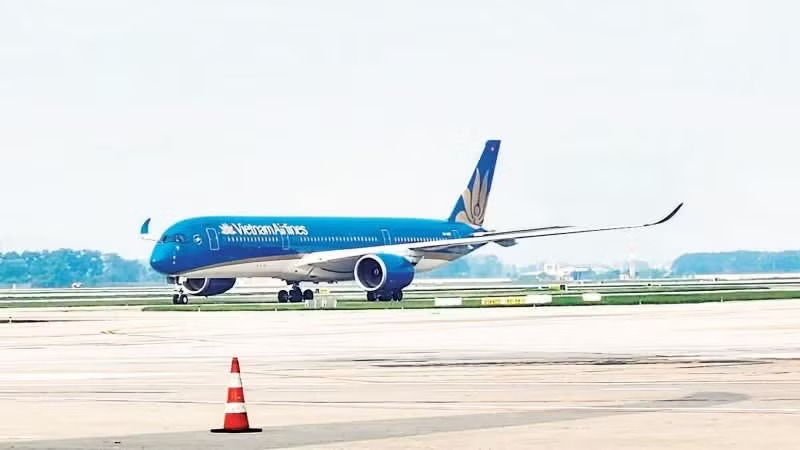
However, domestic airlines need appropriate support mechanisms, covering carbon credits, sustainable aviation fuel (SAF) and tax policy, introduced without delay if they are to meet these obligations effectively.
According to Viet Nam Airlines, the carrier operated more than 100 aircraft on 69 international routes serving 21 countries in 2025, a figure expected to rise to more than 200 aircraft on 123 routes across 27 countries by 2035. As international operations expand, so too will its emissions offsetting obligations.
Meanwhile, carbon credit prices on international markets remain volatile, and the rising cost of sustainable aviation fuel in markets such as Europe and the United Kingdom is adding further pressure on operating expenses.
The issue is not merely one of businesses fulfilling their environmental responsibilities; support mechanisms are needed to ensure that compliance does not become a burden that undermines competitiveness.
Dinh Van Tuan, Deputy General Director of Viet Nam Airlines, said priority should first be given to allocating domestic carbon credits to the aviation sector. When state-invested organisations and enterprises generate carbon credits that meet international standards, these credits could be offered to airlines before being sold on the wider market. Such a mechanism would help retain financial resources within the country, generate demand for domestic emissions-reduction projects, and accelerate the development of Viet Nam’s carbon market.
Carbon credit transactions should be conducted through direct agreements, based on the principle of ensuring reasonable prices that do not exceed the average price, at the same time, of equivalent credits traded on the voluntary carbon market.
A pricing framework based on reasonable rates and capped at prevailing market averages would help airlines control the costs of meeting their offsetting obligations, preventing excessive price inflation when domestic credit supplies are limited or international market prices surge.
At the same time, such pricing would remain sufficiently attractive for state-owned organisations and enterprises to prioritise sales to airlines, while accurately reflecting the international value of the credits and avoiding losses for project developers.
Another noteworthy proposal is to allow airlines to transfer surplus carbon credits to partners that need them, once all offsetting obligations have been fully met.
In practice, carbon emissions and offsetting requirements fluctuate according to operational scale, growth in passenger and cargo transport, international route networks and carbon credit market prices. If surplus credits cannot be transferred, these assets will gradually lose both liquidity and international market value.
This would not only waste corporate financial resources but also reduce the effective use of a valuable green asset in the global carbon market.
Allowing such transactions would also enable enterprises to recover capital previously spent on credits that are no longer required, optimise the value of carbon credit assets and generate additional financial resources to support business operations.
For forest carbon credits, a mechanism is needed to allow enterprises to purchase eligible credits at a maximum price equivalent to the rate agreed between the Ministry of Agriculture and Environment and the Lowering Emissions by Accelerating Forest Finance (LEAF) Coalition.
Under this programme, the Ministry of Agriculture and Environment is implementing an emissions-reduction initiative in the Central Highlands and South Central regions, with plans to issue forest carbon credits certified under the ART-TREES standard, a global framework for quantifying, monitoring and verifying greenhouse gas emissions reductions achieved through forest protection and restoration activities. These credits fall within the categories approved by CORSIA and can therefore be used to meet the aviation sector’s emissions offsetting obligations.
According to estimates, after fulfilling the minimum transfer requirements under the agreement with the LEAF Coalition, the programme will still have a substantial surplus of forest carbon credits. If airlines are permitted to use these credits, the sector would gain an additional domestic source of supply to meet its CORSIA offsetting obligations from 2026 onwards.
Another important issue is the need for appropriate tax mechanisms to ease cost pressures on enterprises as they roll out emissions-reduction measures. According to Viet Nam Airlines, actual expenditure incurred in pursuit of carbon reduction goals, such as the purchase of sustainable aviation fuel and eligible carbon credits, should be deductible against environmental protection tax obligations on aviation fuel.
Under current regulations, Viet Nam Airlines is still required to pay environmental protection tax on Jet A1 aviation fuel. This represents a significant fixed cost in airline operations.
At the same time, participation in CORSIA and compliance with international environmental requirements, particularly in the European market, are generating additional direct costs for airlines, including expenditure on SAF and carbon credits.
Without an appropriate offsetting mechanism, businesses will be required to bear multiple layers of costs for the same environmental objective, creating a situation of “double costs” and significantly increasing financial pressure.
Therefore, consideration should be given to reducing or exempting import duties and value-added tax on sustainable aviation fuel, as well as on technologies and equipment used to modernise aircraft fleets, improve fuel efficiency and reduce emissions.




![[In Pictures] Bridge columns and underpasses in Ha Noi begin to turn green](https://en-cdn.nhandan.vn/images/nyM650OGFWrOVWc-xajqN-rTZ68Rlmc1fiGJOhBRYHH_N-Xs0TE8Psnfce7ORTs-KVfoJaEblqjNufFrgeF3e2xFkGtLQVaXm04VcmMKBEkANUyiOkpz4zAuIKgydVrrfBxmGez0E_YJIag0u_Uil0E7jpuJXsIxeMmGjoY1-W4/1791863309074-2994714492692222878-2994714492692222878-adb9ff3f4175c70066ed8bb80cfbead9.jpg.avif)