To achieve sustainable development while ensuring that environmental protection is never sacrificed for economic growth, the locality is actively adopting new approaches and effective practices to maximise the value of its forests.
Keeping forests green and protecting biodiversity
In mid-June, camera traps deployed in the Dong Nai Nature and Culture Reserve captured a rare sight: a herd of four elephant calves, each around two years old, enjoying a mud bath at a waterhole near the Ba Cai Ranger Station in the 12 Ong Cong area of Phu Ly Commune.
Nguyen Hoang Hao, Director of the Dong Nai Nature and Culture Reserve, said that while forest elephants are regularly observed in the area, this was the first time that four playful elephant calves had been recorded bathing together. The footage demonstrates that the reserve's rare wild elephant population is continuing to thrive.
Ngo Van Vinh, Head of the Dong Nai Forest Protection Department, said monitoring conducted between 2022 and 2025 recorded around 30 wild elephants in the locality, marking an increase of more than 10 individuals since the emergency elephant conservation project was launched.
Although occasional conflicts still occur between wild elephants and communities living along the forest edge, conservation measures have delivered clear results, particularly through the installation of electronic fencing, habitat protection, and efforts to minimise human disturbance in elephant habitats.
According to the Dong Nai Department of Agriculture and Environment, the locality has the largest forest area in the Southeast region, covering nearly 349,000 hectares, with forest cover exceeding 25%. Of this, more than 135,000 hectares are special-use forests, more than 132,000 hectares are production forests, while the remainder are protection forests.
These forests provide habitats for numerous rare and endangered plant and animal species of high conservation value, especially within Cat Tien National Park, Bu Gia Map National Park and other protected areas. Dong Nai's forests are regarded as the "green lung" of the Southeast, helping regulate the climate of a region characterised by major industrial zones and rapid urbanisation.
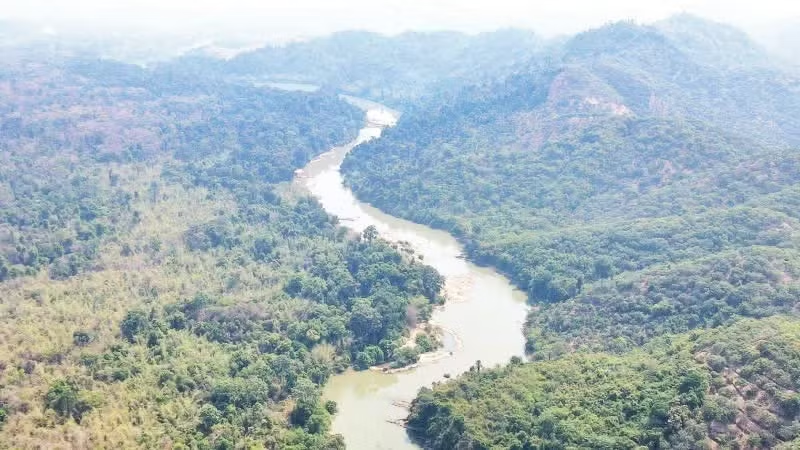
The Dong Nai Nature and Culture Reserve manages a total area of 100,572 hectares, including old-growth forest and the waters of Tri An Lake. Natural forest cover has consistently remained above 85%. Biodiversity has shown continuous signs of recovery, serving as a key indicator of the forest's ecological health.
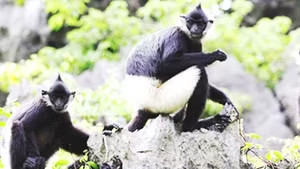
The reserve is home to more than 1,500 plant species and 2,000 animal species, including many listed in both the Viet Nam Red Data Book and the IUCN Red List. Wild elephants, gaur, yellow-cheeked gibbons, and black-shanked douc langurs are among the species regularly recorded there.
"These achievements are the result of Dong Nai's decision to close its forests nearly 30 years ago — the earliest such policy in the country. We have consistently implemented comprehensive and determined measures to restore flora and fauna, maintain stable populations of many endangered species, and ensure strict protection of forest ecosystems," Nguyen Hoang Hao said.

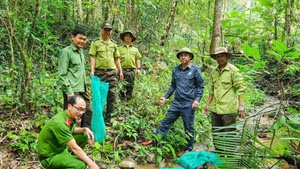
Covering around 26,000 hectares, Bu Gia Map National Park is a special-use forest located on the western slopes of the Southern Truong Son mountain range. The park is home to more than 1,000 plant species and hundreds of animal species, many of which are threatened with extinction. In recent years, the park has rescued numerous wild animals before releasing them back into their natural habitats.
Tran Van Truong, Deputy Director of the Centre for Communication, Tourism and Wildlife Rescue and Conservation at Bu Gia Map National Park, said the centre is currently caring for 65 animals, representing 23 endangered species. As part of its conservation efforts, the centre has successfully bred three yellow-cheeked gibbons in captivity.
Public awareness campaigns have also significantly improved community awareness of wildlife protection. Many illegally captured wild animals have since been discovered by locals and handed over to the authorities or the centre for rehabilitation and eventual release.
Improving livelihoods for forest communities
Night-time wildlife watching has become one of the signature attractions of the Cat Tien National Park Biosphere Reserve, drawing large numbers of visitors. At 6:30 p.m. each evening, open-top vehicles depart with groups of tourists, taking them deep into the forest to observe herds of wild animals as they emerge to feed after dark.
Before leading a group of more than 20 visitors on a late-June evening tour, Nguyen Thi Ngoc Be, a park guide, reminded participants: "The round trip covers around 12 kilometres. Our specialised yellow spotlights will help locate wildlife. We kindly ask visitors to remain quiet, avoid throwing food, and refrain from using personal torches, as these may disturb the animals." Wildlife viewing is limited to between 6:30 p.m. and around 10 p.m. each night to minimise disruption to the animals' natural biological rhythms.
I've visited zoos in Ho Chi Minh City and the safari park on Phu Quoc Island, but watching wild animals at night on the grasslands of Cat Tien is an unforgettable experience. It is exciting and truly immersive in such a natural setting.
Nguyen Thi Phuong Thao, visitor from Ho Chi Minh City
Following the tour, Nguyen Thi Phuong Thao from Ho Chi Minh City said: “I've visited zoos in Ho Chi Minh City and the safari park on Phu Quoc Island, but watching wild animals at night on the grasslands of Cat Tien is an unforgettable experience. It is exciting and truly immersive in such a natural setting.”
According to the management board of Cat Tien National Park, visitors can also join cycling tours to see ancient trees estimated to be between 400 and 700 years old, explore the Ben Cu Rapids and Bau Sau Wetland, or take trekking routes through the forest. These activities have become particularly popular with young visitors from Ho Chi Minh City and international tourists.
The increasing number of visitors has also helped improve the livelihoods of communities living in southern Cat Tien through homestays, eco-lodges, food services, and the sale of local specialities, as well as promoting the area's distinctive indigenous culture.
Nguyen Tuan Anh, Vice Chairman of the Dong Nai Municipal People's Committee, said Dong Nai has identified the effective and sustainable use of the rich biodiversity found in its national parks and nature reserves as an essential factor in long-term forest conservation. The locality is focusing on investing in infrastructure and offering incentives to attract experienced, large-scale investors in forest ecotourism.
The broader goal is to improve the livelihoods of people living near forests. When local communities enjoy tangible benefits and stable incomes, the conservation, sustainable development, and responsible utilisation of natural forest resources can be secured over the long term.


![[In Pictures] Bridge columns and underpasses in Ha Noi begin to turn green](https://en-cdn.nhandan.vn/images/nyM650OGFWrOVWc-xajqN-rTZ68Rlmc1fiGJOhBRYHH_N-Xs0TE8Psnfce7ORTs-KVfoJaEblqjNufFrgeF3e2xFkGtLQVaXm04VcmMKBEkANUyiOkpz4zAuIKgydVrrfBxmGez0E_YJIag0u_Uil0E7jpuJXsIxeMmGjoY1-W4/1791863309074-2994714492692222878-2994714492692222878-adb9ff3f4175c70066ed8bb80cfbead9.jpg.avif)