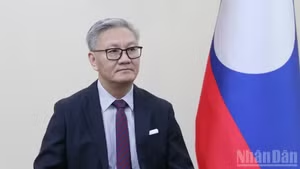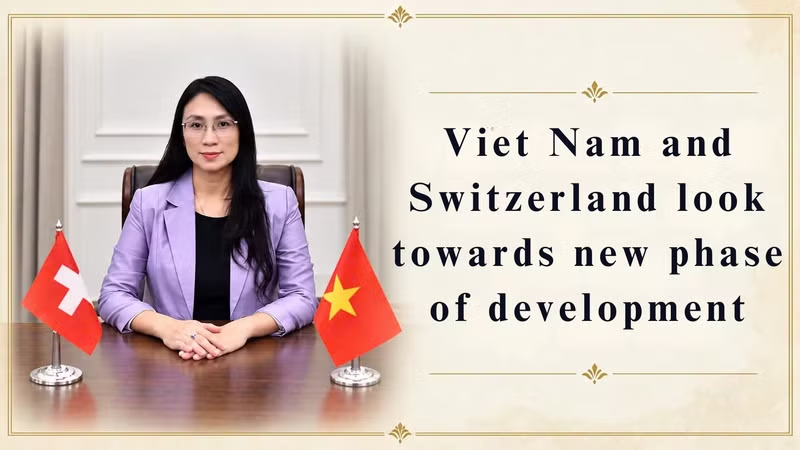
At the invitation of General Secretary of the Communist Party of Viet Nam Central Committee and President of the Socialist Republic of Viet Nam To Lam and his spouse, Swiss President Guy Parmelin and his spouse will pay an official visit to Viet Nam from October 17 to 18, 2026. On this occasion, Vietnamese Ambassador to Switzerland (concurrently accredited to Liechtenstein) Chau Mai Anh spoke with a reporter from Nhan Dan Newspaper regarding the significance of the visit and the prospects for bilateral relations in the coming period.
Promoting a deeper and more effective comprehensive partnership
Discussing the significance of Swiss President Guy Parmelin’s visit, Ambassador Chau Mai Anh noted that, taking place as both countries celebrate the 55th anniversary of the establishment of diplomatic relations (1971–2026), the visit carries great weight.
It contributed to consolidating political trust and advancing the Comprehensive Partnership between Viet Nam and Switzerland, making it both deeper and more effective—an occasion for both sides to review their past progress and set their sights on a new era of cooperation.
According to Ambassador Chau Mai Anh, the visit is also highly significant given that both nations are currently implementing the Comprehensive Partnership framework, which was established in January 2025. This serves as a foundation for both nations to enter a new phase of cooperation—one that is deeper in political terms, more substantive in economic terms, and broader in its future-oriented collaboration.
Notably, President Guy Parmelin is accompanied on this visit by representatives from approximately 15 major Swiss enterprises and business associations. This underscores the growing interest of the Swiss business community in the Vietnamese market, while simultaneously creating new opportunities for businesses from both countries to identify partners and launch collaborative projects. Such initiatives will assist Vietnamese enterprises in accessing science and technology and enhancing the quality of their human resources, thereby supporting the country’s new stage of development.
Regarding the agenda for President Guy Parmelin’s visit, Ambassador Chau Mai Anh stated that the President is expected to hold talks and meetings with high-ranking Vietnamese leaders. These discussions will focus on key strategic directions for cooperation, as well as concrete measures to advance bilateral ties across all sectors—most notably in trade and investment, science and technology, innovation, and finance.
As part of the visit, the two sides will jointly organise a Viet Nam-Switzerland Economic Forum. The event will feature the participation of numerous major Swiss companies and business associations—including the Swiss mechanical and electrical engineering industry association (Swissmem), the Swiss Business Federation (Economiesuisse), and the Swiss trade and investment promotion agency (Switzerland Global Enterprise)—alongside a wide range of Vietnamese enterprises, business associations, and local representatives.
“The forum will connect regulatory authorities, the business community, financial institutions, and research partners from both countries, facilitating direct dialogue, the exploration of investment opportunities, market expansion, and the development of concrete collaborative projects—particularly in high-tech, manufacturing, finance, innovation, and sustainable development,” emphasised Ambassador Chau Mai Anh.
According to Ambassador Chau Mai Anh, a particularly significant highlight of the visit will be the signing of a Free Trade Agreement between Viet Nam and the member states of the European Free Trade Association (EFTA). Following 14 years of negotiations, the signing of this agreement is expected to establish a new framework for cooperation in trade, services, and investment, while enabling businesses from both sides to gain deeper access to each other’s markets.
Furthermore, the two sides will sign several key cooperation documents in the fields of science, technology, trade, and investment. These will serve as a foundation for expanding collaboration in research, human resource development, technology transfer, and the commercialisation of innovation outcomes—thereby helping to concretise the priorities established within the framework of the Comprehensive Partnership.
Ambassador Chau Mai Anh expressed her expectation that President Guy Parmelin’s visit to Viet Nam will provide fresh momentum for both nations to transition from mere potential and commitments toward tangible, measurable collaborative outcomes that deliver practical benefits to the people and businesses of both countries.
Marking a milestone in Viet Nam-Switzerland bilateral relations
Assessing the achievements in Viet Nam-Switzerland bilateral relations, Ambassador Chau Mai Anh noted that the agreement in principle between the two nations to elevate their relationship to a “Comprehensive Partnership” by January 2025 marks a significant development. This milestone establishes a foundation for expanding cooperation, anchored in political trust, complementary interests, and a shared development vision across sectors such as politics, the economy, science and technology, education, and sustainable finance.
The official visit to Viet Nam by President of the Swiss Confederation Guy Parmelin holds significant importance; it serves to strengthen political trust and foster a deeper, more effective Comprehensive Partnership between Viet Nam and Switzerland. Furthermore, it provides an opportunity for both nations to reflect on the journey thus far and look ahead toward a new phase of cooperation.
Ambassador Chau Mai Anh
Ambassador Chau Mai Anh highlighted that, over the past year, cooperation between the two countries has seen positive momentum. In the political and diplomatic spheres, both sides have maintained frequent high-level exchanges and contacts—spanning state, governmental, and parliamentary channels—which have strengthened political trust and enhanced the effectiveness of their collaboration.
Notable engagements include meetings between General Secretary and President To Lam and Swiss President Guy Parmelin in New York (USA) in September 2026; visits to Switzerland by Deputy Prime Minister Nguyen Hoa Binh in January 2026 and Deputy Prime Minister Nguyen Van Thang in July 2026; and, most recently, a visit by National Assembly Vice President Nguyen Thi Thanh in September 2026.
Concurrently, economic cooperation between the two nations has continued to flourish. The total trade turnover of goods between Viet Nam and Switzerland exceeded 1 billion USD in 2025, with the figure reaching nearly 715 million USD during the first eight months of 2026.
Regarding investment, data from the Ministry of Finance indicates that in 2025, Switzerland initiated 18 new foreign direct investment (FDI) projects with a total registered capital of approximately 162 million USD.
Additionally, there were 11 instances of capital adjustments, adding 301 million USD in registered capital, along with 14 capital contributions for equity acquisitions valued at roughly 122 million USD. These figures position Switzerland as the 14th largest investor in Viet Nam for the year 2025.
According to Ambassador Chau Mai Anh, beyond the aforementioned sectors, development cooperation between the two nations is increasingly focused on enhancing economic competitiveness and sustainability. The Viet Nam Cooperation Programme for the 2025–2028 period, implemented by the Swiss Government, reaffirms Viet Nam’s status as a priority partner for Switzerland in Southeast Asia.
The programme centres on three key pillars: sustainable trade and innovation; sustainable public and private finance; and climate-resilient industrial and urban development. This framework serves as a foundation for transitioning from traditional development assistance toward deeper collaboration on institutions, productivity, and technology—all of which are critical drivers for Viet Nam’s shift toward a growth model rooted in science, technology, and innovation.
Free Trade Agreement: A catalyst for comprehensive economic cooperation between Viet Nam and Switzerland
Ambassador Chau Mai Anh further emphasised that the signing of a Free Trade Agreement (FTA) between Viet Nam and the member states of the European Free Trade Association (EFTA) stands as a pivotal event during President Guy Parmelin’s current visit to Viet Nam.
“After 14 years of negotiations, the Free Trade Agreement (FTA) between Viet Nam and the EFTA bloc was officially declared concluded on July 2, 2026, paving the way for the signing phase and the completion of necessary procedures before the agreement enters into force. Covering areas such as goods, services, investment, intellectual property, government procurement, small and medium-sized enterprises, and sustainable development, the agreement goes beyond mere tariff reductions; it holds significant importance by creating opportunities for Viet Nam to diversify its markets, enhance its competitiveness, and attract high-quality investment,” Ambassador Chau Mai Anh shared.
Discussing the potential and opportunities arising from a prospective Free Trade Agreement (FTA) between Viet Nam and the European Free Trade Association (EFTA) member states, Ambassador Chau Mai Anh noted that the EFTA bloc represents a market of over 15 million people. In 2025, the value of trade in goods between Viet Nam and EFTA reached 4.8 billion Euros, with Viet Nam maintaining a trade surplus of 2.5 billion EUR.
Viet Nam’s primary exports to the EFTA bloc include electronic equipment, footwear, and apparel, while EFTA’s key exports to Viet Nam consist of electronics, seafood, pharmaceuticals, and mechanical machinery. Once the agreement enters into force, several Vietnamese sectors—such as textiles, footwear, electronics, machinery, equipment, agricultural products, and processed foods—stand to benefit.
More importantly, the FTA could enable Vietnamese enterprises to integrate more deeply into the supply chains of EFTA-based companies (including those in Switzerland), while also providing access to advanced technologies, management practices, and production standards.
According to Ambassador Chau Mai Anh, the Free Trade Agreement should be viewed as a tool to foster comprehensive economic cooperation. Switzerland possesses strengths in high technology, pharmaceuticals, finance, and innovation, while Viet Nam offers a dynamic market, growing production capacity, and an extensive network of trade agreements.
By effectively combining these respective advantages, the two nations can go beyond simply increasing trade volumes; they can also collaborate on production, research, and innovation, while deepening their integration into regional and global value chains. To capitalise on these opportunities, Viet Nam must continue to improve its investment climate, enhance the capacity of its enterprises to meet international standards, develop supporting industries, and foster collaboration in research, technology transfer, and human resource development.
To realise the prospects for bilateral cooperation, Ambassador Chau Mai Anh stated that the Embassy of Viet Nam in Switzerland will focus on several key tasks: strengthening business connections and investment promotion; assisting enterprises from both nations in exploring markets, identifying potential partners, and preparing to leverage opportunities arising from the Viet Nam-EFTA Free Trade Agreement (FTA) once it enters into force; acting as a bridge between regulatory bodies, businesses, universities, and research institutions in both countries to expand cooperation in science, technology, and sustainable development—thereby developing actionable, long-term value-creating projects; and connecting relevant agencies, experts, and financial institutions to encourage Swiss partners and firms to share their expertise in developing international financial centres, fintech, green finance, and sustainable finance.
Ambassador Chau Mai Anh expressed her expectation that, building upon 55 years of positive relations, the partnership between Viet Nam and Switzerland will evolve toward a more strategic, substantive, and results-oriented trajectory. Guided by the Joint Declaration on a Comprehensive Partnership (January 2025), both nations should continue to strengthen political trust, boost trade and investment, and establish science, technology, innovation, and finance as new drivers for their cooperation.