In practice, AI is increasingly becoming deeply involved in the process of planning, exploring, and enjoying travel journeys, especially among young travellers. According to survey data from Booking.com, up to 99% of Gen Z use AI before their trips; of which 42% receive personalised recommendations, and 40% research destinations and ideal travel times. During their trips, the majority of Gen Z use AI at destinations to translate languages, signs, and menus (53%) or to obtain information about monuments and museums (47%).
Vu The Binh, Chairman of the Viet Nam Tourism Association, assessed that AI is opening many new possibilities for tourism, from analysing market trends, personalising products, and optimising promotion and marketing activities to improving service quality, supporting revenue management, forecasting visitor flows, regulating visitor capacity at destinations, enhancing customer care, and gradually forming a smart tourism ecosystem.
Binh believes that, if properly guided, digital transformation and AI will not only serve growth objectives but also contribute to protecting resources, saving energy, reducing costs, lowering emissions, and improving the efficiency of destination management towards sustainability.
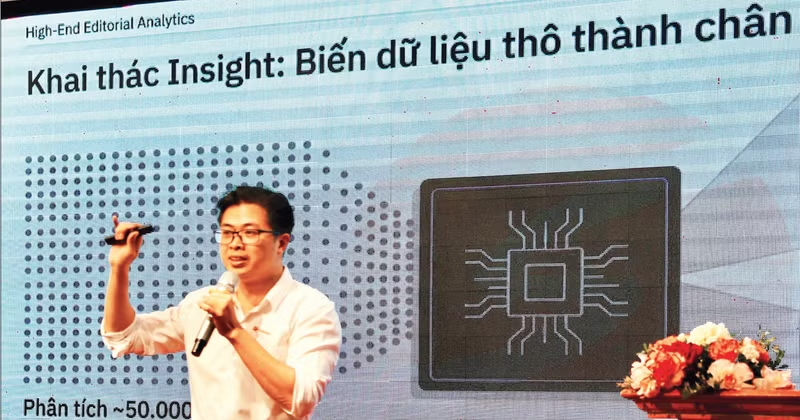
AI is opening many new possibilities for tourism, from analysing market trends, personalising products, and optimising promotion and marketing activities to improving service quality, supporting revenue management, forecasting visitor flows, regulating visitor capacity at destinations, enhancing customer care, and gradually forming a smart tourism ecosystem.
Vu The Binh, Chairman of the Viet Nam Tourism Association.
From a business perspective, Dr Pham Ha, Chairman and CEO of LuxGroup, stated that tourism competition today is not merely between destinations, but between systems that are more productive, make faster decisions, operate more sustainably, and serve customers more deeply. In that context, AI is a powerful productivity lever for tourism.
Dr Pham Ha noted that, if applied properly, one employee can achieve productivity equivalent to three to five people in the past. AI is also helping to narrow the gap between large and small enterprises, as a homestay or a local tour guide can fully access the global market through the digital environment. This is also the foundation for inclusive growth in tourism.
In recent years, to promote the application of AI, Big Data, and the Internet of Things (IoT) in destination management, tourism promotion, and visitor services, Viet Nam has implemented many programmes and initiatives, such as the National Digital Transformation Programme; the project on applying Industry 4.0 technologies to develop smart tourism and promote tourism as a spearhead economic sector; and programmes to accelerate smart tourism digital transformation in the tourism sector.
In Resolution 80-NQ/TW on the development of Vietnamese culture, key tasks and solutions are emphasised, such as developing digital infrastructure and strengthening the application of artificial intelligence (AI), Big Data, virtual reality technology (Blockchain) in the production, distribution, and consumption of culture, as well as in cultural management. This creates an important foundation for the tourism sector to effectively exploit cultural resources in the digital environment.
Recently, organisations and enterprises operating in the tourism sector have increasingly focused on applying technology and data to optimise management and operations and enhance visitor experiences. At the same time, companies specialising in research and provision of AI solutions for tourism development have emerged, with a focus on areas such as AI virtual assistants, navigation robots combined with on-site consultation, multilingual audio guides, and real-time interpretation.
However, it must be frankly acknowledged that the application of technology in general, and AI in particular, in tourism development in Viet Nam still faces many challenges. Fragmented data leads to limited connectivity, sharing, and utilisation. Digital capacity among tourism enterprises is uneven, with the majority being small or medium-sized, resulting in limited resources for technology investment. Moreover, the workforce that both understands tourism and possesses technological expertise remains limited.
Faced with these “bottlenecks”, to realise the goal of applying AI to develop Viet Nam’s tourism in a rapid and sustainable direction, Pham Van Thuy, Deputy Director General of the Viet Nam National Authority of Tourism, stated that there must be close linkage and cooperation among the state, businesses, communities, and international organisations to create a combined strength that promotes the transformation and application process quickly and effectively.
According to Mr Pham Van Thuy, the success of digital transformation and AI application depends greatly on innovation in thinking and action by each individual and organisation. Therefore, tourism units and enterprises need to be proactive and bold in experimenting with new technologies, especially AI, to replace traditional methods and gradually adapt to new market and societal demands. Strong investment in training and developing high-quality human resources capable of mastering technology is essential, as people are the central factor in all development.
Along with the rise of technology, data-driven tourism is emerging as an important trend, whereby every decision, from products and pricing to experiences, is designed based on behavioural data and AI forecasting.
Therefore, according to Dr Nguyen Anh Tuan, Director of the Institute for Tourism Economics (under the Viet Nam Tourism Association), an important solution is to establish a national digital tourism ecosystem with an open data repository, multi-party connectivity, and policies to promote AI application in tourism. He proposed piloting AI-powered destinations to disseminate the model, gradually making AI a core technology in market forecasting, service personalisation, and destination management.
According to Mr Luong Thanh Nam, General Director of Viet Nam Hospitality Solutions Joint Stock Company, in the context of limited resources, for digital transformation to be truly effective, enterprises should start by assessing the current state of human resources, technological infrastructure, and budget readiness, and then choose an appropriate direction, rather than mechanically copying external models.
However, experts also note that for tourism - a sector aimed at delivering emotionally rich experiences - AI can help processes operate faster and more efficiently but cannot replace humans.
As AI becomes more powerful, the responsibility to protect user data becomes greater; likewise, as automation increases, the need to create deep, distinctive experiences associated with the unique identity of destinations becomes more urgent, requiring creative efforts from those working in tourism.
![[Video] Viet Nam among Top three Asian destinations for return visitors](https://en-cdn.nhandan.vn/images/nyM650OGFWrOVWc-xajqN-rTZ68Rlmc1fiGJOhBRYHErj-E25MBpvJqrpphXazfrpe9t-fYCGuQU4CN0yXo3Rg/du-lich-vietnam.jpg.avif)