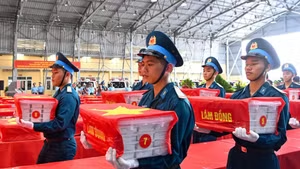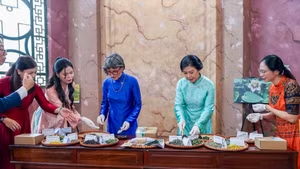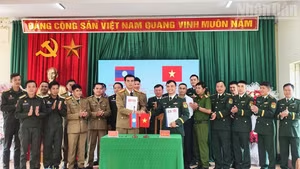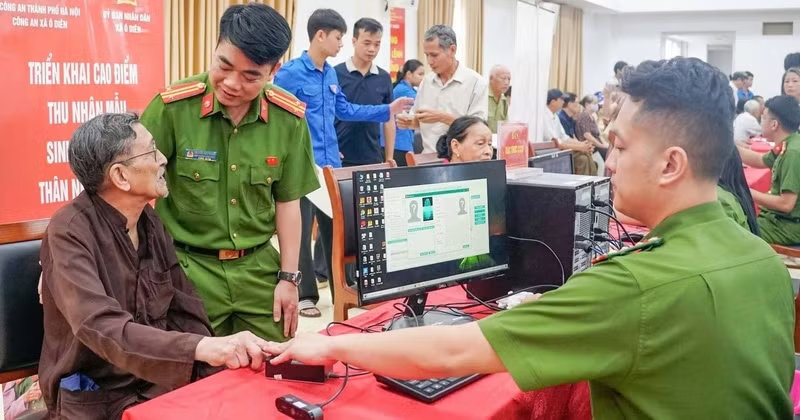
This is not merely a professional task, but also a campaign of profound political, social, and humanitarian significance, demonstrating boundless gratitude for the blood sacrifices made by the Heroic Martyrs.
The DNA sample collection campaign across the capital is an important political task contributing to the effective implementation of the "500-Day Campaign to Intensify the Search, Recovery and Identification of Martyrs' Remains" nationwide.
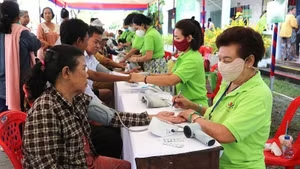
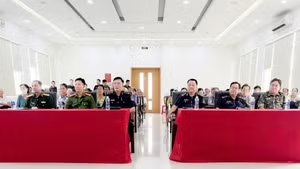
During the peak campaign, Ha Noi established five collection stations and 15 task forces, deploying them simultaneously across 126 communes and wards. Immediately after receiving the implementation plan, local police proactively reviewed and verified information on martyrs' relatives, cross-checked records, and compiled lists of those eligible to provide DNA biological samples.
At the same time, in coordination with the Administrative Police Department for Social Order under the Ha Noi Police, local People's Committees, and relevant agencies, they ensured adequate facilities and personnel so that the sampling process could be conducted smoothly and in accordance with procedures. Throughout the campaign, police officers remained present at collection points to guide and assist each family in completing the necessary procedures and answering related enquiries.
The Ha Noi Police adopted numerous innovative and flexible approaches tailored to the characteristics of each locality and target group. Guided by the mottos "Orders from the Heart" and "Going to every alley, knocking on every door," mobile task forces not only brought DNA sampling equipment but also hope, travelling to individual households to collect DNA samples directly at hospital bedsides or in the homes of elderly and frail relatives of martyrs. Each journey was more than just a professional assignment, it was a continuation of compassion, helping to ease the wounds of war and enabling those who fell for the nation to return, as soon as possible, to the embrace of their families and loved ones.
In many cases, the relatives of martyrs were already of advanced age — ranging from 70 to more than 100 years old — with fingerprints faded or conditions unfit for travel. The task forces patiently integrated data and accurately cross-matched it with the national population database, thereby building tremendous public trust.
Present at one of the DNA collection points, Nguyen Xuan Mao, aged 78, residing in Phu Gia 2 Residential Area, Phu Thuong Ward, whose elder brother, martyr Nguyen Van Thong, was killed on the Dak Lak battlefield in 1967. He emotionally shared that for nearly 60 years, his family had never stopped searching, yet they had still been unable to identify their relative or locate his resting place. For Mr Mao, this DNA sampling campaign, together with the establishment of the national DNA database, opens another opportunity for him and tens of thousands of other martyrs' relatives to find their loved ones after decades of waiting.
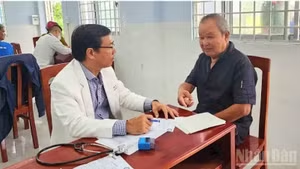
At centralised collection sites located at commune and ward People's Committee offices, the Ha Noi Police not only carried out professional duties but also proactively coordinated with local authorities, organisations, and mass associations to organise health consultations, medical examinations, free medicine distribution, and the presentation of appreciation gifts to martyrs' relatives. At the collection point established at the O Dien Commune People's Committee, the local authorities coordinated with the O Dien Commune Police, specialised units of the Ha Noi Police, and other supporting forces to assist residents in completing documentation, verifying information, and collecting DNA samples carefully and scientifically, thereby ensuring accuracy while creating the most favourable conditions for the public.
Here, the story of The Thi Yen, from On Xuyen Commune, deeply moved many people. Mrs Yen is the younger sister of martyr The Nguyen The Toan. Her parents had four children, with Mr Toan being the eldest. At the age of 26, he left for the Quang Nam battlefield to participate in the resistance war against the United States. For many years, Mrs Yen's family has never abandoned the hope of finding his grave. As time passed, her parents and siblings all gradually passed away, leaving only her to continue the search for her brother. To Mrs Yen, this DNA sampling represents her greatest hope of finding and bringing her elder brother home after nearly 60 years of separation.
Lieutenant Colonel Nguyen Huu Phong, Deputy Chief of O Dien Commune Police, said that the locality currently has more than 400 martyrs whose identities remain unconfirmed. During the peak campaign, the authorities organised the collection of more than 600 DNA samples from martyrs' relatives.
A task force travelled directly to the home of Pham Thi Chap, aged 114 — the biological mother of martyr Nguyen Van Ngoc (born in 1947) — who resides in Village 2, Van Phuc, Nam Phu Commune. At the DNA collection session, witnessing a mother who had lived for more than a century still yearning for news of her fallen son left no one able to hold back their tears. Every step of collecting DNA samples from the mother of a martyr at such an extraordinary age was carried out gently and carefully by the police officers, ensuring full compliance with professional procedures while taking her health condition into account.
The peak DNA collection campaign spread with urgency and synchronisation throughout all districts of the city. All efforts have been directed towards completing DNA collection for 100% of registered relatives of martyrs.
According to the Ha Noi Police, as of 16 July, the force has successfully completed the peak campaign with outstanding results: 15,223 DNA samples from martyrs' relatives have been successfully collected and digitally integrated into the national database system, contributing to the establishment of a database serving the identification of the Heroic Martyrs and extending this journey of gratitude through science and responsibility. These efforts have made Ha Noi one of the country's leading localities in terms of the progress of reviewing and collecting DNA data since the launch of the nationwide campaign on 24 June.
Through the 500-Day Campaign to Search for, Recover and Identify Martyrs' Remains, officers and soldiers of the Ha Noi Police have helped write a journey of gratitude through responsibility, technology and, above all, profound appreciation for those who sacrificed their lives for the independence and freedom of the Fatherland. At the same time, they have projected the image of the capital's police officers as dedicated, responsible, people-oriented public servants who constantly strive to fulfil their duties in the spirit of "Serving the People."