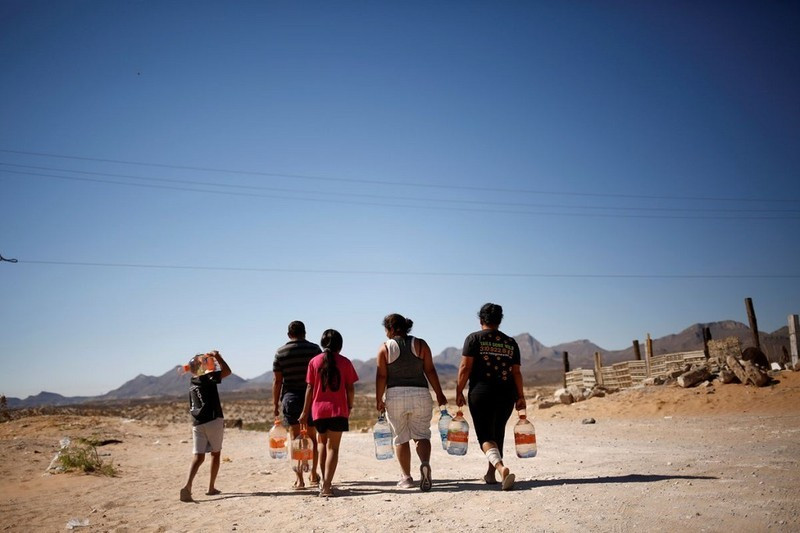
Many regions in the Americas are struggling to solve the issue of water scarcity for production and daily life.
The Peruvian government has just declared a state of emergency in 544 districts for 60 days to address the imminent danger of water shortages.
The decision was made following a report from climate organisations showed the possibility of the El Nino phenomenon in the Central and Eastern Pacific until the summer of 2024. The report states that actions by regional and local governments so far "are insufficient" as they do not have enough technical and operational response capacity.
Meanwhile, Panama — another country in America ¬— is also looking for new sources of water for the Panama Canal, in the context that this essential waterway of the world is imposing restrictions limiting the daily number of ships that can pass through, down from 40 ships to 32 ships per day.
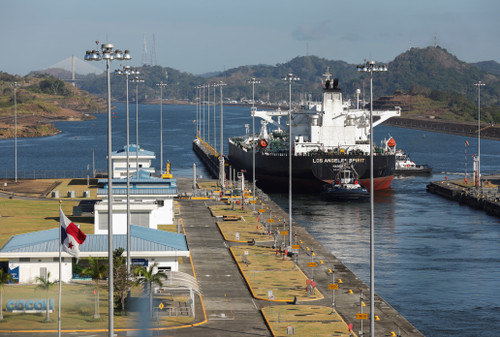 |
| A crude oil tanker is pictured during its transit in the expanded canal through Cocoli Locks at the Panama Canal, on the outskirts of Panama City, Panama March 10, 2023 (Photo: Reuters) |
Prolonged drought has diminished the amount of available water levels in the Panama Canal to historic lows. The restriction on the passage of ships has caused Panama to lose tens of millions of US dollars in potential trade revenue, while increasing pressure on commodity prices due to additional transit surcharges.
Droughts are occurring in many places, from the Americas to Europe, Asia, and Africa, evidencing that the consequences of climate change are creeping into every corner of the world, and not a single country can be immune to the impact of this common challenge.
Climate change alters the natural water cycle and causes severe droughts. As a result, people face intense water shortage.
Uncontrolled stone mining activities have also changed the geological tectonics surrounding groundwater, leading to changes in flow volume.
At the recent 18th World Water Conference in Beijing, China, world leaders called for the effective use and protection of water resources, as well as the sharing of experiences in water management and cooperation to solve challenges related to water resources.
The Conference affirmed that protecting and reasonably utilising water resources is a common obligation and right that all countries and all inhabitants of the earth should fulfil. According to the congress, every person, organisation, enterprise, and country should strive to achieve water conservation, rational development, and efficient utilisation within their capabilities.
Water is the most precious common good, and needs to be at the centre of the global political agenda.
United Nations Secretary-General Antonio Guterres Water
Access to water is one of the 17 Sustainable Development Goals (SDGs) established by the United Nations in the context that the world is struggling to cope with climate change, water scarcity, and pollution.
According to the United Nations Educational, Scientific and Cultural Organisation (UNESCO), one in three schools worldwide has no basic sanitation, meaning no toilet nor sewage system. Meanwhile, clean water and hand-washing facilities are basic conditions to protect children against diarrheal and acute respiratory infections.
In addition, access to water is inextricably linked to climate, environment, food, poverty, and health.
United Nations Secretary-General Antonio Guterres Water stressed that water is “the most precious common good,” and “needs to be at the centre of the global political agenda.”
According to experts from the Stockholm International Water Institute (Sweden), although individual action is important to protect water sources, for truly sustainable change, the real power lies with legally binding treaties and governments committing to stringent targets.