To accelerate the transition, it is essential to introduce dedicated financial support mechanisms and ensure the coordinated and decisive involvement of all relevant agencies.
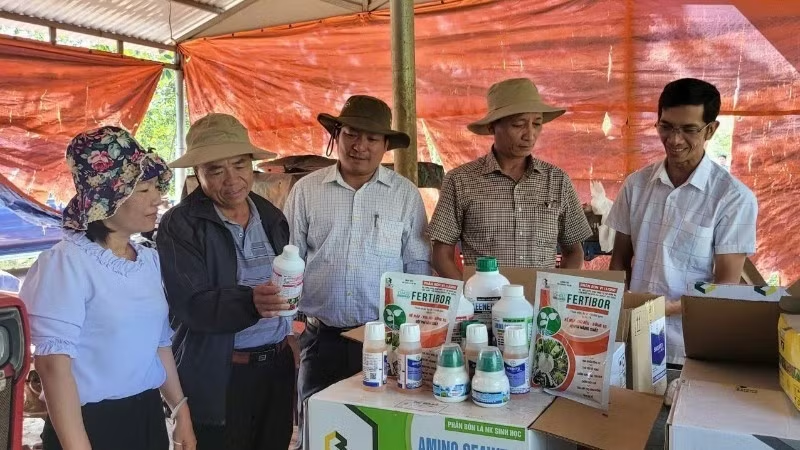
In recent years, farmers in major agricultural regions have taken bold steps in shifting from chemical pesticides to biological ones, and have achieved encouraging initial results.
Bui Tin, Director of Krong Pac Organic Agricultural Cooperative in Dak Lak Province, said the cooperative cultivates more than 120 hectares of durian, of which 56 hectares have been granted planting area codes.
“In the past, every rainy season we could hardly sleep,” he recalled, “because pests and diseases continually broke out in the orchards. Chemical pesticides suppressed diseases instantly, but only for a short time before they reappeared, while also causing soil compaction and suffocating the roots.”
“In recent years, we have switched to biological pesticides. Although they do not work immediately, persistent use has helped our durian orchards eliminate diseases. The trees are healthy, with vigorous fine roots and glossy leaves. This biological approach not only cuts input costs but also protects human health and the environment, and yields high-quality produce for both domestic consumption and export.”
According to Nguyen Van Son, President of the Viet Nam Pesticide Association (VIPA), biological pesticides decompose rapidly in the natural environment. They are less toxic, safer for human health and reduce negative impacts on the environment by protecting natural enemies and maintaining ecological balance. Biological products, especially antagonistic microbes, also stimulate beneficial soil microorganisms, helping loosen the soil and restore its fertility.
Biological pesticides also play a pivotal role in advanced cultivation practices such as Integrated Pest Management (IPM) and Integrated Plant Health Management (IPHM). Their use is an inevitable trend aligned with the development of green, sustainable and low-emission agriculture in Viet Nam and worldwide.
The Ministry of Agriculture and Environment aims to raise the proportion of biological pesticides to 30% of the approved list by 2030, and increase their use by 30%.
The Ministry of Agriculture and Environment aims to raise the proportion of biological pesticides to 30% of the approved list by 2030, and increase their use by 30%. The agricultural sector also strives to train farmers at least 80% of localities and establish effective models for nine key national product groups: rice, coffee, rubber, cashew, pepper, tea, fruit trees, vegetables and cassava.
Despite clear policies and targets, the use of biological products remains modest compared with chemical ones. The main reasons include their generally higher price; slower action; lower efficacy in controlling pests and diseases; shorter shelf life; narrower spectrum of activity; the absence of biological treatments for many pests; and farmers’ limited knowledge of proper use, storage, and integrated techniques such as IPM and IPHM to maximise effectiveness.
Competent authorities and localities need to adopt targeted support policies for farmers in key agricultural regions, particularly by encouraging the use of biological pesticides at household level. This should include specific financial assistance for the purchase and use of biological products, for instance, covering 20-30% of costs during the early transition period.
At the same time, demonstration models for biological products in key crops should be expanded, and training strengthened on correct application and storage. Relevant agencies should support market access by linking farms using biological products with safe agricultural supply chains and outlets, helping farmers secure higher prices and motivation to continue production.
According to Nguyen Van Son, regulators should simplify the registration procedures for biological pesticides, shorten the licensing process for field trials, reduce costs for trial permits and product registration, consider cutting import taxes on biological products and production technologies to zero, and review the requirement for conformity announcements for these products.

![[In Pictures] Bridge columns and underpasses in Ha Noi begin to turn green](https://en-cdn.nhandan.vn/images/nyM650OGFWrOVWc-xajqN-rTZ68Rlmc1fiGJOhBRYHH_N-Xs0TE8Psnfce7ORTs-KVfoJaEblqjNufFrgeF3e2xFkGtLQVaXm04VcmMKBEkANUyiOkpz4zAuIKgydVrrfBxmGez0E_YJIag0u_Uil0E7jpuJXsIxeMmGjoY1-W4/1791863309074-2994714492692222878-2994714492692222878-adb9ff3f4175c70066ed8bb80cfbead9.jpg.avif)