Alongside the determination to transition to greener vehicles, the synchronous development of infrastructure together with policies to support businesses is a direction that the city authorities are calculating in a measured and appropriate manner.
Raising the share of electric buses to 45.3%
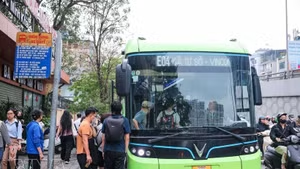
Ho Chi Minh City is implementing a project to convert buses to electric operation, demonstrating its determination to shift towards environmentally friendly public transport. Accordingly, from 2025, all newly invested or replaced public passenger buses must be electric, and from 2030 onwards, 100% of operating buses must run on electricity.
If this transition roadmap is implemented, the city will have around 3,200 electric and green-energy buses within the next five years. Alongside the roadmap, the city’s Department of Construction has taken a “one-step-ahead” approach in replacing fossil fuel vehicles with “clean” energy vehicles.
As a result, in 2024 and 2025, the Department of Construction organised open bidding for 82 out of 108 subsidised bus routes across the city (accounting for 76%) and conducted bidding for the remaining 25 routes in November. During implementation, priority was given to enterprises deploying new vehicles, especially electric buses. Through the bidding process, the city has put into operation 627 electric buses, accounting for 26.3% of the total bus fleet.
In early 2026, the city is expected to deploy an additional 454 electric buses, raising the proportion of electric vehicles to 45.3%. By the end of 2026 and in subsequent years, the city will continue bidding procedures to convert buses to electric operation, with the goal of completing the transition to 100% clean- and green-energy buses by 2030.
According to Le Hoan, Deputy Director of the Public Transport Management Centre under the Ho Chi Minh City Department of Construction, international experience in industrialised countries shows that the first vehicles to be converted to control environmental pollution are public transport vehicles (metro systems and buses), followed by commercial transport vehicles, and finally private vehicles. Therefore, the city’s approach is on the right track. Beyond buses, the city also aims to convert ride-hailing vehicles, delivery vehicles and vehicles used by state agencies to electric or low-emission green vehicles.
International experience in industrialised countries shows that the first vehicles to be converted to control environmental pollution are public transport vehicles (metro systems and buses), followed by commercial transport vehicles, and finally private vehicles. Therefore, the city’s approach is on the right track. Beyond buses, the city also aims to convert ride-hailing vehicles, delivery vehicles and vehicles used by state agencies to electric or low-emission green vehicles.
Le Hoan, Deputy Director of the Public Transport Management Centre under the Ho Chi Minh City Department of Construction
After receiving approval from the city on December 19, the Public Transport Management Centre coordinated with transport enterprises to officially operate six electric bus routes in the Con Dao special administrative zone.
In addition, Ho Chi Minh City plans to establish low-emission zones in the city centre and Can Gio from 2026, as part of a gradual effort to control emissions and curb environmental pollution. These steps are aimed at eliminating carbon emissions from motor vehicles and moving towards net-zero emissions before 2050, in line with the Prime Minister’s directive.
Filling the “gap” in charging infrastructure
Currently, Ho Chi Minh City has only five charging stations for electric buses, with a total of 56 charging points. This is far too few compared with the tens of thousands of bus trips operating daily from 5 a.m. to 10 p.m. Most of these charging stations have been invested in by transport enterprises themselves, while management authorities have yet to fully step in. Meanwhile, bus operators must continuously adjust operating schedules to match charging times, highlighting a major gap in infrastructure for electric vehicles.
According to calculations by the Public Transport Management Centre, assuming each charging point operates an average of 12 hours per day, the existing 56 chargers can serve around 700 buses. With the current fleet of 627 electric buses, the five charging stations are just sufficient to meet the demand. However, if further investment and conversion to electric vehicles continue, the current charging system will no longer be adequate.
The Department of Construction has proposed selecting 19 depots and yards in favourable locations to install charging points. This would create a new revenue source for the state budget through leasing public assets as well as shorten response times to the rapidly growing demand for charging infrastructure.
“Revenue from leasing these sites, estimated at over 22 billion VND per year, will be paid into the state budget and prioritised for reinvestment in road transport infrastructure projects, from upgrading depots to expanding bus-related facilities in the coming period,” Le Hoan said.
Many transport enterprises note that, in practice, most companies are currently having to invest in their own charging stations if they wish to operate electric vehicles, due to the absence of a public charging network. The lack of charging stations is a major barrier, discouraging enterprises from joining the transition from diesel buses to electric buses.
According to the Department of Construction, excluding state budget funding for charging station investment, Ho Chi Minh City would need more than 2.2 trillion VND to implement the vehicle transition roadmap.
Of this figure, more than 1.947 trillion VND would be used to support interest rates for vehicle investment loans, while around 255 billion VND would support interest rates for charging station investment loans. The planned scale of charging infrastructure to meet the city’s bus transition roadmap includes 44 locations with a total of 317 charging points.
Bui Hoa An, Deputy Director of the Ho Chi Minh City Department of Construction, affirmed that for the electric vehicle transition policy to succeed, the city government must introduce sufficiently strong policies to encourage investors to participate in installing charging systems and to provide interest rate support aligned with real conditions.
The electric energy supply system is also a decisive factor in determining the feasibility of the roadmap to convert buses, along with road transport vehicles in general, to electric and green energy. Fully aware of this, Ho Chi Minh City is studying and finalising financial support policies, including subsidies, interest rate support, tax and fee incentives, and risk-sharing mechanisms for green vehicle investment projects.