Pressure from global energy volatility and the need for urgent policy action
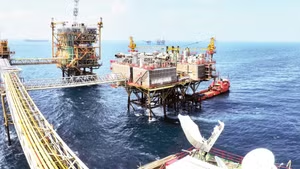
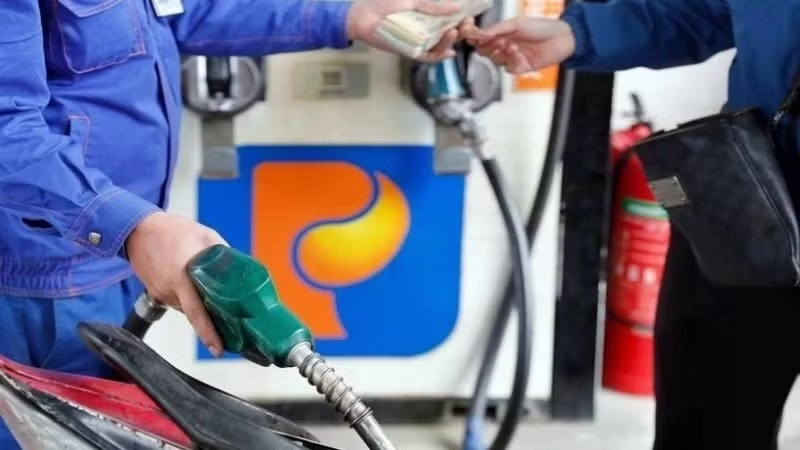
In its submission of a draft Resolution to the National Assembly Standing Committee on adjusting environmental protection tax rates on petroleum products, the Ministry of Finance noted that recent global developments have been increasingly complex. In particular, military tensions in the Middle East have caused sharp fluctuations in the global energy market, pushing up oil and gas prices and raising the risk of supply disruptions. These factors have directly impacted the domestic petroleum market, intensifying pressure on price management and inflation control.
A report by the Ministry of Industry and Trade shows that since early March 2026, tensions between the US and Israel on one side and Iran on the other have continued to escalate. Although Iran has stated it will not close the Strait of Hormuz — a strategic maritime route for global oil transport — it has warned that it may target vessels from the US and Israel passing through the area, significantly heightening geopolitical risks to the global energy supply chain.
In response, many countries have implemented measures such as temporarily halting exports of petrol and diesel, reducing capacity or suspending operations at refineries, and pausing new contracts or renegotiating previously agreed shipments. Several Middle Eastern countries have also scaled back oil and gas production.
The United Nations Conference on Trade and Development (UNCTAD) has warned that any disruption in the Strait of Hormuz could drive up global energy and food prices, thereby increasing the cost of living, particularly for vulnerable populations.
Domestically, petroleum price management has closely tracked global market developments in line with Government Resolution No. 36/NQ-CP dated March 6, 2026. However, price movements throughout March 2026 indicate sustained and significant upward pressure.
To mitigate this, the Government has directed the use of the petroleum price stabilisation fund to curb the pace of increases. During the pricing review on March 10, 2026, disbursements from the fund were set at relatively high levels, ranging from 4,000 to 5,000 VND per litre across petroleum products, in a bid to support the market and limit spillover effects on production, business activity, and household expenditure.
Nevertheless, global price trends have remained unpredictable, with intermittent declines followed by sharp rebounds. By the pricing review on March 19, 2026, the retail price of RON95-III petrol had risen to approximately 30,690 VND per litre, while diesel reached around 33,420 VND per litre, underscoring the continued strain on domestic price management.
Although the stabilisation fund has helped moderate the pace of increases, the Ministry of Finance believes that additional fiscal policy measures — particularly tax adjustments — are necessary to help bring down domestic prices.
Notably, Conclusion No. 14-KL/TW dated March 20, 2026 by the Politburo called for the immediate use of fiscal instruments such as taxes and fees to stabilise supply and minimise domestic fuel price increases, thereby reducing adverse impacts on production, business activities, and people’s livelihoods, and contributing to macroeconomic stability.
Tax reduction within permissible limits to support macroeconomic stability
On that basis, the Ministry of Finance has proposed the drafting of a Resolution by the National Assembly Standing Committee on environmental protection tax rates for petroleum products under expedited procedures, shortening the issuance timeline and enabling swift policy implementation.
Under the draft, the environmental protection tax on petrol (excluding ethanol) and aviation fuel would be reduced to 1,000 VND per litre, while the rate on diesel would fall to 500 VND per litre during the Resolution’s effective period. Thereafter, tax rates would revert to those stipulated under Resolution No. 109/2025/UBTVQH15 until December 31, 2026.
According to the Ministry of Finance, environmental protection tax currently accounts for around 6.7% of the base price of petroleum products. Adjusting the tax within the authorised framework of the National Assembly Standing Committee is considered a feasible solution that can be implemented swiftly while remaining consistent with existing legal provisions.
With the proposed tax cuts, retail petrol prices could fall by approximately 1,080 VND per litre (inclusive of value-added tax), while diesel and aviation fuel prices could decline by around 540 VND per litre. However, the Ministry cautioned that the actual reduction would depend on global refined fuel price movements.
Regarding macroeconomic impacts, calculations by the General Statistics Office suggest that the tax adjustment would help contain inflation. Specifically, the consumer price index (CPI) for March 2026 could rise by around 1.63 percentage points compared with the pre-conflict scenario; CPI for the first quarter of 2026 may increase by about 0.43 percentage points year-on-year; and the average CPI for 2026 is projected to rise by approximately 1.35 percentage points. This increase is lower than the scenario in which environmental protection tax rates remain unchanged (around 1.4 percentage points), thereby helping to ease inflationary pressures.
At the same time, the tax cut is expected to reduce state budget revenues by approximately 1.79 trillion VND per month (including the impact on VAT). However, the Ministry of Finance noted that this shortfall could be partially offset by higher crude oil revenues if global prices rise, alongside measures to strengthen revenue management, combat tax losses, transfer pricing, and tax evasion, and enhance fiscal discipline.
The draft Resolution also proposes an implementation period from its issuance until June 30, 2026, while allowing the Government to proactively adjust the duration if necessary, ensuring flexibility in response to rapid changes in the global petroleum market.
According to the Ministry of Finance, this tax adjustment not only falls within its legal mandate and aligns with the current regulatory framework, but also serves as a flexible and effective policy tool to stabilise the petroleum market, support production and business activities, ease cost pressures on households, and maintain macroeconomic stability while keeping inflation under control in 2026.




![[Infographic] GRDP growth scenarios for 34 provinces and cities in fourth quarter of 2026](https://en-cdn.nhandan.vn/images/nyM650OGFWrOVWc-xajqN-rTZ68Rlmc1fiGJOhBRYHFSa4DhrHNDxEFdnz313Vk5dNJuxdkHglPA3rLeaPeiaUheNuCI723k2lNssd-YLJuKR58epWq7s21lV5WjM-HR2-Qpbi4MwAzqt9wRjL4WjGkfEz7RO9qhcwg8o8LQFK8/grdp-growth-scenarios-for-34-provinces-and-cities-in-q42026-anh-dai-dien.jpg.avif)