Hue now faces the imperative of fundamentally transforming its growth model, creating new and breakthrough drivers of development — particularly in pursuit of double-digit growth.
Clearly identifying growth bottlenecks
In recent years, Hue’s economy has maintained relatively stable growth, with average GRDP growth reaching around 7.25% per year in the 2021–2025 period. Budget revenues have risen by more than 10% annually, while the economic structure has shifted positively, with the service sector taking a leading share. The size of the economy has gradually expanded, with GRDP per capita reaching approximately 3,000 USD. A number of large-scale investment projects have been attracted, contributing to improvements in the urban landscape and infrastructure.
However, according to the city’s Department of Finance, Hue’s economy still faces several limitations: its scale remains modest; labour productivity is not yet high; growth drivers are not clearly defined; and no key economic sector with strong spillover effects has yet emerged. Growth momentum also remains insufficiently sustainable, still heavily reliant on a number of traditional sectors. According to Vice Chairman of the City People’s Committee Nguyen Van Manh, Hue is presented with many new development opportunities, but without a decisive shift in its growth model and the creation of breakthrough drivers, it will struggle to achieve rapid and sustainable growth.
“Bottlenecks in institutions, resources, and economic structure are constraining Hue’s ability to break through,” emphasised Dr Tran Thi Hai Yen of the University of Finance–Marketing. Meanwhile, representing the business community, Nguyen Tien Quang, Director of the VCCI Central and Central Highlands Branch, noted: “The investment environment has improved, but Hue needs to push ahead with stronger reforms to build confidence and motivation for businesses to expand production and operations.”
One of Hue’s key bottlenecks also lies in the quality of its human resources. Although it is a major educational centre in the region, the quality and structure of its workforce have yet to meet the requirements of emerging industries. In addition, weak regional and sectoral linkages have limited Hue’s ability to fully assert its role as a growth pole in Central Viet Nam. These assessments highlight the urgent need to transform the growth model towards greater modernity, efficiency, and sustainability.
In response to development requirements in the new phase, leaders of the Hue City People’s Committee have affirmed that achieving double-digit growth is essential to create a breakthrough and narrow the development gap with other localities in the region. Accordingly, the city is focusing on resolutely addressing difficulties faced by businesses, accelerating key projects, and effectively tapping into new growth potential. Some economists believe that Hue is at a “transformation threshold”; without timely reform of its growth model, it will be difficult to achieve high growth targets in the medium and long term. The urgent task, therefore, is to build a growth model suited to its distinctive conditions — one that accelerates economic expansion while preserving and promoting its unique cultural values.
Shaping new pillars of growth
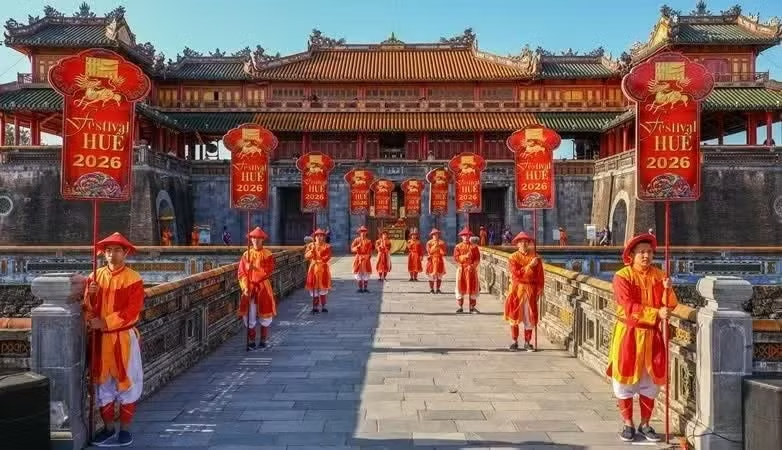
Hue possesses a distinctive system of cultural heritage and stands as a major cultural centre of the country. This constitutes a unique competitive advantage and an important foundation for economic development. In recent years, the city has gradually tapped into its heritage value through tourism development and the organisation of large-scale cultural and artistic events, notably the Hue Festival. However, according to experts, this exploitation remains below its potential, largely confined to traditional tourism, with a modern cultural industry ecosystem yet to take shape.
Economic researchers note that Hue must shift its growth model from one “based on inherent advantages” to one “driven by innovation and high added value.” This is a prerequisite for ensuring rapid yet sustainable growth. The city is therefore developing growth models based on new pillars aligned with the characteristics of a heritage urban area.
Hue possesses a distinctive system of cultural heritage and stands as a major cultural centre of the country. This constitutes a unique competitive advantage and an important foundation for economic development.
With its rich cultural heritage, Hue is well positioned to develop a heritage economy — a distinctive growth model. Experts point out that the development of cultural products, cuisine, and the night-time economy has yet to match its potential. The imperial cuisine brand could become a cornerstone of the night-time economy if supported by systematic investment and a long-term strategy. The challenge, therefore, is not merely to attract visitors, but to increase spending value, extend their length of stay, and build a cultural industry ecosystem.
According to Nguyen Van Manh, Hue City has identified the development of a heritage economy linked to tourism and cultural industries as a key pillar. However, this process must ensure harmony between preservation and development, safeguarding the authenticity of heritage without trading culture for economic growth. Professor Dr Tran Thi Van Hoa, former Vice Rector of the National Economics University, observed: “Hue should develop a creative heritage city model, in which heritage is not only preserved but becomes a direct resource for economic growth.”
Alongside the heritage economy, the digital economy has been identified as one of the most important growth drivers. Experts believe that integrating digital growth with green growth is an inevitable pathway for Hue to achieve rapid and sustainable development in the new context. The application of digital technologies in preserving, promoting, and exploiting heritage is seen as a key solution. Meanwhile, Associate Professor Dr Huynh Quyet Thang of Ha Noi University of Science and Technology emphasised that “the role of science, technology, and digital transformation in building Hue into a major cultural and tourism centre in Southeast Asia is of paramount importance.”
In recent years, Hue has made positive strides in building digital government, developing information technology, and fostering an innovation ecosystem. However, “Hue needs an ecosystem for training and supplying high-quality human resources to meet the demands of the digital economy, modern services, and smart urban governance,” noted Associate Professor Dr Pham Tien Dat.
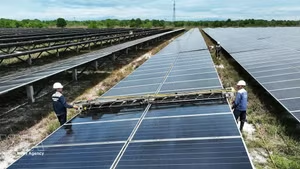
To achieve double-digit growth, Hue must pursue comprehensive development across sectors, creating a diversified system of growth drivers. One major direction is the development of clean and high-tech industries, attracting selective investment projects that prioritise advanced, environmentally friendly technologies in line with the characteristics of a heritage city.
This approach aims to enhance added value, create jobs, and gradually reduce reliance on the service sector. In parallel, infrastructure investment continues to be identified as a breakthrough area. The completion of transport systems, urban infrastructure, seaports, and airports will expand development space, improve connectivity, and attract investment resources.