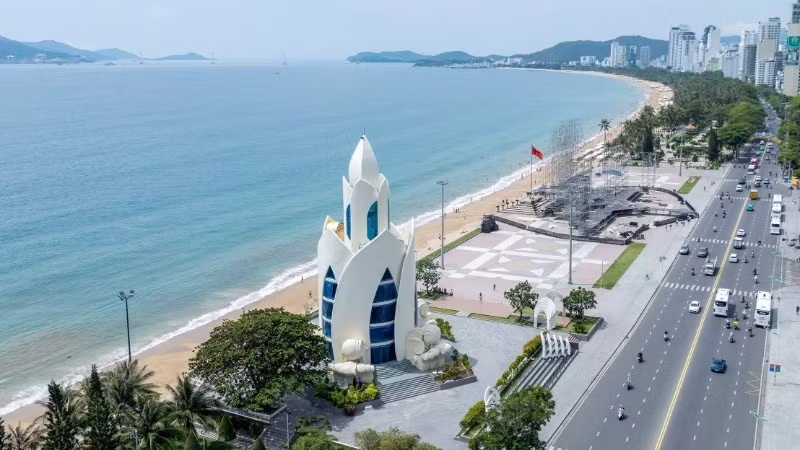
When visiting the coastal city of Nha Trang, many people visit Agarwood Tower, located by the sea beside the windy April 2 Square. As a beautiful architectural structure, the tower is not only a distinctive cultural symbol of Nha Trang–Khanh Hoa but also a sacred spiritual site, for worshipping fallen Heroes and Martyrs. Every day, residents and visitors offer incense and flowers, expressing reverence and prayers.
It is no coincidence that when writing a book about the land and people of Khanh Hoa, writer Quach Tan titled it “Xu Tram Huong” (The Land of Agarwood). Regarding agarwood products, he wrote meticulously and in detail about the characteristics, uses, and images of agarwood in people's lives. He concluded that agarwood is the special product that has made Khanh Hoa renowned both domestically and internationally. When one speaks of agarwood, they speak of Khanh Hoa; and when speaking of Khanh Hoa, agarwood naturally comes to mind.
Agarwood is formed from the wounds of the Aquilaria malaccensis tree — like a sea mussel hiding its pain inside to crystallise into a precious pearl. For generations, the scent of agarwood has been present in the most solemn moments of Vietnamese spiritual life, when people wish to dialogue with their origins, their ancestors, and the deepest, purest part of themselves. For poets and scholars, agarwood is a soulmate; for the people of Khanh Hoa, its fragrance is intertwined with rituals, reverence, and aspirations. For those living far from home, a faint whiff of their homeland’s agarwood brings warmth amid cold winds because within that scent lies their homeland, family, and the Vietnamese spirit — which is silent but profound.
Folk verses still sing: Agarwood from Van Gia sweeps its fragrance through the mountains and forests…To preserve and promote the values of agarwood, the Khanh Hoa Provincial People’s Committee has recognised Phu Hoi 1 agarwood-carving craft village in Van Thang Commune, the former Van Ninh District, as a provincial-standardised craft village; designated it as a potential community tourism site; and allocated 4 billion VND for constructing a display house and workshop. Many products in the locality have been exported to foreign markets such as China, Japan, India, and the US.
Within the cultural and art flow of agarwood craftsmanship, the agarwood enjoyment of Khanh Hoa people has reached a level of sophistication, subtlety, and elegance. Besides harvesting natural agarwood, Khanh Hoa residents now actively cultivate Aquilaria malaccensis trees to create agarwood. Advances in science and technology in exploitation, production, and craftsmanship have created increasingly high-quality and refined agarwood products, affirming the brand and sustainable value of Khanh Hoa agarwood.
On June 3, 2025, the Ministry of Culture, Sports and Tourism issued Decision No. 1651/QD-BVHTTDL recognising “Knowledge of exploiting and processing Khanh Hoa Agarwood” as a national intangible cultural heritage.
Dr. Nguyen Duy Thai, from the Institute of Culture and Development under the Ho Chi Minh National Academy of Politics, refers to the concept of “soft power” in his monograph Vietnamese Agarwood Culture. In reality, to strengthen the “soft power” of agarwood culture, it is essential to thoroughly study issues related to agarwood culture within the overall Vietnamese cultural system; identify the characteristics of Vietnamese agarwood culture; and clarify the role of agarwood culture in cultural development.
Nha Trang, Khanh Hoa, is also home to the Khanh Hoa Agarwood Museum, built by Khanh Hoa Agarwood Company. The museum currently displays around 5,000 documents, images, and artefacts. In 2019, the museum was recognised by Guinness Viet Nam as the first private museum in the country.
According to Nguyen Van Tuong, Chairman of Khanh Hoa Agarwood Company, agarwood is a “messenger of the Vietnamese soul”, where pure cultural and spiritual values are condensed.
“I want to change the community’s perception of agarwood, not only as fragrance for enjoyment but as a sacred essence of Vietnamese culture — a place where spiritual, medicinal, health-related, and contemplative values converge,” he emphasised.
From this aspiration, all efforts aim to build the Khanh Hoa agarwood industry into a symbol of local culture, contributing to the homeland and the nation with sustainable, noble, and sacred values.
He has been deeply concerned with the idea of building the Nha Trang Peace and Creativity Village, focusing on meditation and agarwood culture and art, conserving endemic plant species, and cinema development. Khanh Hoa agarwood, from a local product, has now become a national cultural heritage and is gradually connecting Viet Nam with the world. Unfortunately, for many objective reasons, implementation has remained slow.
“The state needs to study and correctly assess the economic and cultural potential of agarwood in order to develop comprehensive, scientific macro policies for the sustainable development of Viet Nam’s agarwood industry,” Tuong proposed.
Agarwood today is accompanying Khanh Hoa as it enters a new journey — a journey of creating cultural value to integrate into the world in a confident and intelligent manner. Recently, during a dialogue between General Secretary To Lam and the Boston Global Forum (BGF) held in the UK, the vision of developing Khanh Hoa–Nha Trang into a global centre for cultural and artistic creativity in the age of artificial intelligence was also presented by BGF.
In this context, Khanh Hoa agarwood is an important “soft component”, contributing to shaping a new source of strength for the locality.