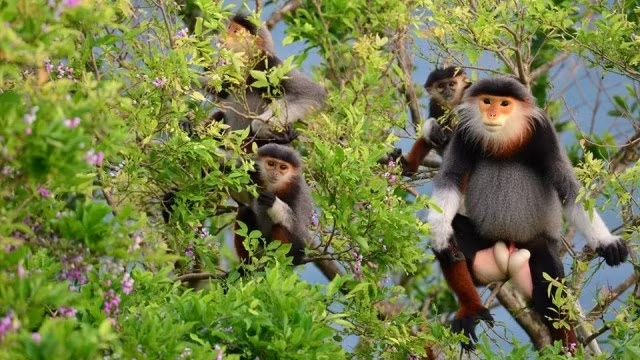
The latest statistics were announced at a seminar held yesterday in Da Nang on the current status of the red-shanked douc, its total numbers, density and distribution, as well as conservation measures for one of the most endangered species resided at Son Tra Peninsula in the central city.
This is the result of a scientific research under the Program "Conservation of the red-shanked douc and habitats of the species" approved by the Da Nang People's Committee at 569/QD-UBND and implemented by the biodiversity conservation NGO GreenViet.
While making the announcement, Bui Van Tuan, Head of Department of Scientific Research of GreenViet, said that since 1977 there have been many studies and surveys on red-shanked doucs conducted on Son Tra Peninsula. However, they were only carried out in a specific region with partial data collected only.
The latest research results are based on the linear method and data observation-collection method. The research team conducted surveys on four lines with a total length of 139 km at 150 sites on the Son Tra Peninsula with the frequency of a 3 time repeat on 2-4 km on each route.
After surveying and collecting data, the team conducted data analysis based on the following parameters: number of individuals per 1 km2; number of flocks per 1 sq. km; and number of individuals in a troop. As a result, the team recorded 1,335 individuals of red-shanked doucs living in 237 troops.
The majority of recorded red-shanked doucs are in the northern part of the Son Tra Peninsula. This result also coincides with GreenViet’s studies for the past five years. The habitat of the species is about 3,133 ha.
According to Huynh Phuoc, Vice Chairman of the Da Nang Union of Science and Technology Association, Son Tra is considered as an area with the world's largest red-shanked douc population.
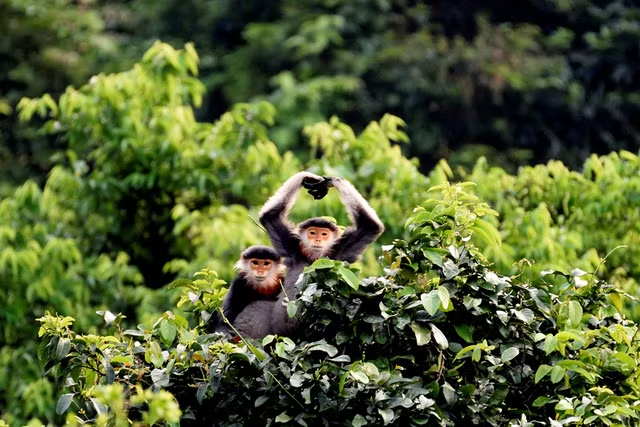
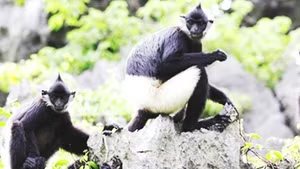
Red-shanked doucs on Son Tra Peninsula (Credit: Bui Van Tuan via dantri.com.vn)
Previous reports released by Lippold and partners (2008) and Dinh Thi Phuong Anh and partners in 2010 only recorded about 180-200 red-shanked doucs in Son Tra. A report from the Douc Langur Foundation in 2013 increased the figure to about 300-350 individuals.
Tuan pointed out factors that affect red-shanked doucs, including the risk of reduced living areas due to the planning of ecotourism development projects, the risk of habitat fragmentation (the risk of accidental collisions with vehicles when passing over roads, increased hunting and being trapped when developing tourism is out of control, disease transmission from human to doucs by feeding and limitations in the control of human activities on the Son Tra Peninsula.
The update of study results on the number, distribution and population density of red-shanked doucs at Son Tra will be the basis for Da Nang and other functional departments to make necessary solutions to conserve the species in Son Tra.
At the workshop, delegates also presented solutions to protect the red-shanked douc living on the Son Tra Peninsula, with enhanced supervision of visitors’ activities at checkpoints of entry into the peninsula aimed at monitoring and minimising trapping and hunting activities, while simultaneously halting and eliminating projects located in the important distribution of douc in the north of Son Tra Peninsula, as well as focusing on awareness raising activities for visitors in dealing with wildlife on the peninsula.
In the long run, Da Nang should coordinate with nature conservation organisations to implement monitoring programmes on monitoring changes and distribution of the species during a six month cycle and restoring their habitat to ensure food sources and prevent threats to the existence of the species.
Bui Huy Tri, a representative from Da Nang Department of Construction, said that the department is reviewing Son Tra planning under the direction of the City People's Committee, affirming that the city will create the best conditions for Son Tra. Tri also expressed his desires that not only for the red-shanked douc but a complete living map of specific animals, plants and coral reef systems in Son Tra also need to be understood to delineate protection areas, as well as developing appropriate planning.
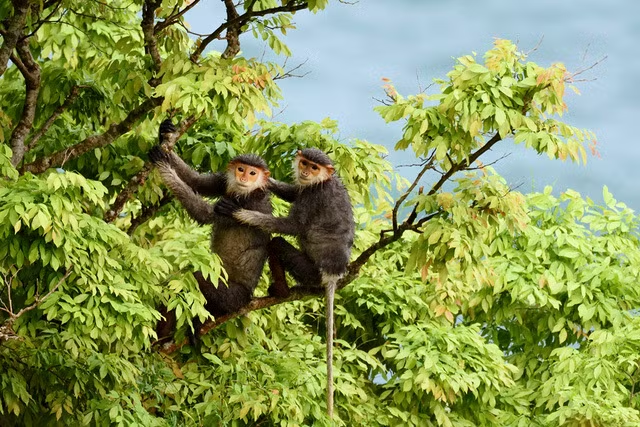
Red-shanked doucs on Son Tra Peninsula (Credit: Bui Van Tuan via dantri.com.vn)
Son Tra owns a natural forest ecosystem associated with the sea and is the only place in Vietnam home to ecological values in the heart of a modern city. Research results have confirmed that Son Tra has 985 species of vascular plants and nearly 300 species of terrestrial vertebrates. The seas surrounding the Son Tra Peninsula also has important coral and seagrass ecosystems, with 191 species of reef hard corals, 72 seaweed species and three seagrass species.
Son Tra Peninsula is also the easiest place in the world to observe the red-shanked douc in its natural environment. It is endemic to Indochina. According to the International Union for Conservation of Nature (IUCN), the species ranks 4/7 in the Red List of Threatened Species.
In Vietnam, the species is well protected. The Vietnam Red Book also ranks this species as Endangered (EN), and Decree No. 32NĐCP/2006 by the Government places red-shanked douc as "strictly prohibited from hunting or trading in any form."
However, the explosion of development activities, especially tourism, in recent years, has caused tremendous pressure and threatened the viability of the habitat for the red-shanked douc. Meanwhile, the most complete, accurate and scientific information on the species in the peninsula is not up-to-date.

Red-shanked doucs on Son Tra Peninsula (Credit: Bui Van Tuan via dantri.com.vn)