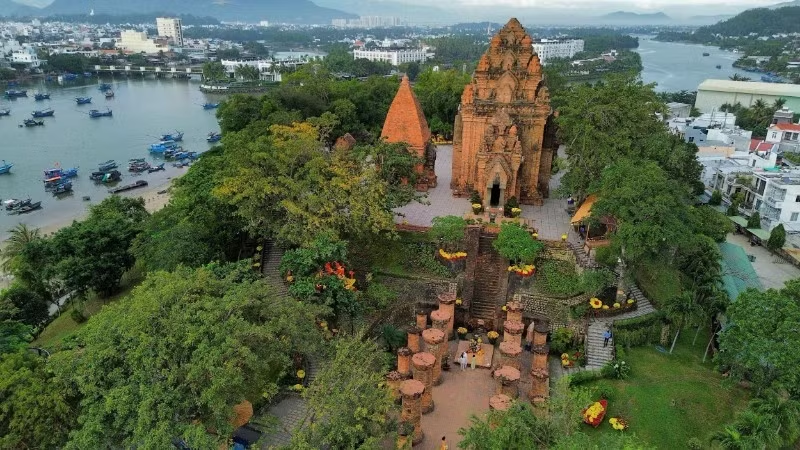
Standing on Cu Lao Hill overlooking the mouth of Nha Trang Bay, where the Cai River flows into the deep blue sea, Ponagar Tower has endured for more than 12 centuries. Unlike the usual placement of Cham towers on isolated mountains, as seen at My Son or in the Binh Dinh region, the ancient Cham people chose a site where land, water and sea converge. According to Professor Ngo Van Doanh, who has devoted his life to researching Cham towers, Ponagar Tower is one of the very few structures that still preserve the “original spirit” of Champa art. Its beauty does not lie in monumental scale but in the harmonious combination of form, materials and religious aesthetics — like a warm, low note in the long symphony of Cham architecture.
Passing through the eastern gate, visitors immediately encounter a spacious courtyard opening toward the sea, a sign that this was once a place of festivals and communal gatherings. Centuries ago, Cham people from coastal villages, from the upper reaches of the Cai River, and even from as far as Phan Rang and Phan Ri would gather here in the lunar third month to celebrate the anniversary of the goddess, who is considered the Mother of the land.
The highlight of Ponagar Tower is the main tower dedicated to the goddess. Nearly 23 metres high, the tower is built of fired red bricks without mortar, but it has still withstood centuries of storms, wars and the passage of time. The decorative motifs on the tower are restrained rather than dense, using fine lines and simple but strong forms. The sandstone apsara dancers, though less elaborate than those at Tra Kieu, still convey a graceful and supple spirit in their flowing poses amid sacred dances.
Despite historical upheavals, Cham deity statues have been preserved and Cham festivals have been conserved, while Vietnamese communities have added folk rituals strongly influenced by Mother Goddess worship, offering incense in their own traditions. This gentle cultural accretion has created a unique spiritual space where two cultures coexist and complement each other, shaping the distinct identity of Ponagar Tower today.
Tran Duc Ha, Director of the Khanh Hoa Centre for Cultural Heritage Conservation, said that in the 19th century, under the Nguyen Dynasty, Ponagar Tower was restored many times. Ancient Chinese-script steles noting these restorations are still present. These stone steles are witnesses to a period when Cham relics were acknowledged and cared for by Vietnamese dynasties, becoming an inseparable part of the local cultural life.
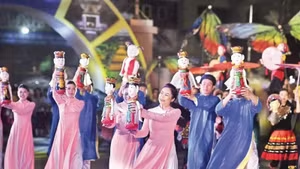
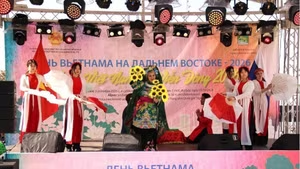
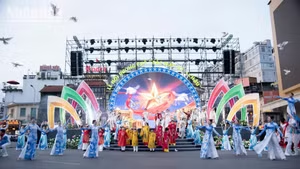
“Today, every lunar third month festival, Ponagar Tower becomes alive with the sounds of drums, chants and singing. Vietnamese women wear colourful ao dai, while Cham women are in traditional long skirts. Folk cakes are placed beside Cham offerings. Soft dances flow like the waters of the Cai River, while decisive Cham dances echo the sea breeze of Nha Trang,” Ha added.
What makes Ponagar Tower truly distinctive is the continuity between past and present. Many Cham towers across central Viet Nam survive only as silent ruins, but Ponagar remains alive — alive in festivals, in the breath of belief, and in the spiritual life of local residents. Standing inside the tower, looking up at the high, light-filled vault, inhaling the mingled scents of incense and old brick, visitors feel clearly that this is not only a tourist site, but a dwelling place of faith prolonged over centuries.
The architecture of Ponagar Tower also clearly reflects this spirit of cultural exchange. Layers of Vietnamese people’s restoration did not disrupt the original Cham structure but added details compatible with local beliefs. As a result, Ponagar Tower bears a distinct identity: preserving Cham features in form, but Vietnamese in spirit. This makes the tower unique — it is both a Cham heritage site and a shared cultural legacy.
Professor Ngo Van Doanh once said that Ponagar is “the most compelling evidence of a gentle meeting between two cultures” — gentle because the transformation took place in peace and mutual understanding, compelling because it has endured despite all historical upheavals.
Today, from the upper levels of the tower, visitors can see modern bridges spanning the Cai River below, the bustling streets of Nha Trang, and fishing boats heading out to sea each morning. The surroundings have changed, but Ponagar Tower remains a vivid testament — a story of people, belief and harmony. It is a place where past and present join hands, where ancestors and contemporaries bow together before a beauty that transcends time. Perhaps this is the greatest value Ponagar Tower offers: not only to be admired, but to be retold — as a remarkable journey of architecture and culture by a thousand-year-old seashore.