As part of its socio-economic development strategy, Dong Nai is striving to develop green, eco-industrial parks in order to gradually realise the net-zero emission target.
A serious commitment to green development
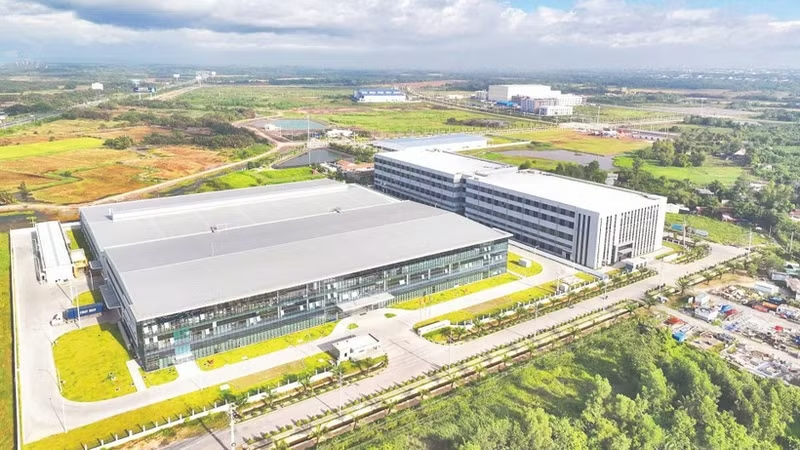
After more than 12 years of operation, the 282-hectare Long Duc Industrial Park has attracted more than 70 projects with total registered investment of nearly 2 billion USD, creating jobs for over 8,000 workers.
The park has invested in a modern infrastructure system and prioritises high-tech projects, supporting industries and environmentally friendly manufacturing in line with an eco-industrial, green development orientation.
According to Ishii Hiroyuki, General Director of Long Duc Investment Co., Ltd., self-assessment results show that Long Duc Industrial Park meets 15 out of 22 government criteria for eco-industrial parks.
The company is continuing to complete documentation, upgrade infrastructure and promote industrial symbiosis linkages in order to soon obtain certification as the first eco-industrial park in Dong Nai Province. Long Duc also aims to become a pioneer in green-transition industrial park infrastructure investment in Dong Nai.
“With its geographical advantages and well-developed infrastructure, especially Long Thanh Airport, Dong Nai will be an attractive destination for leading global investors. To date, we have invested in two industrial parks in Dong Nai and are preparing to invest in a third, built to green and ecological standards to meet business demand,” Ishii Hiroyuki said.
In 2020, Amata Industrial Park was selected by the Ministry of Planning and Investment (now the Ministry of Finance) and the United Nations Industrial Development Organisation (UNIDO) to participate in a pilot project to develop an eco-industrial park model.
Focusing on four groups of criteria for eco-industrial park recognition, namely park management, environment, social community and economy, with support from the Global Eco-Industrial Parks Programme, Amata Industrial Park has so far met 86% of the criteria under the international framework and could reach 97%.
Building on this initial success, Amata is replicating eco-industrial park standards at the Long Thanh High-Tech Industrial Park, which covers more than 410 hectares. On December 19, Dong Nai Province broke ground on two industrial parks, Bau Can-Tan Hiep and Xuan Que-Song Nhan, located adjacent to Long Thanh International Airport. With a combined area of more than 2,000 hectares, they are expected to attract around 20 billion USD in foreign direct investment and create 130,000 jobs.
According to representatives of KN Holdings Group, the project developer, both parks are planned for green development, using clean energy and attracting high value-added industries that are deeply integrated into global supply chains, such as semiconductor equipment manufacturing, chips, electronic components and aviation supporting industries.
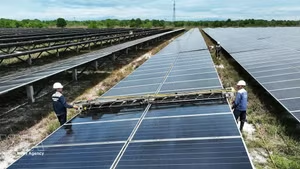
The developer has committed to deploying comprehensive green energy solutions, including renewable energy projects in Dong Nai, rooftop solar power systems, energy storage batteries, charging stations and centralised cooling systems.
These measures will provide clean energy and green credits for factories operating within the parks, helping to cut emissions, protect the environment, move towards net zero and promote green industrial development.
Towards rapid and sustainable development
To date, industrial parks in Dong Nai have attracted 1,909 projects from 45 countries and territories with total investment exceeding 36.7 billion USD, as well as 835 domestic projects worth more than 170 trillion VND.
As one of the country’s leading industrial park infrastructure developers, Sonadezi is operating 12 industrial parks in Dong Nai, Khanh Hoa, Lam Dong and Ho Chi Minh City. These parks host nearly 1,000 domestic and foreign enterprises with total investment of around 12 billion USD and more than 30 trillion VND.
With a focus on sustainability, Sonadezi is taking decisive action to accelerate greening and smartisation throughout the investment and operation of its industrial parks. This is particularly significant in the context of the first Dong Nai Provincial Party Congress for the 2025-2030 term, which set the goal of developing Dong Nai into a green, prosperous, civilised and modern province.
“We aim to integrate green and circular economy principles and net zero targets not only into Sonadezi’s operations, but also across secondary enterprises,” a Sonadezi leader said.
According to Pham Viet Phuong, Deputy Head in charge of the Dong Nai Industrial Parks and Economic Zones Authority (DNIEZA), the development of green and eco-industrial parks is increasingly becoming a key criterion for investors pursuing sustainable development.
One assessment criterion is that the combined area of green space, transport, technical zones and shared social infrastructure must account for at least 25% of total land. Accordingly, long-established industrial parks that fail to meet this requirement will be surveyed and reviewed to identify secondary enterprises using land inefficiently; land used for improper or low-efficiency purposes will be reclaimed and planning adjusted. For newly established industrial parks, the application of the eco-industrial park model is encouraged from the design and construction stages through to operation.
In attracting investment, DNIEZA prioritises industries capable of meeting industrial symbiosis criteria, ensuring effective linkages, exchange and utilisation of resources, energy and waste among enterprises within the parks.
From a state management perspective, Nguyen Tuan Anh, Director of the Dong Nai Department of Agriculture and Environment, said the sector is focusing on promoting renewable energy development, cleaner production and circular industry, while encouraging enterprises to invest in rooftop solar power and waste recycling and reuse. The province is also building a database system and conducting greenhouse gas inventories at provincial level to support management and policy-making for emissions reduction.
Standing Vice Chairman of the Dong Nai Provincial People’s Committee Nguyen Kim Long noted that the transformation of existing industrial parks and investment in new ones based on green and eco-industrial models is steering Dong Nai in the right direction from a labour-intensive industrial hub to a centre for high-tech and supporting industries, creating a breakthrough driver for green, sustainable economic growth.
However, the greening of industrial parks faces many challenges and requires close coordination among departments and agencies to ensure accuracy, fairness and effectiveness, thereby creating the most favourable environment for business development.
“We are actively supporting and guiding enterprises to install self-consumption solar power systems at factories within industrial parks in accordance with current regulations. We are committed to further strengthening the investment environment to attract leading global technology companies to join us in developing green industrial parks,” Long affirmed.