However, growth objectives must go hand in hand with stability and the control of major economic balances, and the people must benefit from the fruits of that development.
Double-digit growth - a central political task
Despite the prolonged impact of the COVID-19 pandemic and global economic volatility, with the engagement of the entire political system, the people and businesses under the leadership of the Party, the National Assembly and the Government, the country has achieved important and remarkable accomplishments in recent years. Specifically, in 2025, GDP reached 514.4 billion USD, 1.48 times higher than in 2020; GDP per capita reached 5,026 USD, 1.4 times higher than in 2020; social welfare was ensured, among other achievements.
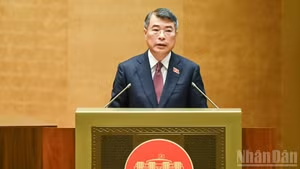
Regarding the five-year socio-economic development plan for 2026–2030, presenting the Government’s proposal to the National Assembly, Deputy Prime Minister Nguyen Van Thang stated that the Government aims for GDP growth of 10% or higher in 2026 and on average during 2026–2030, alongside maintaining macroeconomic stability. GDP per capita is projected to reach 8,500 USD by 2030, 1.7 times higher than in 2025; peace and stability will be maintained; and all aspects of people’s lives will be improved so that the people can benefit from all development achievements.
To realise these important goals, the Government has proposed 11 key groups of solutions. Among them, the Government will shift strongly from “pre-inspection” to “post-inspection” in state management; transform the growth model; accelerate restructuring of sectors and fields; and develop business sectors and new economic models. In 2026 alone, the Government will prioritise institutional and legal improvements; reduce at least 50% of compliance costs and administrative procedure time compared to 2024; resolve backlog projects; and mobilise and effectively utilise resources.
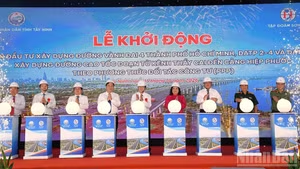
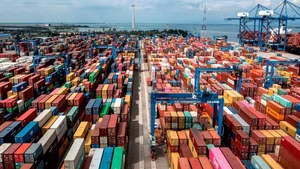
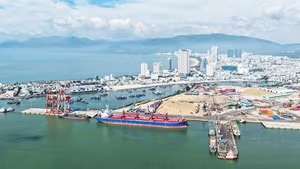
In particular, Deputy Prime Minister Nguyen Van Thang emphasised that the Government will focus on developing a synchronised and modern infrastructure system; promoting urbanisation and urban development, regional connectivity; investing in expressways in line with planning; gateway seaports combined with international transshipment; major airports; high-speed rail along the North–South axis; international railway connections; and urban railways.
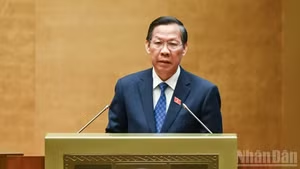
To achieve sustained double-digit growth, at the National Assembly, Prime Minister Le Minh Hung also referred to the strategic breakthroughs outlined in the Party Congress Resolution. Specifically, regarding institutions, the Party Central Committee and the Politburo have tasked the Central Policy and Strategy Commission with studying and submitting to the 3rd Plenum a resolution on reforming the growth model.
However, even before that resolution is issued, “we will continue our efforts, and the Vietnamese economic engine will keep running. It is still the same engine, but if institutions are improved like upgrading the road quality, we can achieve higher speeds. Therefore, institutions remain the most crucial and decisive factor in realising the set objectives,” the Prime Minister stressed.
Preventing the country from falling behind and people from missing development opportunities
In reality, maintaining an average GDP growth rate of over 10% per year during 2026–2030, alongside the requirement to prevent the country from falling behind and to ensure people do not miss development opportunities, is a goal clearly defined and consistently emphasised by the Party and the State.
Specifically, the documents of the 14th Party Congress reaffirm that the state economy plays a leading role, while the private sector is an important driving force, requiring the formation of domestic enterprises capable of competing internationally and deeply integrating into value chains. Therefore, discussing this issue, Nguyen Duc Hien, Deputy Head of the Central Policy and Strategy Commission, suggested that management reform should follow the principle of “one task - one focal point”, reducing overlap and adopting a value chain-based approach.
Meanwhile, by the end of 2025, Vietnam’s banking system comprised 127 credit institutions with total assets of nearly 28.9 quadrillion VND; outstanding credit reached approximately 18.6 quadrillion VND, equivalent to 144% of GDP. According to Nguyen Ngoc Canh, Deputy Governor of the State Bank of Vietnam, banks not only provide capital but are increasingly expanding their functions through financial product development, digital transformation and support for businesses in accessing resources. At the same time, monetary policy is flexibly managed to control inflation and ensure capital flows for the economy.
From another perspective, representing the business community, both a driver of growth and a direct channel for absorbing massive investment flows to realise growth targets, Dau Anh Tuan, Deputy Secretary General of the Vietnam Chamber of Commerce and Industry (VCCI), pointed out that enterprises must be organised along value chains and enhance their leading capacity.
However, he also emphasised that the private sector still faces structural limitations: large in number but small in scale. Nearly 97% of enterprises are small and medium-sized, limiting their ability to invest in technology, improve productivity and participate deeply in global value chains. Therefore, restructuring the enterprise sector towards forming leading corporations linked with networks of SMEs is considered a key condition for achieving the set growth targets.
Overcoming pressures while ensuring macroeconomic stability
Regarding resources and their allocation to realise the growth targets, Prime Minister Le Minh Hung stated that total social investment over the next five years is expected to average 40% of GDP, equivalent to 38.5 quadrillion VND. Compared to the 2021–2025 period, when total social investment accounted for only about 33%, this figure places significant pressure on the upcoming term. Specifically, total public investment is projected to exceed 8 quadrillion VND, compared to only 2.87 quadrillion VND in the previous term. This means state budget mobilisation will increase by approximately 2.7 times, equivalent to an additional 6.5 quadrillion VND.
Notably, the over 8 quadrillion VND in public investment accounts for just over 20% of total social investment. The remaining nearly 80% must be mobilised from other sources, including domestic enterprises, private investment and foreign investment. “If we do not create a transparent and clear legal framework that encourages people and businesses to invest, how can we mobilise nearly 80% of total social and foreign investment capital?” the Prime Minister stated frankly.
The head of the Government also stressed that growth must go hand in hand with stability and the control of major economic balances, and that “overheated” growth or high growth accompanied by macroeconomic instability is unacceptable. According to the Prime Minister, while short-term growth can be boosted through various forms of investment, the long-term cost of instability would be far greater for the economy.
The year 2026 is a pivotal year to lay the foundation for the next growth phase. Therefore, the Prime Minister emphasised that the Government is fully aware of the need to implement measures to ensure macroeconomic stability.
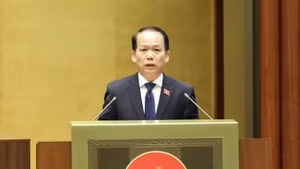
While appreciating the Government’s determination, from the perspective of the reviewing body, Phan Van Mai, Chairman of the National Assembly’s Committee for Economic and Financial Affairs, noted that challenges in 2026 and the 2026-2030 period will be significant and more intense than before, requiring the five-year plan to be formulated and implemented within a new context, with higher demands on growth quality, autonomy and economic resilience.
Pursuing high growth while maintaining macroeconomic stability is a major challenge, requiring prudent, flexible and disciplined policy management. Therefore, Phan Van Mai proposed clarifying the scope and limits of fiscal and monetary policies; ensuring consistent coordination and avoiding abrupt shifts. Establishing a new growth model must be concretised with a clear, focused roadmap, avoiding dispersion. At the same time, it is necessary to continue creating the most transparent and favourable investment and business environment for enterprises and citizens.
On this issue, Prime Minister Le Minh Hung said that the Government has recently assigned the Ministry of Justice to lead a comprehensive review of administrative procedures and business conditions, with the requirement to “resolutely reduce compliance time and costs, and eliminate cumbersome business conditions and procedures”. This is something that can be done immediately and can support businesses and citizens while strengthening confidence in State policies.
“With the support of the National Assembly, Government agencies, ministries, localities, the business community and the people, I believe we can strive for and achieve this goal,” the Prime Minister affirmed.
According to the tentative agenda of Phase 2 of the 1st Session of the 16th National Assembly, scheduled from 20 to 23 April 2026, the National Assembly will continue discussing the five-year socio-economic development plan for 2026–2030 and is expected to vote to adopt the Resolution on the plan on the morning of 23 April 2026.