Changes in poor villages
Ta Com is a remote village of Trung Ly Commune, Thanh Hoa Province. More than 90% of its 112 households are poor, and it has been a hotspot for drug-related issues.
Functional forces launched special operations against drug crime, sent 20 drug addicts to rehabilitation, and intensified communication to transform this key area in terms of security and order.
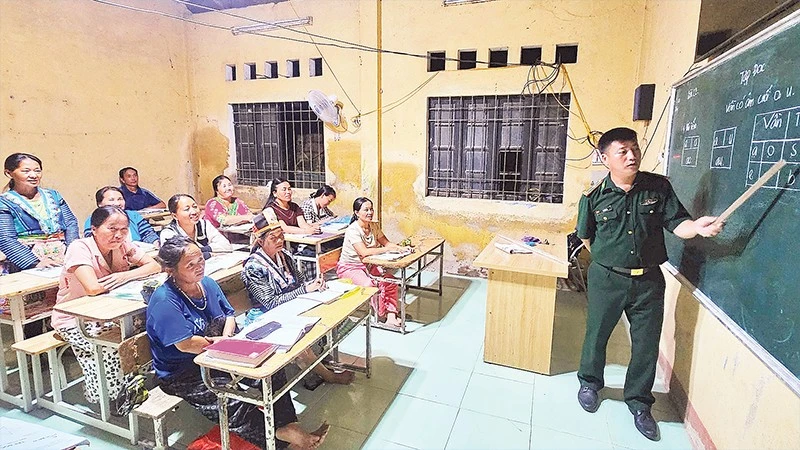
Border Guard officers have recently completed literacy classes for 60 residents. Sung Thi Dung, 30 years old, shared that by diligently attending the literacy class, she has become literate; she is now able to access VNeID to handle administrative procedures herself, and continues to study and acquire more knowledge.
At Ta Com Village, Trung Ly Border Guard Station has installed solar-powered lighting, laid concrete carpets for the road to the cultural house, and built a sports ground. With the support of sponsors, it has provided a computer classroom and standard sanitation facilities. Youth, women and villagers were mobilised to plant flowers and greenery along the roads, regularly clean the environment, and build bright–green–clean–beautiful residential areas.
Sung A U, a member of the Border Guard Party, contributed part of his income to buy poultry breeds for five poor households to raise. Together with the inter-sectoral team, commune and village officials, he advised households to contract cassava cultivation to supply processing factories and encouraged ethnic minority residents to breed livestock supported by national target programmes, expanding the herd to 450 buffaloes and cows.
From the centre of Tam Chung Commune to On Village, nearly 24 km of concrete road has been completed, boosting socio-economic development. On Village has newly built and put into use a cultural house; the resettlement area is home to over 40 households, ensuring safety and disaster preparedness.
Thanks to persistent advocacy by the Border Guard, H’Mong residents have abandoned outdated practices: no more child marriage, consanguineous marriage, or funeral rites lasting longer than 24 hours.
In addition, the Border Guard has disseminated knowledge, skills, and experience in economic development; donated chicken and duck breeds; guided households in growing safe vegetables; assisted families with housing difficulties; participated in improving residential areas, cleaning the environment, and building roads to cultural houses; and installed 50 solar-powered streetlights in rural areas.
Giang A Trong, Party Cell Secretary and head of On Village, added that Border Guard officers have provided advice on detecting and nurturing Party members, establishing a Party cell, and improving the quality of mass organisations’ activities. The new Party cell has admitted two more members, though currently has 16 as young Party members who have volunteered to join the army.
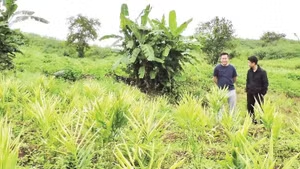
Tam Chung Border Guard Station continues to advise on building “Bright Border Villages”, mobilising residents to convert idle gardens into vegetable plots, plant 30 hectares of fruit trees, expand livestock farming, and join hands in building new-style rural areas. Locals no longer clear forests for cultivation, receive financial support for forest protection, own on average about four buffaloes or cows per household, and enjoy improved living conditions.
Joint efforts to expand “Bright Border Villages”
Thanh Hoa has nearly 214 km of land border, with 16 communes and 46 border villages. Based on assigned tasks and practical demands, Thanh Hoa Border Guard, together with Party committees, local authorities and residents, selected 11 disadvantaged villages to implement comprehensive solutions in building the “Bright Border Villages” model.
The Border Guard continues to advise on consolidating and improving the quality of political systems in the villages, effectively using resources from national target programmes and socialised funds, and “discussing and working together” with the people.
According to Nguyen Van Dung, Chairman of Tam Chung Commune People’s Committee, building bright border villages is a sound policy, reflecting the deep care and responsibility of the Border Guard towards border communities. Party committees, authorities, and mass organisations mobilise manpower and resources to develop rural areas and improve people’s material and spiritual lives. In On village alone, 36 poor households have received support for raising breeding cattle under national target programmes, creating sustainable livelihoods to help them escape poverty.
Over the past year, officers and soldiers from 11 border guard stations in Thanh Hoa uplands have contributed 3,200 workdays to help locals improve gardens, upgrade homes and cultural houses, and beautify rural landscapes; planted hundreds of trees and thousands of metres of roadside flowers; and completed two literacy classes for women’s union members.
The Border Guard has been the core force in mobilisation, raising nearly 4 billion dong in socialised contributions to deliver public facilities. Many border villages now have new gateways, solar-powered lighting systems, volleyball courts, additional equipment for community houses, and renovated classrooms.
The Border Guard has also donated plants and livestock breeds, effectively implemented livelihood models, and helped residents to develop the economy and improve their household incomes.
The “Bright Border Villages” initiative has fostered positive changes in people’s awareness and actions, encouraging self-reliance and harnessing internal strengths, unity, and consensus in building new lives, thereby transforming the face of border rural areas and consolidating people’s trust in the Party, state and border forces.
Colonel Nguyen Van Dong, Deputy Political Commissar of Thanh Hoa Border Guard Command, emphasised: “The ‘Bright Border Villages’ model is not merely a movement but a regular, long-term political task. We will continue to lead and direct units to enhance coordination with local Party committees and authorities; strengthen communication; maximise the engagement of the entire political system; and promote people’s strength. Particular attention will be given to expanding good practices and effective models; proactively advising and mobilising resources to improve people’s material and spiritual lives; and building comprehensively strong border areas, contributing to firmly safeguarding national sovereignty and border security.”