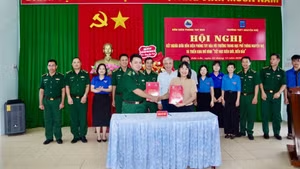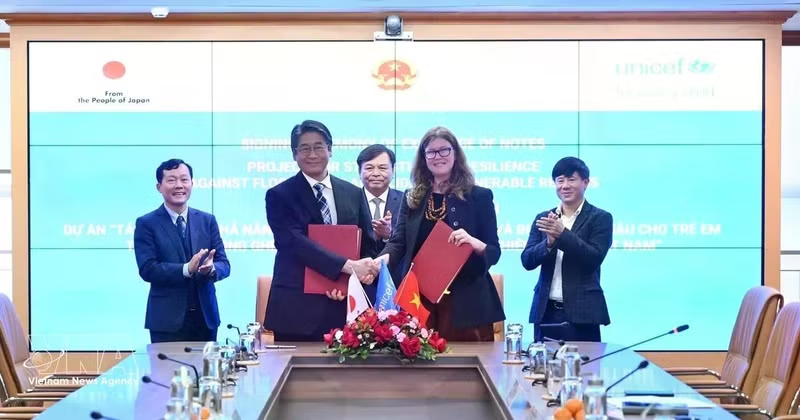
The signing was witnessed by Deputy Minister of Agriculture and Environment Nguyen Hoang Hiep.
Funded by the Japanese Government and implemented through UNICEF in Viet Nam, the project will be carried out by the Viet Nam Disaster and Dyke Management Authority under the Ministry of Agriculture and Environment, with total funding of 6 million USD for the 2026–2030 period.
It aims to better protect children, families and communities in disaster-prone areas by improving access to information and enhancing knowledge and skills for disaster preparedness, response and recovery, while strengthening long-term resilience to natural disasters and climate change.
It is expected to benefit around 27 million children, families and communities nationwide through improved disaster risk reduction planning, early warning and prevention. Targeted activities in Cao Bang, Lao Cai, Nghe An and Ha Tinh are projected to directly support approximately 2.2 million children and 7 million people living in high-risk areas.
Addressing the ceremony, Deputy Minister Nguyen Hoang Hiep stressed that the project would help strengthen Viet Nam’s disaster risk reduction system, with a particular focus on the most vulnerable groups, especially children.
He praised the long-standing cooperation with Japan and UNICEF, reaffirming the ministry’s commitment to enhancing resilience for children, families and communities in areas most exposed to climate-related disasters.
Japanese Ambassador to Viet Nam Ito Naoki said Japan was pleased to continue its close cooperation with Viet Nam and UNICEF in advancing disaster risk reduction efforts. Through improved risk identification and analysis, early warning systems, disaster risk governance and prevention, the project would help mitigate the impacts of floods, inundation and landslides, contributing to a safer and more resilient future for children and communities across Viet Nam.
UNICEF Representative in Viet Nam Silvia Danailov noted that children, while contributing least to climate change, were among those most severely affected by its impacts. A child-centred disaster risk reduction approach, she said, will help ensure disaster management systems and social sectors are inclusive and responsive to children’s needs, while strengthening prevention and resilience at the community level.
With support from the Japanese Government and close coordination with national partners, the project would contribute to better protecting children and ensuring that no child is left behind.
Natural disasters in Viet Nam have been increasing in both frequency and intensity. Typhoon No.3 in 2024 (Yagi), along with severe floods, inundation and landslides in 2025, caused significant human and material losses, highlighting gaps in risk information systems, early warning mechanisms and local prevention efforts. This underscores the need for targeted and sustainable investments in disaster risk reduction and early warning, particularly for children and vulnerable communities.
Through the project, Viet Nam will strengthen disaster risk information systems to support policy-making, planning and early warning at both central and local levels; enhance disaster risk governance and risk-informed investments, including safer schools and community infrastructure; improve community-level prevention and resilience through local early warning mechanisms; integrate disaster risk reduction and climate change education into the national curriculum; and promote youth participation in disaster preparedness and response.
The project aligns with Viet Nam’s commitments under the Sendai Framework for Disaster Risk Reduction 2015–2030, the Paris Agreement on climate change and the Sustainable Development Goals, while also reflecting Japan’s commitment to human security and dignity. It builds on the long-standing cooperation among the Japanese Government, UNICEF and the Vietnamese Government in advancing disaster risk reduction and resilience-building efforts.