Quiet markets, fewer customers
Located in the centre of Bac Giang Ward (Bac Ninh Province), Thuong Market has long served as one of the area's key trading hubs. For many years, the market was a bustling commercial centre, attracting large numbers of shoppers and helping shape the local trading culture.
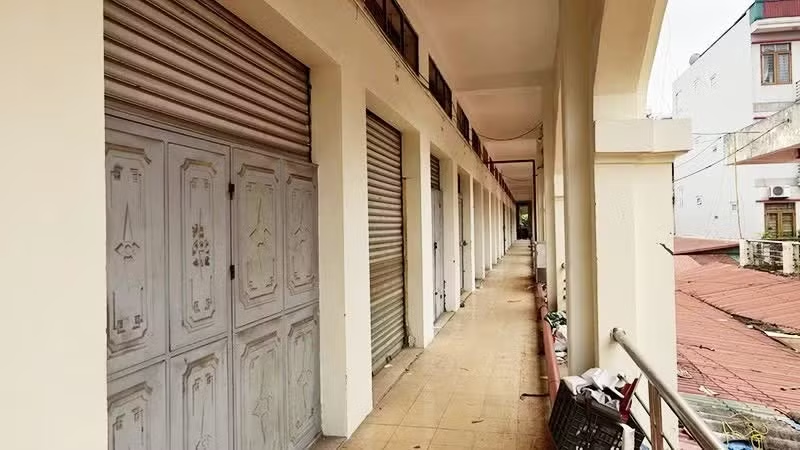
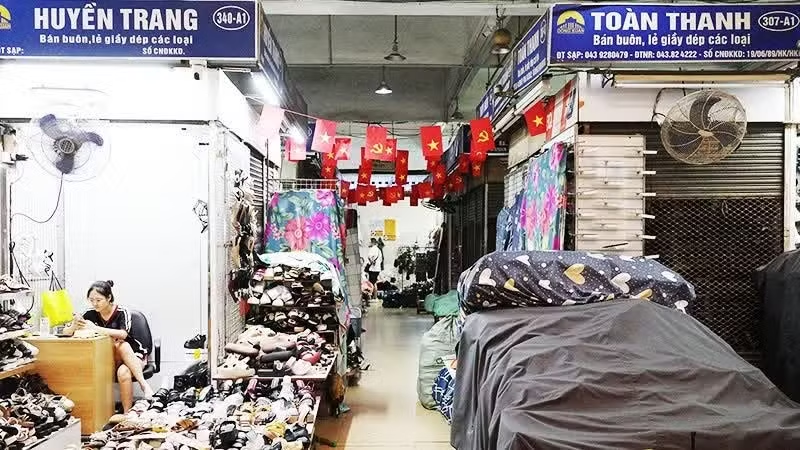
Over time, however, the market has become increasingly quiet. According to Ms Duong Thi Hoa, Director of the Trade Support Management Board of Thuong Market, the market once accommodated more than 500 traders, but today only around 300 remain in operation. Most of them now use their stalls primarily as storage facilities for wholesale goods rather than for direct retail sales. Hoang Thi Lan, a fabric trader, said “I have been selling here since the 1990s. Back then, the market was crowded, but it has become quieter and quieter. Some days I cannot sell anything at all.” She added that sluggish sales affect not only the fabric traders but almost the entire market.
Although Thuong Market is now more spacious and less congested, the lack of customers stands in stark contrast to its former vibrancy. Unsold inventory continues to accumulate, cash flow has become increasingly limited, and many traders are considering closing their businesses once they have cleared their remaining stock. Nguyen Thi Que, who runs a dried-food stall, shared her concerns “I may have to find another job to make a living. Some days I sit here from morning until noon and earn only a few thousand dong.”
Duong Thi Hoa believes the main reason for the sharp decline in customers is the widespread encroachment of pavements and roads by street vendors, together with the proliferation of informal markets, which has diverted customers away from traditional markets. “People tend to buy whatever is most convenient, so stalls operating outside the market gates are often their first choice,” she explained. Another factor is changing consumer behaviour. Many people, particularly younger consumers, increasingly prefer shopping at supermarkets or online because it is more convenient, offers greater variety, and saves time.
The same situation can be observed across Ha Noi. Many markets that were once thriving, such as Hom Market, Cau Giay Market, and Thanh Xuan Market, have experienced declining customer traffic under pressure from e-commerce and modern retail systems. At these markets, numerous stalls have closed, particularly those selling clothing and household goods, with traders returning their rented premises.
Several attempts to modernise traditional markets into shopping centres, such as with Hang Da Market, Cua Nam Market, and Mo Market, were once expected to succeed but have generally failed to achieve the desired results. Relocating fresh food and essential goods stalls to basement levels effectively removed the greatest competitive advantage of traditional markets: convenience. Consumers accustomed to buying daily necessities quickly and easily lost interest when they had to park their vehicles and walk long distances simply to purchase vegetables or fish.
The challenge of socialisation
To address the economic challenges facing traditional markets, the conversion from state management to socialised models, where private enterprises, businesses, or cooperatives invest in and operate markets, has long been discussed and implemented, albeit slowly. Statistics from the Viet Nam Market Development Association show that since 2003, only around 12–15% of markets have undergone this transition, largely due to legal obstacles.
According to Professor and Doctor Duong Van Chien, Chairman of the Viet Nam Market Development Association, the main barrier lies in determining public assets and the ownership rights of traders’ property within markets. In addition, there remain many inconsistencies in classifying market land, service land, and public-use land. He pointed out that market land differs fundamentally from ordinary commercial land. Market projects require government-approved site clearance and compensation policies serving public interests, whereas commercial or urban development projects generally operate through private negotiations. Ironically, compensation in many cases is still calculated according to state compensation frameworks, making it difficult to attract substantial private investment.
Environmental requirements for socialised market projects have also become increasingly stringent. Previously, investors only needed to commit to environmental protection measures before commencing operations. However, under current regulations, investors must hire consultants to prepare environmental plans, defend them before relevant authorities, and then obtain approval from provincial People’s Committee chairpersons. This often requires the construction of expensive wastewater treatment systems.
“Experience shows that traditional markets managed directly by the state rarely recover their investment costs. By contrast, socialised market models optimise operational efficiency and generate stable land-rental revenues for the state, but they are being constrained by delays in eliminating informal markets,” said Duong Van Chien.
To provide a humane solution for vulnerable street vendors displaced by the removal of informal markets, Chien noted that existing market development regulations already contain provisions for this issue. Areas are designated within markets for small-scale producers and vendors selling their own products. Market management boards charge only nominal fees, typically between 5,000 and 10,000 VND per trader. These areas can serve as a lifeline, helping low-income workers move into a formal, organised trading environment without being overwhelmed by taxes and fees.
Vu Duc Quynh, Deputy Head of the Trade Management Division at the Ha Noi Department of Industry and Trade, agreed that socialising traditional markets is the right direction. However, he also acknowledged potential drawbacks, particularly conflicts between businesses’ profit objectives and the social welfare goals of traders and consumers. “Many socialised markets have encountered complex problems, and not all of them have operated effectively. For example, private operators at Tam Da Market and Kim Lien Market eventually returned management to the authorities,” he noted.
Renewing business models
In the era of rapidly expanding e-commerce and the digital economy, traditional markets still possess considerable potential, provided they adapt to contemporary lifestyles. This challenge is particularly pressing in the newly expanded Ho Chi Minh City.
A survey conducted by researchers at the University of Economics and Law, Viet Nam National University Ho Chi Minh City, found that despite the rapid growth of modern retail channels, more than 40% of residents still maintain the habit of shopping at traditional markets. These markets remain an important cultural feature that has accompanied generations of Vietnamese consumers. Shoppers continue to value the unique benefits and experiences they offer compared with other retail channels. However, longstanding issues such as environmental pollution and concerns regarding product quality and origin remain unresolved, prompting many younger consumers to seek alternatives.
Following administrative restructuring, Ho Chi Minh City now has more than 400 traditional markets. In the current context, transforming their operating models has become an urgent necessity. Nguyen Nguyen Phuong, Deputy Director of the Ho Chi Minh City Department of Industry and Trade, stressed that traditional markets must modernise their business models, improve service quality, and offer a wider variety of higher-quality products. In addition, markets should develop supporting services to attract both residents and tourists.
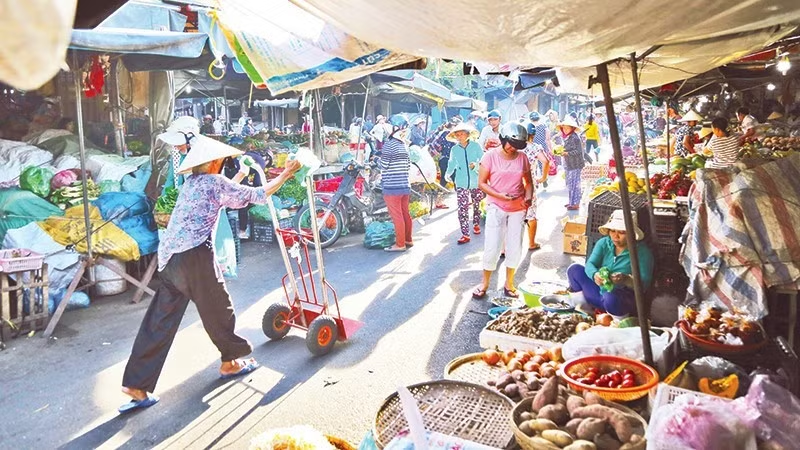
To adapt, many traditional markets across the city have begun implementing positive changes. At Binh Tay Market, a historic landmark in Cho Lon, vibrancy has returned through tourism, culinary, cultural, and evening activities. One notable initiative is the programme “Touching the Past – Binh Tay Market”, featuring lion dances, traditional drum performances, food experiences, and handicraft activities for visitors.
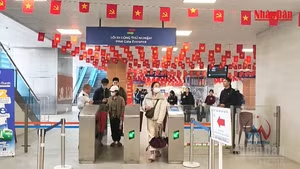
Similarly, at Tan Dinh Market in the former District 1 area, the programme “Cultural Experience – The Tan Dinh Signature” invites local and international visitors to explore unique cultural features while shopping for products with clearly displayed prices and transparent origins. At Ben Thanh Market, in addition to successful livestream sales by traders, the market has also been attracting more visitors since Metro Line No. 1 commenced operations.
Despite these encouraging developments, significant challenges remain in restructuring and improving the adaptability of traditional distribution channels. Le Truong Son, Deputy General Director of the Ho Chi Minh City Union of Trading Cooperatives (Saigon Co.op), noted that one of the biggest obstacles is the fragmented nature of many markets and the lack of clear investment planning, which discourages organisations from participating in restructuring or making long-term financial commitments. To realise their full potential, markets require the involvement of professional operators and restructuring aligned with modern urban planning.
Son proposed dividing markets into two main categories. The first would consist of multifunctional markets such as Ben Thanh, Binh Tay, and Tan Dinh, serving shopping, tourism, and cultural purposes. The second would comprise community markets that meet essential daily needs, particularly for workers and lower-income groups.
He emphasised that upgrading infrastructure has become an urgent priority, as many traditional markets have deteriorated over time. In addition, authorities need to strengthen food safety standards and improve product quality management. Flexible digital transformation for traders, greater use of technology, and the modernisation of business practices should become an integral part of trading activities in traditional markets.