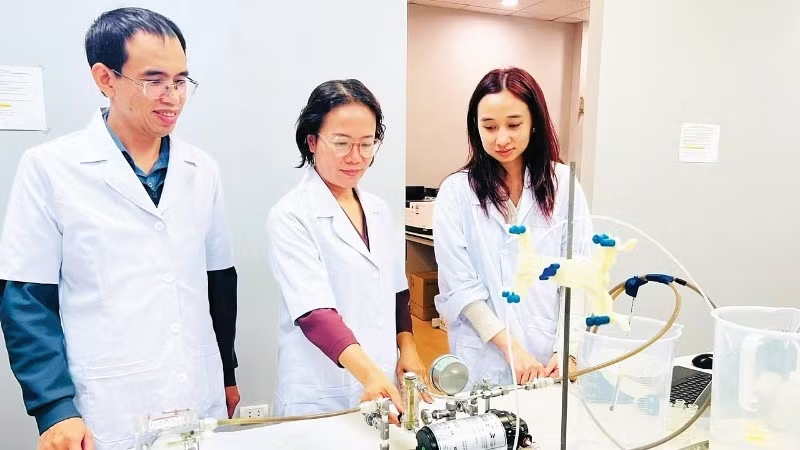
According to Nguyen Thi Minh Huong, Vice President of the Viet Nam Women’s Union, a new feature of the 2025 Kovalevskaia Award compared to previous years is that the collective prize was presented to groups of scientists working within a shared research cluster. The award-winning collectives and individuals have all recorded outstanding achievements in scientific research and in educating and training younger generations. Their works also demonstrate high applicability and bring tangible benefits to daily life, including projects aimed at enhancing the value of Vietnamese agricultural products and treating wastewater.
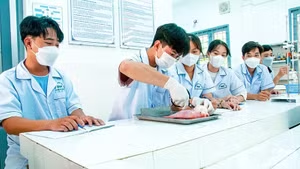
Receiving the 2025 Kovalevskaia Award for the research cluster titled “Application of biocatalysts to enhance the value of Vietnamese agricultural products,” female scientists from the Faculty of Food Science and Technology and the School of Chemistry and Life Sciences under Ha Noi University of Science and Technology shared that each research achievement serves as a driving force for creative thinking, especially in what they describe as a “discipline of happiness.”
“We are fortunate to work in the field of food, one of the most essential areas of daily life. Our research stems from specific local needs and real-world challenges faced by enterprises. We have published hundreds of scientific papers at home and abroad, including more than 70 works within the research cluster ‘Application of biocatalysts to enhance the value of Vietnamese agricultural products’, which have been acknowledged by the scientific community,” Associate Professor Dr Vu Thu Trang said.
The group’s projects focus on innovation in production improvement and the development of new products aligned with global trends, based on Vietnamese raw materials. Their work promotes sustainable production through two main directions: applying enzymes and microorganisms to create health-beneficial products, and utilising by-products from the food industry to achieve zero-waste production. Dr Do Thi Yen said the research team is developing core technologies, identifying solutions to improve the quality of raw materials, processing key agricultural products, and transferring technologies to modern production lines.
With research closely aligned with Viet Nam’s practical needs in environmental protection, energy security and climate change adaptation, Professor Dr Tran Thi Viet Nga, a leading expert in water and wastewater treatment, was honoured as an individual award recipient.
With more than 25 years of experience, she has established herself as a prominent scientist in infrastructure and environmental engineering in Viet Nam and the region. She emphasised that water and wastewater management today goes beyond treating polluted water for safe supply and environmental protection; it also requires maintaining the balance of the natural water cycle to ensure sustainable use of water resources.
Over the years, Professor Nga has focused on developing and improving water and wastewater treatment technologies to achieve high efficiency and suit Viet Nam’s conditions, while promoting sustainable water and waste management, ensuring energy security and adapting to climate change. She has concentrated on researching and mastering membrane technologies in water and wastewater treatment, notably anaerobic membrane bioreactor (anMBR) technology; refining and optimising anaerobic processes to improve the biological breakdown of organic matter, while unlocking the potential for resource recovery and the generation of value from waste streams.
Through persistent efforts, she has carried out 21 science and technology projects at various levels, serving as principal investigator for 14 of them. She is currently leading an international project for the 2023–2028 period to develop water supply systems adaptable to polluted water sources in Viet Nam.
Sharing her achievements, Professor Nga said: “I have always strived to achieve meaningful outcomes in research, with practical applications that benefit the community. I feel fortunate and happy to pursue a career in scientific research that I truly love.”