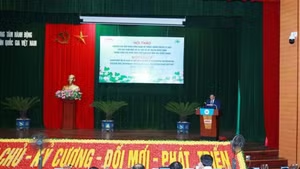
“Only young people can rapidly and effectively drive digital transformation,” emphasised Pham Anh Tuan, Chairman of the Gia Lai People’s Committee. This vision shapes the province’s approach to digital transformation movement, one that places citizens at its centre and youth at the forefront.
An extended arm of digital government
Backed by strong provincial government commitment, the Community Digital Technology Teams model in Gia Lai was officially launched and has quickly proved its worth. A total of 135 teams have been established across all communes and wards, each comprising 15 to 20 members, mostly young people.
Operating under the guidance of local People’s Committees and in coordination with the police, mass organisations, telecom providers, and community groups, these teams have become a true grassroots arm of digital government.
A notable example is Quy Nhon Ward, one of the province’s leading areas for digital transformation. Its 20-strong Community Digital Technology Team runs a rotating duty schedule at the Public Administrative Service Centre, offering residents daily support in navigating online public services. The team also makes proactive household visits to help residents activate their VNeID accounts, particularly the elderly and those unfamiliar with digital tools
Nguyen Huynh Gia Hao, a team member, said: “With the team’s support, residents feel much more confident about asking how to use smartphones. After just one guided session, many are able to pay bills or access online public services on their own.”
Youth members also work alongside the police in door-to-door campaigns to install and activate electronic ID accounts, and coordinate with banks to organise training sessions on digital payments. They also help farmers and small traders set up e-commerce accounts and standardise QR codes linked to the origin of local speciality products.
Senior Lieutenant Doan Le Minh Hoang, an officer from the Pleiku Ward Police, noted: “Going forward, the team will continue to identify residents who have not yet engaged with technology, organise small-group training sessions, and create online neighbourhood groups, helping to build digital awareness and skills while strengthening public security in the area.”
Digitalisation delivering tangible results
What sets Gia Lai apart is its use of specific, measurable targets, regularly tracked through a transparent KPI system. These include: all communes and wards maintaining active digital technology teams; at least three community support sessions being held at service points each month; at least 80% of local adults having achieved basic digital skills; and between 95% and 100% of residents having activated and actively using Level 2 VNeID accounts.
Support has been tailored to the needs of each community. As a result, digital transformation in Gia Lai has moved beyond surface-level rollout to become woven into the fabric of daily life: online services are reaching households, paperless and cashless transactions are becoming commonplace, and residents are gradually building digital habits of their own.
The province has also integrated digital skills training into community outreach sessions, spreading knowledge about the digital world, online safety, and fraud prevention to all segments of society through accessible, easy-to-understand formats. Some areas have even developed bilingual materials for ethnic minority communities.
Nguyen Thi Vi Vi, Secretary of the Quy Nhon Ward Youth Union, said: “Digital transformation training is not limited to meeting halls. Platforms such as Zalo, Facebook, and local broadcasting systems are also used to provide regular updates and guidance as well as answers to residents’ questions. This allows emerging issues to be addressed quickly and ensures people receive information in a timely, responsive way.”

According to Ro Mah Gan, Secretary of the Youth Union chapter in Op Village, Pleiku Ward, one of the most notable aspects of digital transformation is how quickly information can now be shared, with Zalo groups and community pages becoming two-way communication channels between authorities and residents.
Gia Lai has selected 30 exemplary communes and wards to serve as models for science, technology, innovation, and digital transformation. These localities receive greater resource investment and are held to higher standards across digital public services, digital skills, data management, community initiatives, and information security.
By 2030, all 30 are expected to meet ‘core standards’, sharing lessons learned and best practices, inspiring other localities to follow suit, and ultimately helping to build a sustainable digital society network across the province.
Numerous innovative models have been introduced. These include ‘One Digital Skill per Week’, which uses youth pages and Zalo groups to share knowledge and offer tailored online guidance; extracurricular sessions on fraud prevention for school students; and competitions like ‘Youth Livestream Sales’, which help agricultural and OCOP products reach wider audiences via e-commerce platforms, giving the local digital economy a meaningful boost.
Pham Hong Hiep, Secretary of the Gia Lai Youth Union, said: “Beyond supporting public administration, digital skills training, or fraud prevention, young people in Gia Lai are increasingly taking the lead in building a community digital economy, introducing new approaches to production, and bringing digital habits and an innovative spirit into every home, especially in remote, disadvantaged, and ethnic minority areas.”
The Community Digital Technology Team model, the ‘Digital Literacy for All’ movement, the core commune initiatives, and the many youth-led innovations in Gia Lai offer a compelling model for other localities in the country’s broader digital transformation journey, one where innovation starts with awareness, with people, and with community.