In line with policies promoting innovation in agriculture, the spirit of Resolution 57 and the net zero target are steadily being realised in the fields themselves.
Transforming barren land
During a field trip to Dak Lak, we came to understand local farmers’ need for inputs that are affordable yet effective in promoting fruit tree health, benefiting both their crops and their livelihoods. The adoption of new biotechnology has helped address this challenge.
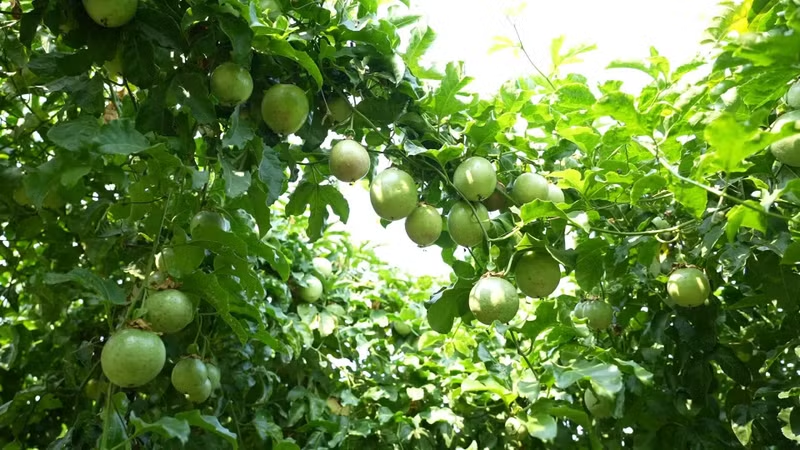
Under the harsh Central Highlands sun, the passion fruit trellises of Dau Chi Thanh, Head of the Dak Lak Ecological Agriculture Cooperative, stretch across the hillside in a soothing expanse of green. Clusters of fruit hang and sway in the breeze, their glossy skins brimming with life.
Reaching this point has been a long and determined journey for Thanh, one built on implementing clean farming models and researching sustainable soil improvement methods. On once rocky, barren land where only casuarina trees could survive, his passion fruit vines now grow lush across the hillsides.
Gardens that once yielded poorly, producing small and unattractive fruit, have undergone a remarkable transformation thanks to new biotechnology. Just three months into the season, passion fruit can be harvested continuously in successive rounds, with daily yields reaching several hundred kilogrammes.
On a 1.5-hectare plot, Thanh spends only around 40 million VND (approximately USD 1,500) on labour, just a quarter of the cost at some other farms. He noted enthusiastically that by using organic biological products, labour costs have dropped by 70%, while pesticide use has also been reduced by around 70%. On some days, he harvests three to four tonnes of fruit, with his revenues rising by 50-60% – truly remarkable figures.
“With prices ranging from 60,000 to 100,000 VND per kilogramme, revenues of hundreds of billions of dong from passion fruit are no longer far-fetched,” he said with a broad smile.
Currently, Thanh’s passion fruit model spans dozens of hectares and continues to expand to hundreds more across Dak Lak. In the near future, he plans to share this technology with several farms in the Van Hoa plateau area of Phu Yen Province, now part of Dak Lak Phu Yen.
He emphasised that his approach is to proceed steadily, ensuring quality control and developing sustainable market channels. His goal is not rapid growth, but growth with lasting impact.
“In agriculture, sustainable development requires the broader application of biotechnology, supportive mechanisms to ease farmers’ transition, and clear standards for clean produce. Most importantly, there must be a shift in mindset from 'doing more' to 'doing it right',” he said.
He has observed that once farmers gain a proper understanding, they adapt very quickly. When they see real results, they naturally share the experience with others.
“I value Bo De Group not just for selling products, but for enriching farmers’ knowledge. I do not farm to prove my own ability, I do it to show that Vietnamese farmers can produce clean, sustainable, high-value products,” he added.
Ta Van Thang, a representative of Bo De Group in Lam Dong, noted that when this new biotechnology was first introduced, farmers were sceptical. However, results from an agritourism strawberry farm open to on-site visitors have proven highly rewarding for its owner.
He explained that strawberries typically require frequent spraying, especially during the rainy season. Yet by using Bo De organic biological products, Nguyen Van Loc’s farm in Xuan Truong Ward, Lam Dong Province has significantly reduced pesticide use, allowing visitors to pick and eat fruit directly on the farm, a much safer experience for tourists.
“On a 1,000-square-metre plot, farmers previously spent around 10 million VND annually on fertilisers and pesticides. By switching to these biological products, costs have fallen by half,” Thang said.
Beyond cost savings, the products also extend crop lifecycles from five months to seven-nine months for tomatoes, and from 1.5 years to over two years for passion fruit, while reducing pest and disease incidence by up to 60-70%. As a result, the produce offers both higher yields and cleaner quality, contributing to environmental protection and public health.
From policy to practice in greening agriculture
One of the key tasks outlined in Resolution 57 is to promote international cooperation in scientific research and technological development with countries at the forefront of science and technology, particularly in fields such as artificial intelligence, biotechnology, quantum technology, semiconductors, nuclear energy and other strategic technologies.
To implement the resolution on biotechnology and remain committed to greening agriculture, scientists and Bo De Thinh Vuong Group Joint Stock Company (formerly Bo De Seafood Group) have chosen to partner with export enterprises to establish stable raw material supply zones, systematise production, and develop safe agricultural value chains serving both domestic and international markets.
During visits to farms undergoing transformation through the use of organic biological products, Nguyen Thi Hang, Chairwoman of Bo De Thinh Vuong Group, said that over the past 17 years, the group has persistently pursued the development of innovative biotechnology products to support farmers and advance green, clean agriculture in pursuit of net zero.
She noted that human life is measured in breaths, and that protecting the environment and regenerating the soil are therefore fundamental to long-term development. The group’s goal is to equip farmers with the knowledge they need to stand on their own two feet and develop professional farming practices.
“Currently, the Government, the Ministry of Agriculture and Environment, and the National Agricultural Extension Centre are working together to promote a nationwide programme to professionalise farmers. This is also the path we are on, bringing knowledge to farmers and supporting them along the way,” she said.
The implementation of Resolution 57 is opening a transformative path for Viet Nam’s agriculture. It not only highlights biotechnology as a pillar of innovation but also aims to build a green, circular agricultural system that reduces dependence on chemicals and traditional inputs. This provides a foundation for pioneering models such as Bo De Group and leading cooperatives to shift from experience-based production to farming driven by science, data and standards.
In particular, in pursuit of the 2050 net zero target, agriculture is gradually transforming from a major emissions source into a carbon sink through soil regeneration, reduced emissions from chemical fertiliser use, and optimised crop lifecycles.
With the widespread application of biotechnology, each farm not only produces clean food but also helps address environmental challenges, enhances export value, and brings Viet Nam’s agriculture closer to global green standards.
Looking out over gently sloping hills covered in lush, vibrant passion fruit vines, Dau Chi Thanh reflected that farmers who have depended on the land for generations have hoped for more than 20 years for stronger government support in mainstreaming biological products in agriculture. Only then, he believes, can the soil truly sustain plant life over the long term.
In the journey to enhance farmers’ knowledge, scientists emphasise that the goal is not merely higher yields or lower costs, but a fundamental shift in how people treat the soil – as a living resource that must be nurtured. Experts note that the 2050 net zero goal presents both a challenge and an opportunity for Vietnamese agricultural products to increase their value and secure a place on the global green agriculture map through breakthroughs in biotechnology.
As evening falls over the Central Highlands, golden sunlight bathes the lush green trellises stretching across the hillsides. The joy in Thanh’s eyes and those of the other farm owners deepens the confidence of the scientists and enterprises developing organic biological products.
Their shared journey to heal the soil is, in essence, a journey to heal their own lives through safe, clean food grown from their own land.