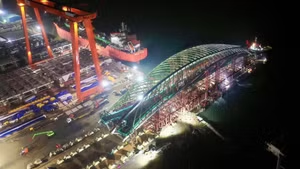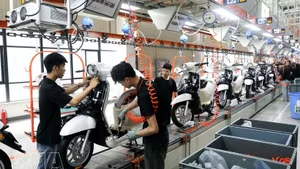
This group is identified as the core force, playing a leading role in driving the development of the capital’s industrial sector.
Key industrial firms are not only asserting their position through product quality and brand strength but are also making an increasingly significant contribution to Ha Noi’s socio-economic growth.
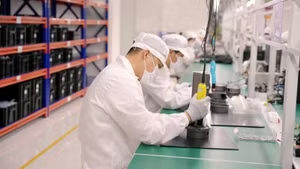
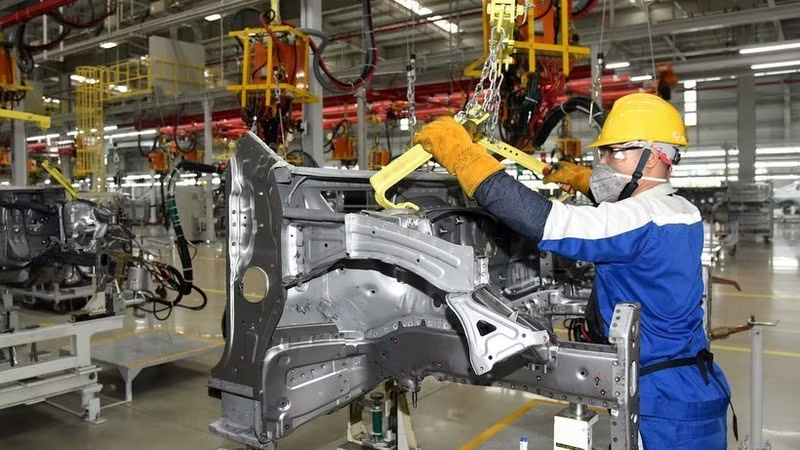
At present, the city has 107 businesses with 199 products recognised as key industrial products. These companies are relatively large in scale, with stable production capacity, strong competitiveness, and good international integration capability, creating a powerful spillover effect across the industrial sector.
The figures underline the importance of this segment. Each year, the businesses producing key industrial products generate nearly 200 trillion VND in revenue, accounting for around 35% of the city’s total industrial output value. Export turnover stands at nearly 2 billion USD, while providing stable employment for around 80,000 workers. This is an important foundation for Ha Noi to promote industrial development in a modern and sustainable direction.
To help businesses expand their markets, the city has been intensifying trade promotion, product promotion, supply–demand matching, and partner search activities.
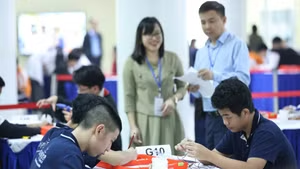
Since 2022, annual trade fairs and exhibitions featuring key industrial products have been held regularly, becoming a large-scale trade promotion channel that helps businesses reach new markets, broaden partner networks, and increase orders.
In 2025, the Ha Noi Key Industrial Products Fair and Exhibition will continue with its next edition, bringing together more than 200 businesses with hundreds of booths from many localities nationwide along with several countries. The event not only creates opportunities to promote brands, but also enables firms to access new technology solutions, trends in green and smart manufacturing, and digital transformation, thereby increasing added value for products.
However, alongside these advantages, key industrial firms are also facing a range of challenges. Pressure to innovate in technology, automation, and digital transformation, along with increasingly stringent standards in international markets, poses major questions around financial resources, access to high-end technology, and, in particular, high-quality human resources.
In practice, a gap remains between training and businesses’ labour needs. Many young workers lack hands-on skills, foreign-language competence, and familiarity with modern production lines, forcing companies to invest time and money in retraining. In a context of global competition, this is a “bottleneck” that must be addressed soon if firms are to embed more deeply in supply chains.
From this reality, Ha Noi is promoting linkage models between businesses and training institutions, moving towards demand-driven training aligned with the actual needs of the labour market. Strengthening cooperation in training, internships, applied research, and technology transfer is seen as a fundamental solution towards building a highly skilled workforce capable of mastering technology and adapting quickly to the requirements of modern production.
Over the long term, a co-ordinated approach combining trade promotion, support for technological innovation, and human resource development will provide the foundation for key industrial firms to truly act as pacesetters, leading the capital’s industrial sector. As they participate more deeply in global value chains, these companies will not only enhance their own competitiveness but also help strengthen Ha Noi’s position as a major industrial centre of the country.