Deputy Prime Minister Pham Thi Thanh Tra signed Prime Minister Decision No. 1116/QD-TTg, dated June 22, 2026, amending and supplementing Decision No. 1579/QD-TTg, dated October 13, 2020, approving the Programme on Healthcare for the Elderly through 2030.
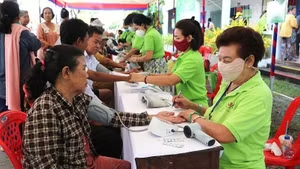
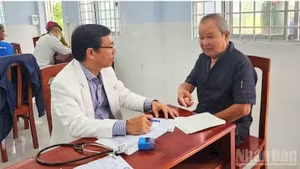
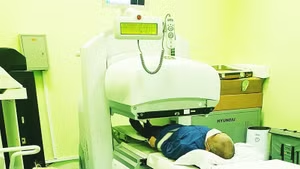
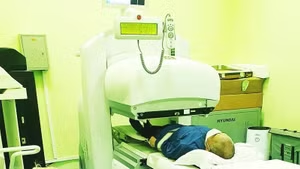
Under the new regulations, from 2026, older people are entitled to at least one free periodic health check-up each year. Every commune, ward, and special zone must have at least one club for the care of older people, with the proportion of daytime care facilities for older people reaching at least 20% by 2030. By 2030, 100% of provinces and centrally governed cities are expected to have either socialised care facilities for older people, a geriatric hospital, or a general hospital with a geriatric department.
In addition, the government has issued Decree No. 168/2026/ND-CP, detailing a number of articles and implementation measures for the 2025 Population Law, which takes effect from July 1, 2026.
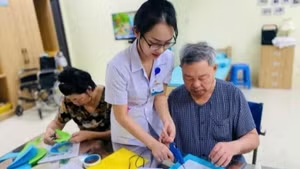
Particularly noteworthy is the community-based care model for older people, operated under commune-level health stations in the form of "leave in the morning, return in the evening", which aims to provide care for older people within their local communities. Older people will be able to socialise, participate in cultural, artistic, and sporting activities, practise health-enhancing exercises, and receive guidance on self-care skills and disease prevention.
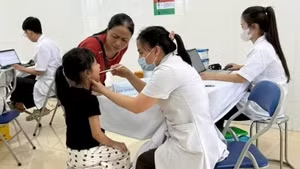
In Ha Noi, Long Bien Ward is the first locality to pilot the "Daytime Health Care Centre for Older People" model. After nearly one month of operation, the centre has welcomed more than 280 visits for tours and trial experiences, while 18 people have registered as regular participants. The facility has also conducted 280 health monitoring sessions; updated 280 electronic health records; organised dozens of sessions in health-enhancing exercises, yoga, and rehabilitation; and served hundreds of nutritionally balanced daytime meals. During the day, older people receive care in a safe environment, are monitored by healthcare staff, and participate in activities suited to their physical condition before returning home to their families in the evening.
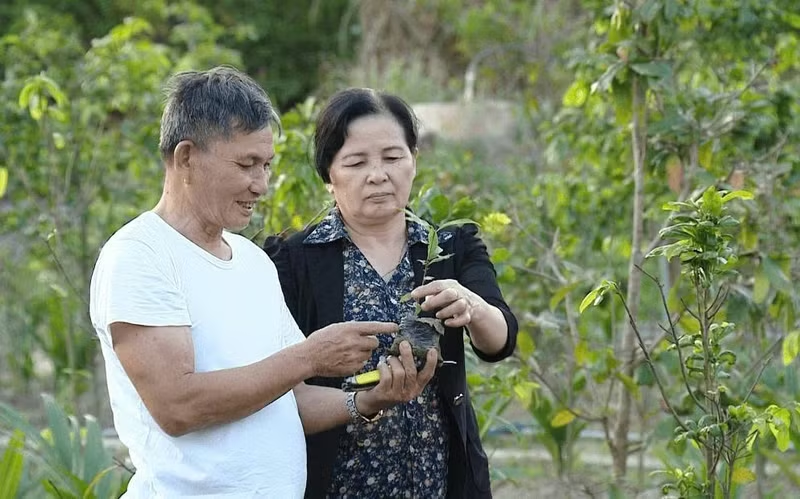
Nguyen Thi Mui of Long Bien Ward is 82 years old. Previously, while her children were at work each day, she stayed at home alone and had to take care of herself. With advancing age and declining health, she has not only faced difficulties with daily activities but also frequently felt lonely because she had no one to talk to. Since her children began taking her to the daytime healthcare centre, she has received dedicated care from the staff and has had opportunities to socialise with many other older people. As a result, she has become much happier and more relaxed. Mr Nguyen Van Ha, Mrs Mui's son, shared that he used to worry constantly whenever his mother was home alone, making it difficult for him to concentrate at work. Since taking her to the ward's daytime healthcare centre, however, he and his family have felt greatly reassured.
Unlike residential care, the "leave in the morning, return in the evening" model enables older people to receive health monitoring and professional care while continuing to live with their families. Vu Thu Ha, Vice Chairwoman of the Ha Noi People's Committee, said that greater attention should be paid to healthcare for older people. The daytime healthcare facility in Long Bien Ward has already demonstrated positive initial results. In the coming period, the city will standardise its name as the "Older People's Care Model", with the goal of helping older people live happily and healthily. The Vice Chairwoman also requested relevant units to continue operating the model, review and refine its mechanisms and procedures, and complete a practical evaluation during July before expanding it on a larger scale.
Many other provinces and cities across the country are also simultaneously stepping up efforts to care for older people. Most localities are converting surplus public buildings into care facilities. To improve the living conditions of older people without pensions or with low incomes, amid continuing increases in living costs, the Ministry of Health has proposed that the government consider adjusting and increasing the level of the social retirement allowance. The Ministry of Home Affairs is currently seeking public comments on a draft law amending and supplementing several articles of the Law on Social Insurance. Under the new proposal, the eligibility age for receiving this benefit could gradually be reduced to 70 years old, creating greater opportunities to strengthen social security for older people in the coming years. In addition, recipients of the social retirement allowance will be provided with free health insurance cards and will also recieve funeral expense support upon their death.