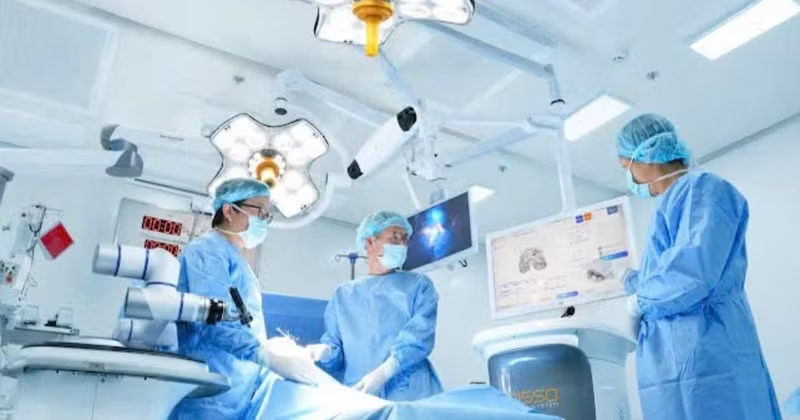
Viet Nam's healthcare sector has made significant progress in specialised fields, mastering numerous advanced techniques and technologies. Notably, although introduced later than in some other countries, robotic surgery is now facing a breakthrough opportunity thanks to policies promoting specialised healthcare development and digital transformation, together with the growing healthcare needs of the population.
In recent years, many leading hospitals have deployed robotic surgery systems for clinical treatment. Most recently, doctors at K Hospital successfully performed a robot-assisted endoscopic oesophagectomy and reconstructive surgery for 66-year old patient Nguyen Hai B from Thuan Trung Commune, Nghe An Province.
This was a complex case requiring absolute precision because the tissues surrounding the oesophagus had become severely fibrotic following chemotherapy and radiotherapy, presenting several clinical challenges for the surgical team. The doctors therefore decided to employ a robot-assisted endoscopic surgical system.
Equipped with a high-definition 3D camera providing magnified, high-resolution images and highly flexible robotic arms, the surgeon was able to accurately access and completely dissect lymph nodes in difficult areas. The operation was successfully completed, ensuring complete cancer resection while providing maximum safety for the patient.
Ha Noi Medical University Hospital has also recently inaugurated and put into operation a new-generation robotic surgery system. Thanks to its advanced technological platform, doctors can perform procedures with greater dexterity and precision, supported by clear anatomical visualisation that overcomes the limitations of conventional laparoscopic techniques. At the hospital, the robotic system is used in urological, gynaecological, general, thoracic and vascular, cardiovascular and gastrointestinal surgeries.
Recently, the Vinmec Healthcare System officially inaugurated its High-Tech Robotic Surgery Centre, featuring advanced robotic surgical platforms in general surgery, orthopaedic trauma, and neurosurgery-spinal surgery. According to Vinmec, the system's most distinctive feature is that it is the first and only multi-connected robotic ecosystem model in Viet Nam.
In addition to its advanced technological ecosystem, Vinmec is also the pioneer in developing the "3-in-1" robotic surgery model: personalised, automated and standardised. Patients receive an individualised treatment plan based on 3D imaging and simulation before surgery; are supported by an AI-integrated robotic ecosystem during surgery; and benefit from treatment processes that comply with international standards in training, research and clinical practice.
Professor, Doctor, Physician Tran Trung Dung, Chief Executive Officer of the Vinmec Healthcare System, said that the High-Tech Robotic Surgery Centre network has been developed using a multi-connected model, bringing together specialists, hospitals and leading global technology partners within a single ecosystem.
This marks an important step towards bringing the world's advanced medical achievements closer to the Vietnamese people, while laying the foundation for Viet Nam to gradually become a new regional centre for robotic surgery and high-tech medical treatment in Southeast Asia.
However, medical experts emphasise that no matter how modern or advanced robotic technology becomes, it is not a miracle capable of replacing doctors. It is merely a tool that enables surgeons to operate with greater precision and efficiency.
Professor, Doctor Tran Van Thuan, Deputy Minister of Health and Chairman of the National Medical Council, commented that the inauguration of the High-Tech Robotic Surgery Centre by the Vinmec Healthcare System is not merely the introduction of another advanced technology into medical examination and treatment, but also demonstrates the aspiration to master knowledge, technology and advanced treatment standards for the benefit of Vietnamese patients.
Robotic surgery represents an important advancement in modern medicine, but it cannot replace the role of physicians. Rather, it serves as a support tool that enables doctors to improve treatment accuracy and effectiveness. Robotic technology can only truly realise its value when operated by doctors with strong professional expertise, medical ethics and scientific thinking.
In modern surgery, the value of technology lies not in the complexity of the equipment, but in the tangible benefits it delivers to patients: more precise interventions, less invasive procedures, faster recovery and greater opportunities for a better quality of life. Every indication for robotic surgery must be based on scientific evidence, rigorous professional protocols and the most appropriate choice for each individual patient.
Thuan stated that the Ministry of Health will continue to improve the legal framework, professional guidelines and a transparent, favourable regulatory environment to support research, technology transfer and the application of advanced medical techniques in healthcare. However, innovation must always go hand in hand with good governance, compliance with the law, protection of patients' data, and adherence to the principles of safety, quality and effectiveness.