One of the key objectives set out in Politburo’s Resolution No.72-NQ/TW, dated September 9, 2025, is that from 2026, every citizen will be entitled to at least one free annual health check-up or screening examination and will have an electronic health record established to enable lifelong health management.
This is a social welfare policy of profound humanitarian significance, clearly reflecting the Party's and the State's consistent commitment to placing people at the centre of development. By ensuring regular health examinations for every citizen and digitalising personal health records, the healthcare system will be better equipped to manage public health more effectively, shifting from a reactive model to one focused on forecasting, prevention and early intervention. This will help reduce healthcare costs while improving people's quality of life and life expectancy.
As one of the country's leading economic, cultural, scientific and healthcare centres, Ho Chi Minh City has issued Action Programme No.08-CTrHD/TU, dated March 2, 2026, to implement Politburo’s Resolution No. 72-NQ/TW with strong political determination to realise the goal of providing every resident with at least one free annual health check-up, beginning in 2026.
The city's healthcare system currently comprises 170 hospitals and medical centres, 168 community health stations, approximately 12,000 private clinics, and more than 48,000 hospital beds. Every year, healthcare facilities receive more than 51 million outpatient visits and provide over 3.8 million inpatient treatments. However, with a population of nearly 15 million, achieving universal free annual health check-ups within 2026 requires the coordinated efforts of the entire political system.
With a firm commitment to delivering tangible results, the Standing Board of the Ho Chi Minh City Party Committee, together with the Secretary of the Municipal Party Committee, the People's Council and the People's Committee, has exercised decisive leadership through swift action, clear assignment of responsibilities and performance-based evaluation.
The city has formulated and launched the “Universal Health Check-up and Screening Programme for 2026–2030 period” based on a systematic and scientific approach, clearly defining objectives, implementation timelines, resources and the responsibilities of each agency, unit and locality under the principle of "clear person, clear task, clear timeline, clear responsibility and clear outcome."
The programme aims to ensure that 100% of residents living in the city's 168 wards, communes and special administrative zones receive at least one free health check-up annually. Implementation began on May 25 and is scheduled for completion no later than December 31, 2026.
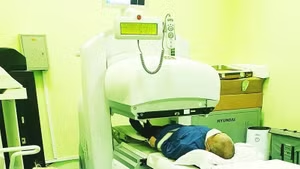
Ho Chi Minh City has allocated an estimated 2.5 trillion VND to finance the programme during 2026. To mark the National People's Health Day 2026, the city simultaneously launched free specialist health screening programmes across the city with the participation of 60 hospitals.
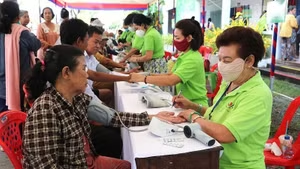
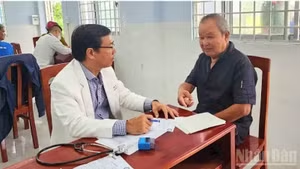
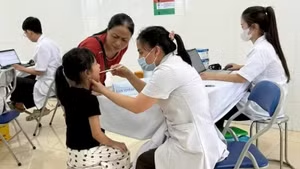
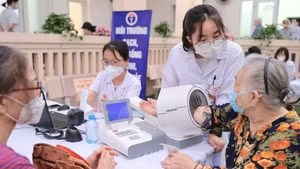
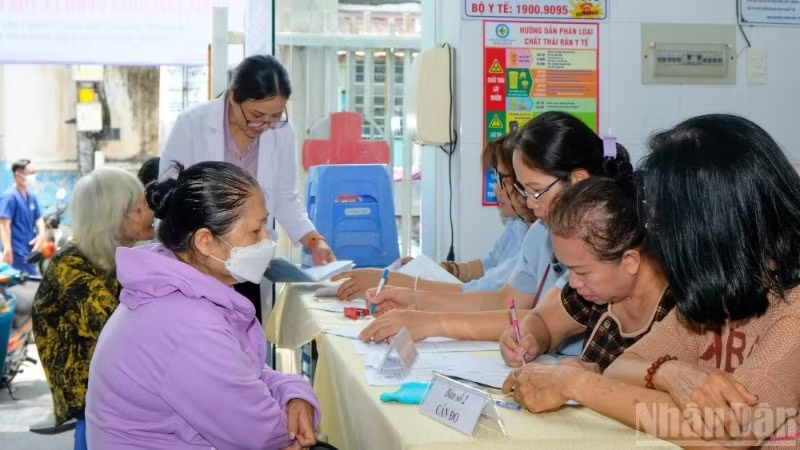
On April 17, the universal health check-up programme was officially launched across all 168 wards, communes and special administrative zones, with the participation of more than 100 hospitals. Within just the first ten days, the programme recorded more than 162,000 medical examinations. According to Director of the Municipal Department of Health Tang Chi Thuong, the initial results demonstrate the city's strong determination to fulfil its universal health screening target while confirming that the initiative is not a short-term campaign but the foundation for a sustainable, long-term community health management system.
A notable feature of Ho Chi Minh City's approach is its strong emphasis on digital transformation and the adoption of electronic medical records. To date, 163 out of 164 hospitals have successfully implemented electronic medical records. Health data have already been updated for nearly 1.9 million schoolchildren, while health screening records have been established for more than 600,000 elderly people.
The health sector has also organised professional training through approximately 400 virtual training sites to standardise examination and screening procedures and achieve the goal of establishing electronic health records for the entire population during 2026.
To further improve primary healthcare services, the city has allocated specialised medical resources to its most remote areas, implemented rotational deployment of specialist doctors from higher-level hospitals to grassroots facilities, and expanded flexible models for health examinations. In addition to services provided at healthcare facilities, mobile health check-up teams have been deployed to schools, enterprises and residential communities.
The "continuous healthcare team" model, piloted in 13 wards and communes, has produced encouraging results. After more than two months of implementation, thousands of residents have received home visits from medical teams for health examinations, consultations and follow-up care.
The experience of Ho Chi Minh City demonstrates that the Party's policy has been translated into concrete action through strong political commitment, comprehensive solutions, decisive leadership, rapid implementation, clearly assigned responsibilities and a steadfast focus on measurable outcomes.