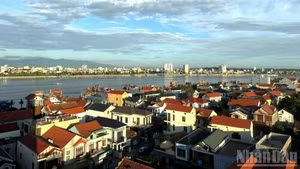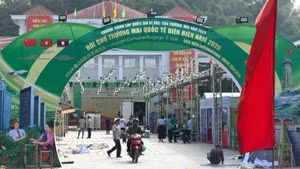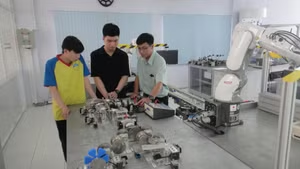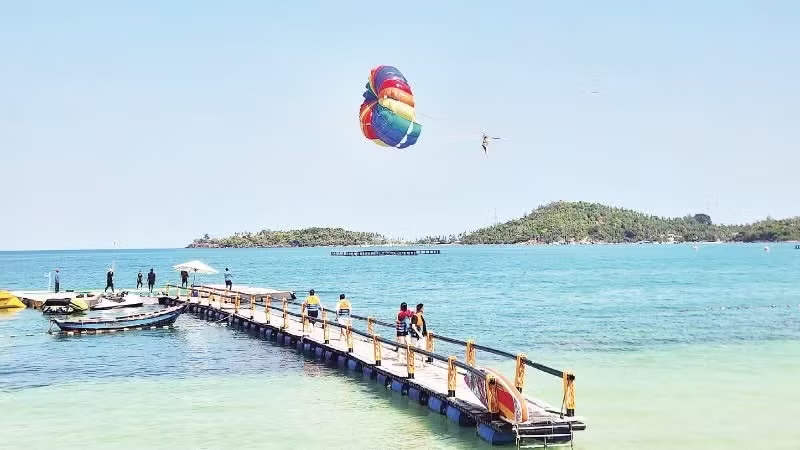
With modern thinking and a shared aspiration for progress among both authorities and residents, the image of a prosperous, modern island region is gradually taking shape, earning Kien Hai a place on the national tourism and fisheries map.
Kien Hai Special Administrative Zone (formerly Kien Hai District) was established on January 14, 1983 and covers more than 3,350 sq km, including over 3,325 sq km of sea and 24.75 sq km of natural land, with a population of nearly 23,000. It extends along a sweeping axis comprising 23 islands that span over 90 km.
Awakening a green paradise
It was not easy for us to secure ferry tickets from Rach Gia to the Nam Du archipelago. A staff member from the Superdong high-speed ferry agency explained: “At this time of year the sea is calm and with the holidays approaching, tickets are fully booked two days in advance. On weekdays there is only one fixed round trip; at weekends there are two, but they are almost always sold out.”
The scarcity of tickets is the clearest testament to the powerful appeal of Hon Tre, Hon Son and Nam Du – places that were still remote and isolated just a decade ago.
After more than two hours at sea, Cu Tron Island in the Nam Du archipelago greeted us with a striking bustle. The Nam Du pier was crowded with passengers embarking and disembarking, with goods moving constantly. Recalling memories of a pristine island just a few years ago, we found Nam Du transformed, with rows of multi-storey houses, well-built shops and clean coastal roads.
We were greeted by Tran Van Hoang, a local man who switched from being a travelling photographer to working in tourism services in 2014, as tourism on the island began to take off.
“I work with tour operators from the mainland, taking visitors fishing, coral diving and dining on board. Tourism has significantly improved my family’s life and broadened my outlook through contact with visitors from everywhere,” he said.
Hoang took us to the memorial for victims of Typhoon Linda, located beside the Bai Chet Border Guard Station of the Nam Du Border Post, a deeply moving site commemorating the storm that struck southern Viet Nam in 1997.
That historic storm left painful scars, with hundreds dead or missing and thousands of vessels sunk. Yet, reflecting on today’s vibrancy, Lieutenant Colonel Ho Van Tam, Deputy Head of the station, said: “The island receives 400-500 visitors a day, rising to thousands at weekends. It has truly revived. Tourism growth has driven an expansion of hospitality services, creating sustainable livelihoods. That is the greatest consolation for past losses.”
Over the past five years, Kien Hai has welcomed more than 2.1 million visitors, an extraordinary figure for a small island area still facing infrastructure constraints.
From Hon Tre and Hon Son to Nam Du, visitors are captivated not only by clear turquoise waters, white sands and swaying coconut palms, but also by the rich lore of whales, revered here as the protectors of fishermen. The ceremonial burial of a whale over 13 metres long in 2017 has become a distinctive cultural landmark, deepening the spiritual dimension of tourism in the area.
If tourism is a vibrant “new garment”, then marine aquaculture is the people’s reliable “rice bowl”. Rather than relying solely on traditional wooden cages vulnerable to natural disasters, Kien Hai is transforming its cage materials and farming technology.
Mai Van Hiep is one of the pioneers of this shift. With support from the provincial Agricultural Extension Centre, he adopted HDPE plastic cages, materials known for their strength and resilience against extreme weather, to farm pearl grouper.
“These cages withstand rough seas and last for decades, so I’m confident about offshore farming. Using industrial feed instead of low-grade forage fish keeps the environment cleaner, raises survival rates to over 91%, and significantly increases profits,” he said.
Aspiring to become a second Phu Quoc
Kien Hai currently has around 215 households engaged in cage fish farming, with nearly 1,200 cages. Collective brands such as “Lai Son grouper” and “Nam Du cobia” are gradually building a national reputation.
Notably, thanks to sound policies for marine economic development, Kien Hai has eliminated poverty and achieved its goal of eliminating substandard and temporary housing.
Another encouraging sign is the growing sense of responsibility among fishermen: with more than 1,077 vessels complying with IUU regulations, Kien Hai is joining the national effort to have the European Commission’s “yellow card” lifted, moving away from destructive fishing practices toward responsible fishing, sustainable aquaculture and marine tourism.
Kien Hai’s potential goes beyond household-scale fish farming. Major corporations such as Mavin and Australis Viet Nam have conducted site surveys and received in-principle approval for large-scale industrial marine farming projects.
In the Hai Bo Dap area of the Nam Du archipelago, Mavin is implementing a sea bass farming project using advanced technologies: Norwegian cages, French feeding systems and Australian harvesting technology.
Covering about 2,000 hectares of water surface, the project aims to produce 30,000 tonnes of fish annually. The integration of automation and IoT sensors enhances productivity and addresses bottlenecks across the value chain, from breeding to export.
Despite these achievements, local leaders candidly acknowledge areas needing improvement. Tourism in Kien Hai remains largely unregulated, while transport infrastructure and waste management pose ongoing challenges. The new long-term strategy directly addresses these issues. The Party organisation has set a clear vision: to grow rich from the sea while keeping it clean and blue.
Nguyen Quoc Tuan, Secretary of the Party Committee, outlined three strategic priorities: developing services, tourism and large-scale industrial marine farming; applying science, technology and digital transformation to environmental and disease management; and building integrated infrastructure, particularly fishing ports with logistics services.
As we left Kien Hai, the words of Le Hoang Minh, a guesthouse owner in Cu Tron Village, stayed with us: “Nam Du and Kien Hai are developing, but what we long for most is access to the national power grid. With stable electricity, tourism can truly take off and a new chapter can begin for people here. We await it as we await the first rains of the season.” It is a hope shared by local authorities.
Today, Kien Hai offers not only breathtaking landscapes but also a solid social foundation, with 100% of teachers meeting professional standards, a well-funded healthcare system, and the unity of nearly 23,000 residents.
This once-rough gem is being polished to shine brighter than ever. A modern, prosperous island region in the southwest of the country is no longer a distant dream. Kien Hai is striding forward with confidence, aspiring to stand alongside Phu Quoc and propel Kien Giang’s marine economy to new heights.