Notably, the introduction of proactive vaccination represents a major shift in the approach to universal healthcare.
Preventing diseases and delivering healthcare from the primary level
Tran Dac Phu, former Director of the Department of Preventive Medicine (now the Department of Disease Prevention under the Ministry of Health), said the new Law on Disease Prevention has filled gaps in the legal framework for addressing increasingly prominent issues such as non-communicable diseases, mental health, nutrition, and lifelong healthcare.
“The greatest advance is that the law covers both infectious and non-communicable diseases, while linking environmental factors, food safety and occupational health with existing provisions in other laws,” Phu said.
By placing emphasis on early and preventive measures, the law, according to the expert, translates the concept of life-course healthcare into practice, ensuring continuity from pregnancy and childbirth through adulthood.
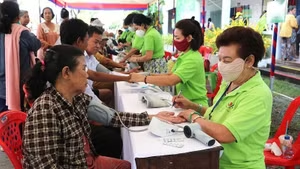
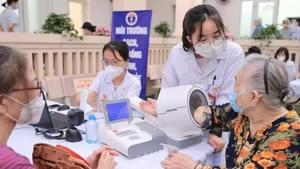
People will benefit from regular health check-ups, early detection of chronic diseases, full immunisation coverage, and monitoring of risk factors.
“These are core measures to reduce disease incidence, hospital admissions and mortality, thereby easing the burden on the healthcare system and society,” he added.
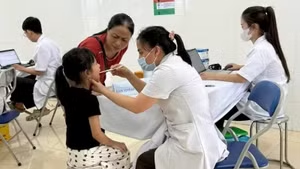
Dr Duong Chi Nam, Deputy Director of the Department of Disease Prevention, noted that incorporating proactive immunisation campaigns into the law helps strengthen community-level prevention and close immunity gaps caused by insufficient annual vaccination coverage.
“For example, with measles, the health sector is currently striving to restore vaccination rates to above 95% for all vaccines. Once this is achieved, combined with proactive immunisation campaigns, we can address the risk of measles outbreaks. Besides measles, many other diseases could also move towards elimination if vaccination coverage above 95% is maintained and immunisation campaigns are strengthened. However, any specific assessment must be based on professional data,” Dr Nam said.
The 2025 Law on Disease Prevention, recently passed by the National Assembly, introduces a new provision on disease prevention using vaccines and medical biological products.
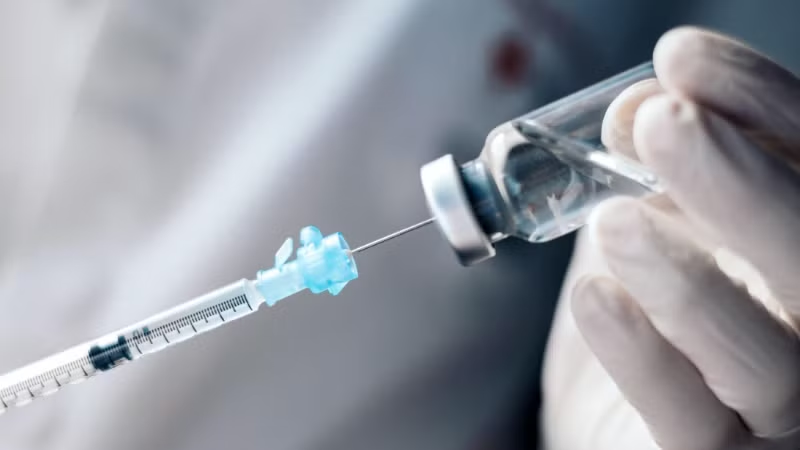
Phu explained that whereas immunisation previously referred only to vaccination, under the new regulation it will also include the administration of medical biological products for disease prevention, for example, monoclonal antibodies against respiratory syncytial virus.
Without this provision, such biological products could only be administered in treatment facilities.
Under the new rules, compulsory immunisation under the Expanded Programme on Immunisation will encompass not only routine vaccination but also catch-up doses and proactive immunisation campaigns.
Proactive immunisation campaigns involve administering vaccines even when there is a risk of an outbreak, rather than waiting until an epidemic occurs. This is essential, as it allows competent authorities to procure vaccines and biological products for immunisation even before an outbreak has emerged.
Globally, including in Viet Nam, vaccines are currently available to prevent nearly 30 infectious diseases. People need to receive vaccines through both the Expanded Programme on Immunisation and paid services, and to remain vaccinated throughout their lives.
Another notable point is that the new law does not focus solely on the prevention and control of infectious diseases, but also extends to other conditions such as cancer, mental health disorders and nutrition. This reflects a shift in the government’s approach to disease prevention.
In addition, the law places strong emphasis on vulnerable groups such as the poor and near-poor, people living in remote and disadvantaged areas, and those at high risk. These groups often face significant barriers to accessing healthcare services and are more likely to suffer severe consequences if preventive measures are inadequate.
Thus, instead of concentrating solely on the control of infectious diseases as in the past, the Law on Disease Prevention promotes a prevention-centred mindset, with treatment playing a supporting role, thereby institutionalising policies to protect public health and reduce the burden of disease.

Increasing the budget for preventive healthcare
According to Dr Nam, one of the law’s key provisions is increased budget allocation for preventive healthcare, including higher salaries for health workers. This will help strengthen the preventive healthcare system, enabling early and proactive disease prevention for the population.
Sharing this view, Phu said the State’s commitment to ensuring funding for disease prevention, rather than leaving preventive units to struggle under previous autonomy mechanisms, represents a breakthrough.
The new law’s provision for a disease prevention fund will create stable, proactive and more flexible resources to respond to epidemic risks or implement large-scale preventive programmes.
“The Law on Disease Prevention is an important foundation for Viet Nam to move decisively towards a modern healthcare model that values prevention and primary healthcare. If implemented effectively, it will help people stay healthier, reduce disease incidence, ease pressure on hospitals and lessen the economic burden on society. It is truly a necessary law with long-term significance,” Phu affirmed.
The Deputy Director of the Department of Disease Prevention also stressed that, to effectively implement the new policies, communication efforts must be strengthened to raise public awareness. At the same time, the epidemiological surveillance system needs to be reinforced, with regular updates on emerging and re-emerging diseases domestically and internationally.
In the context of population ageing, the rise of non-communicable diseases, and growing demand for comprehensive healthcare, the passage of the Law on Disease Prevention provides a crucial foundation for Viet Nam’s “Immunisation for Everyone” strategy to protect its people.