Currently, cyberspace is considered the fifth operational environment. Protecting the Fatherland early and from afar in cyberspace is an urgent task to ensure national sovereignty in the new situation.
According to Lieutenant General Le Van Hai, Deputy Political Commissar of the National Defence Academy, protecting the Fatherland early and from afar in cyberspace is a proactive strategy to prevent cyber threats, attacks, and malicious information from their inception, protecting national sovereignty and interests on the internet.
This is an urgent task, using proactive and comprehensive thinking, combining high-tech techniques with ideological struggle to maintain cybersecurity and national security.
Ensuring national sovereignty in cyberspace, promoting the development of science, technology, innovation, and national digital transformation in the new era is a pressing issue of special importance.
The Party and State of Viet Nam have implemented numerous policies and decisions to ensure national sovereignty in cyberspace, as well as various laws such as the Cybersecurity Law, the Information Technology Law, the Electronic Transactions Law, and the Telecommunications Law.
These provide a solid legal foundation for activities in cyberspace and for protecting national sovereignty and security in cyberspace.
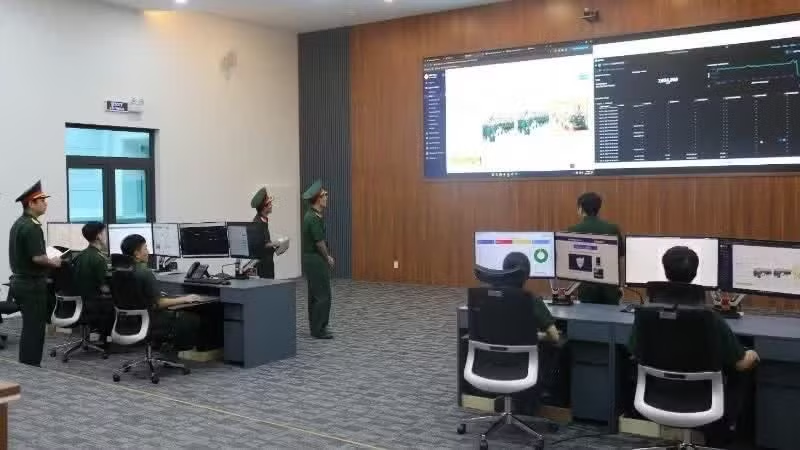
As one of the key units of the military tasked with protecting the Fatherland in cyberspace, the Party Committee of the 86th Command has effectively led and directed the implementation of solutions to build and develop a safe, healthy, and widespread cyberspace. They consistently perform well in managing, inspecting, and evaluating information security, promptly detecting and neutralising malware and spyware on military data transmission networks, preventing the leakage of military information on the internet; actively and proactively strengthening the entire military’s computer network system according to the secure network model; and regularly monitoring and promptly responding to and resolving incidents, ensuring the smooth operation of the military computer network.
Over the years, the 86th Command has developed into a force advancing straight towards modernisation. The “weapons” of the soldiers on this silent front are intelligence, monitoring software systems, and powerful defensive and counter-attack algorithms.
They not only protect the security of critical information systems of the Party, Government, and military, but also proactively conduct reconnaissance, early detection of security vulnerabilities, and attacks from international hacker groups.
Building a people’s defence posture in cyberspace is about building trust, political fortitude, and the “resistance” of the masses.
However, according to Lieutenant General Le Van Hai, no matter how modern the technology becomes, the core strength of Viet Nam’s national defence always lies in building a “people’s defence posture” in cyberspace.
This is an innovative development in the military thinking of our Party. In the online environment, where there is a lot of mixed true and false information, each citizen is a “sensor”, a “soldier” on the ideological front.
Building a people’s defence posture in cyberspace is about building trust, political fortitude, and the “resistance” of the masses. When every citizen possesses sufficient knowledge to identify fake news, proactively refute false narratives, and take responsibility for spreading positive values, we will have an impenetrable firewall. This defence is built upon raising legal awareness and safe internet usage skills among all segments of the population.
Building synergy requires close coordination between specialised forces such as the 86th Command and the Cyber Security Department, and the entire population through official media campaigns. Every citizen needs to actively work with officials and Party members to “use the good to overcome the bad”, ensuring that the mainstream of cyberspace remains filled with faith, national pride, and a strong will to succeed.