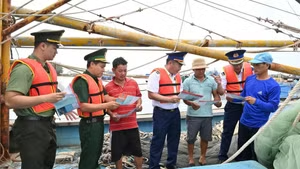
Nationwide, there are nearly 3,000 agricultural product chain linkage projects and plans, involving thousands of enterprises and cooperatives and more than 211,000 farming households. Through these linkages, farmers gain access to new science and technology, receive guidance on implementing production processes in accordance with standards, participate in training courses on production management, e-commerce and digital transformation, and connect with enterprises and markets.
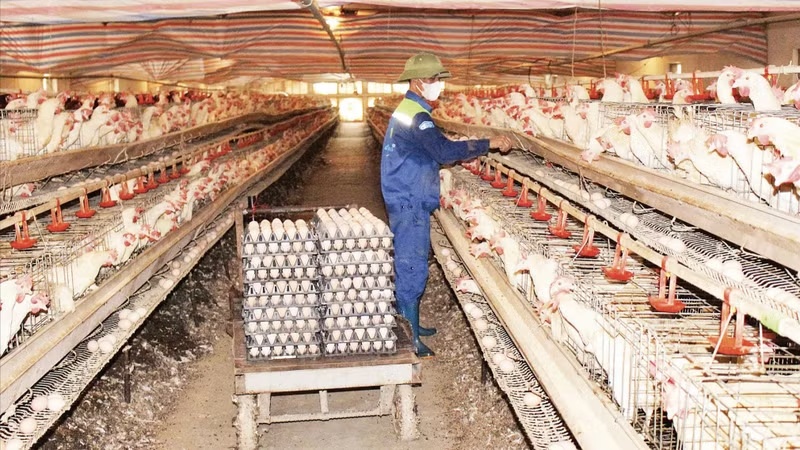
Among these, livestock farming is a highly linked sector, with 695 projects and plans, accounting for 23.7% of the total number of agricultural linkage projects nationwide. Regarding the development of national key product chains, localities have established 209 pork linkage chains and 150 poultry meat and egg linkage chains. The proportion of products produced and distributed through linkage chains with controlled food hygiene and safety quality and traceability accounts for 31% of the industry’s entire value system.
Deputy Director of the Hai Phong Department of Agriculture and Environment Vu Ba Cong said that the city has a total pig herd of more than 610,000 and a poultry flock of more than 26.1 million, with production value reaching more than 13 trillion VND in 2025. The city has 18 concentrated livestock farming areas, around 200 efficiently operating farms and 100 establishments certified as disease-free. To date, many enterprises, cooperatives and livestock farming households in the locality have participated in linkage chains covering production, slaughtering, processing and product consumption, contributing to increasing the incomes of livestock farmers.
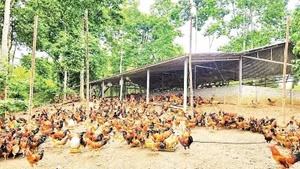
Chairman of the Board of Directors and Director of Chieu Vien Agricultural Cooperative in Chan Hung commune, Hai Phong, Nguyen Van Chieu said: “The cooperative is currently raising 10,000 laying hens and has established a linkage to purchase eggs from 15 households, supplying between 40,000 and 43,000 eggs to the market each day. As the egg products have traceability, they are trusted by consumers, helping improve production efficiency.”
Son La province has six cooperative unions, 825 agricultural cooperatives and many enterprises and establishments directly involved in agricultural production and exports. With these advantages, the province has encouraged production linkages along value chains, enabling farmers, cooperatives and enterprises to participate together from production and purchasing to processing and product consumption. This model helps reduce pressure on product consumption and risks when the market fluctuates, while increasing the value of agricultural products and farmers’ incomes.
Over the years, Dong Giao Food Export Joint Stock Company (DOVECO) has been considered one of the enterprises leading the agricultural value chain in Son La. The company has around 1,000 hectares of raw material areas, and works with 12 enterprises and cooperatives as focal points for collecting products and guiding farmers in production processes to increase value.
Director of the Son La Branch of DOVECO Luong Trung Hieu shared: “To make farmers trusted partners in the linkage chain, the company always encourages them to change their methods from traditional to modern, and promote the application of science and technology in production to ensure quality and food safety. In reality, traditional farming is no longer suitable for large-scale production in response to stringent market requirements.”
However, contractual linkages among farmers, cooperatives and enterprises remain loose and are easily disrupted by market fluctuations. Production remains fragmented and small-scale, infrastructure in raw material areas is not synchronised; in some places, people are not yet enthusiastic about product-consumption linkages; and investment resources to support production linkages do not meet the needs of farmers, cooperatives and enterprises…
To make chain linkages effective, many agricultural experts believe that resources for investment in agricultural production infrastructure need to be balanced and allocated to establish concentrated commodity production areas based on the strengths of each locality.
Local authorities need to effectively supervise the signing of contracts between producers and consumers, ensuring the principle of equality among participating parties and working towards the goal of mutual benefit.
Localities need to mobilise resources to provide support, encourage and create favourable conditions for cooperatives to participate in production linkages along value chains; plan large-scale commodity production areas, invest in infrastructure serving production, and attract enterprises to invest in production linkages associated with processing.


![[Video] Eight-month public investment disbursement reaches 50% of yearly plan](https://en-cdn.nhandan.vn/images/nyM650OGFWrOVWc-xajqNz57td8idIAL_VG9puyG2UZSh9a-ip79SRwvbzBwNEcQ_SZtLGThwR4Kp7S4xd9nklBm2seVye4c367gN-6eKf4/giai-ngan-von-dau-tu-cong.jpg.avif)