Changing farming practices
Instead of cultivating small, scattered plots, many households across the sugarcane-growing regions supplying Song Con Sugar Joint Stock Company across Giai Xuan, Tan Phu, Nghia Dong, Tan Ky, Tan An, and Anh Son Dong Communes have aggressively leased land from other households to expand production, forming concentrated sugarcane-growing areas that are more suitable for mechanisation.
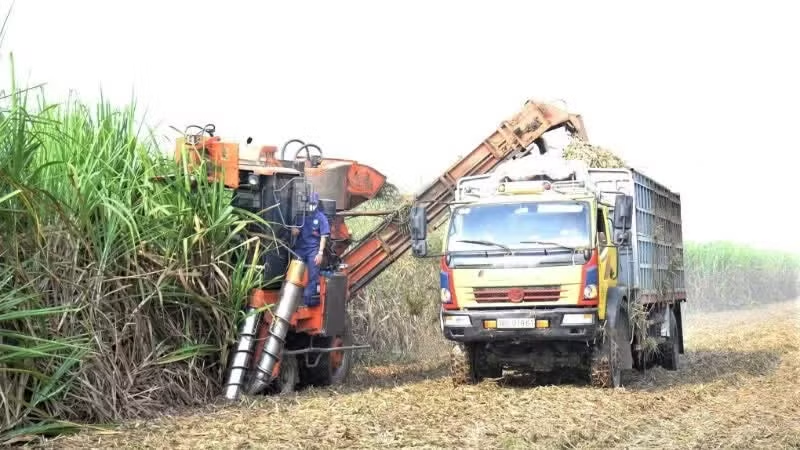
The family of Nguyen Huu Long in Dai Thang Hamlet, Nghia Dong Commune, is one such example. By leasing land from other local households, the family now cultivates 20 hectares of sugarcane, including individual fields of up to 6 hectares. Every stage of production, from land preparation and planting to crop care, and harvesting, is now entirely mechanised.
Long noted that when cultivation was carried out on small, fragmented plots, production relied heavily on manual labour, resulting in high costs and lengthy cultivation periods. Once land was consolidated into larger contiguous areas, deploying heavy machinery became vastly more viable.
For several consecutive years, his family's sugarcane yield has reached around 90 tonnes per hectare, a sharp increase from their previous 70 tonnes per hectare.
Long's family is not alone. Many other households in the company's raw material area are also shifting towards large-scale production. Nguyen Huu Ngoc from Vinh Son 2 Hamlet, Anh Son Dong Commune, said mechanisation has been applied across all of his family's nearly 14 hectares of sugarcane fields.
"Ploughing, planting, spraying, and the first fertiliser application are all done by machines. Only the top-dressing stage is carried out manually. During harvesting, depending on the factory's requirements, my family sometimes mechanises the entire process, from cutting the cane to loading it onto trucks," Ngoc explained.
Nguyen Sy Hai, Head of the Raw Material Division at Song Con Sugar Joint Stock Company, said the company's sugarcane-growing area covers 6,500 hectares, most of which is located in communes that formerly belonged to Tan Ky District. Sugarcane growers have eagerly embraced mechanisation, which now drives around 80% of production stages, delivering clear efficiency gains.
Hai noted that in the past, farmers relied on buffaloes and oxen to plough the land, then had to plough again after applying fertiliser to cover it with soil. Today, subsoil ploughs can plough, apply fertiliser, and cover the soil in a single operation, slashing production time while helping retain soil moisture.
At the harvesting stage, dozens of workers were previously needed to harvest one hectare of sugarcane, equivalent to around 70-80 tonnes a day. By contrast, modern harvesting can cut and transport one hectare of sugarcane to the factory in less than a day.
"To increase output and ensure consistent quality, the company not only provides loans for fertiliser and seedlings but also offers farmers loans to hire machinery and equipment," Hai added.
Large-scale farmland is a prerequisite
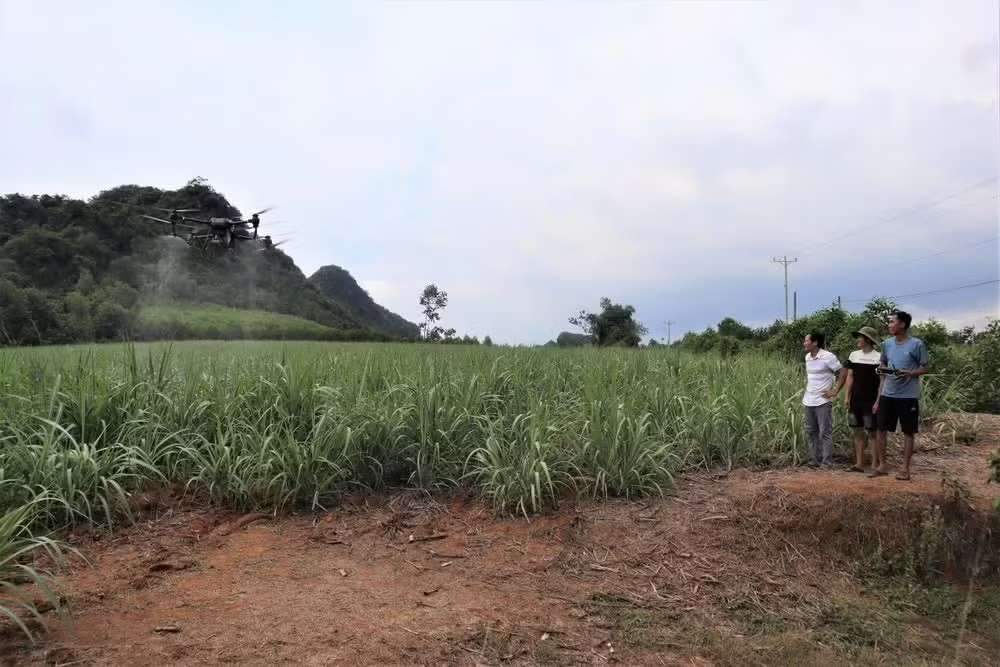
Gone are the days when farmers carried pesticide sprayers on their backs. Today, drones have become an indispensable tool for hundreds of farming households in Tan Ky, Nghia Dong, and Tan Phu Communes. They are now used for spraying crop protection products, sowing seeds, and even applying fertilisers.
Nguyen Dinh Sy from Tan Yen Hamlet, Tan Phu Commune, said he purchased his first drone for 470 million VND. As one drone could not meet the growing demand from local farmers, he bought a second one in early 2025 for 370 million VND.
Each drone can spray crop protection products across more than 30 hectares a day. The service costs 800,000 VND per hectare. By comparison, manual spraying previously allowed one worker to cover a maximum of only 3 hectares a day.
"The land must be large enough to use drones for spraying, with each field covering at least about 0.5 hectares. Recently, many households with adjacent fields have agreed to cultivate their crops at the same time so they can jointly hire drones to spray their fields simultaneously during the crop care period," Sy explained.
In Giai Lac Commune, the Communal Public Service Centre established a 65-hectare large-scale demonstration field during this year's spring crop, involving 127 farming households, with field sizes averaging 15 hectares. The area was planted with Thai Xuyen 111, Duong Uu 612, and TBL 225 rice varieties.
Nguyen Trong Huong, Director of the Giai Lac Communal Public Service Centre, reported that the model achieved a yield of more than 7.8 tonnes per hectare, significantly higher than the 6.8-7 tonnes per hectare recorded outside the model.
The higher yield stemmed from several factors, primarily the adoption of concentrated production and synchronised mechanisation throughout land preparation, planting, crop care, and harvesting. Meanwhile, in Yen Thanh Commune, the familiar sight of buffaloes pulling ploughs has virtually disappeared in recent years.
According to the Communal People's Committee, more than 1,600 hectares of rice were cultivated during this year's spring crop. When the rice ripens, combine harvesters enable rapid harvesting, helping farmers avoid losses caused by storms and heavy rain.
In recent years, Nghe An Province has made significant breakthroughs in mechanisation and the application of scientific and technological advances in agricultural production.
The mechanisation rate for key crops such as sugarcane and rice has exceeded 60%. Mechanisation has reached more than 95% in land preparation and over 85% in harvesting. The use of drones for spraying crop protection products is also becoming increasingly widespread.
Nguyen Dinh Hung, Deputy Head of the Nghe An Sub-Department of Cooperative Economy and Rural Development, stated that the province has stepped up efforts to attract businesses to participate in production linkage chains, particularly those capable of helping farmers apply mechanisation.
In 2013, the Provincial People's Committee introduced a policy to support investment in large-scale demonstration fields, including assistance for land consolidation, seed, agricultural input, and fertiliser costs, as well as technical training for farmers.
According to the Nghe An Sub-Department of Cooperative Economy and Rural Development, the province currently has 60 large-scale farming models covering around 10,000 hectares. During the 2026 spring rice crop alone, 10 large-scale field models covering a combined 1,235 hectares were implemented, attracting the participation of 6,736 farming households.
Total financial support amounted to 11.6 billion VND. "Although positive results have been achieved, mechanisation in the province still falls short of production needs," Hung said.
He concluded that fragmented farmland, limited in-field transport and irrigation infrastructure, and uneven levels of mechanisation across different areas remain major bottlenecks that the province has identified and is working to address. Removing these obstacles will create more favourable conditions for mechanisation, the application of science and technology, and the development of large-scale commercial agriculture.