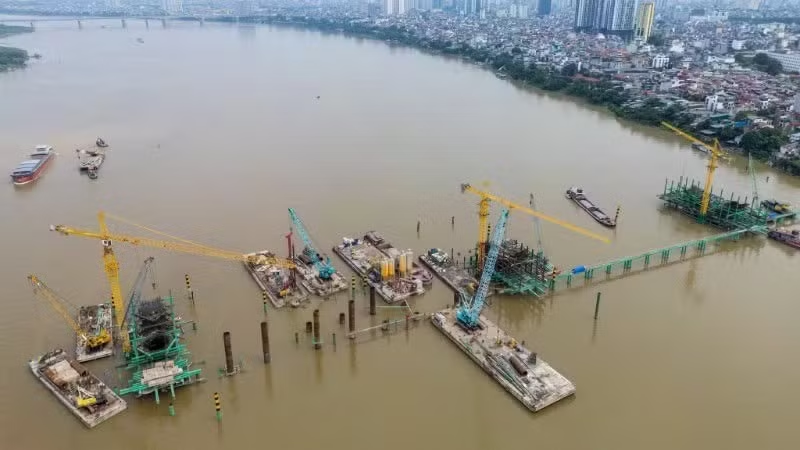
Proactively preparing response scenarios for flood season and applying a range of modern technologies are among the key measures enabling these major infrastructure projects to be completed on schedule, thereby meeting the development needs of Ha Noi.
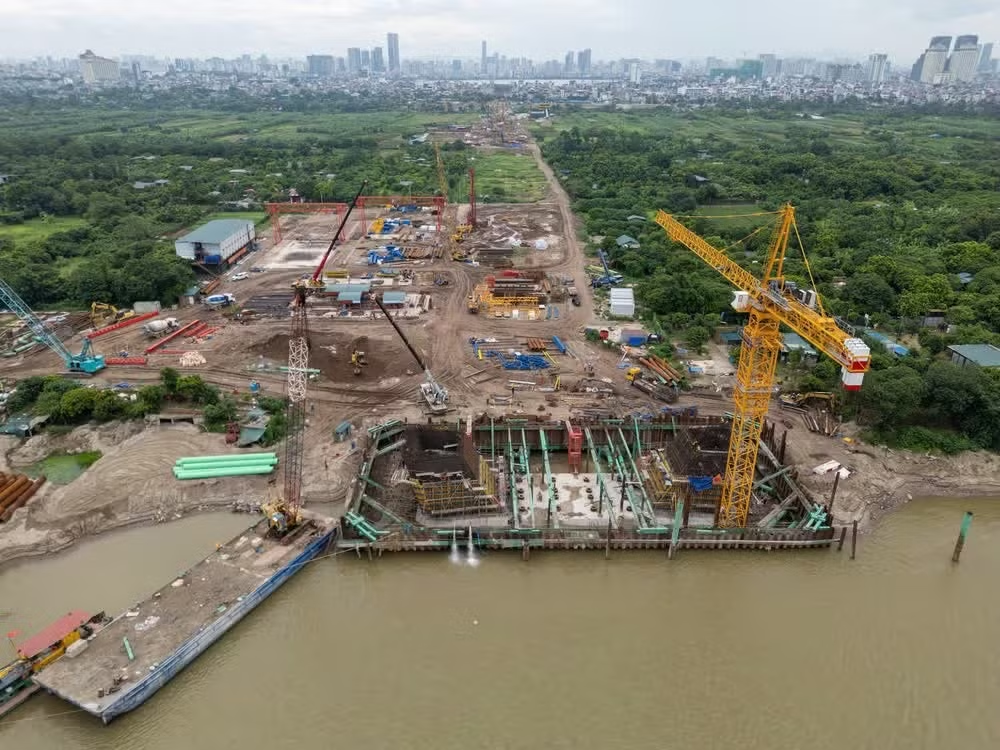
According to Le Huy Phu, an engineer with the EPC consortium's project management board for Tu Lien Bridge, the consortium has deployed around 14 construction teams across the entire project, mobilising approximately 100 experts and engineers, 800 workers, 40 cranes of various types, 40 excavators, and eight concrete batching plants, together with numerous barges and tugboats, while maintaining round-the-clock operations with three shifts and four work rotations each day.
To date, land clearance for the Tu Lien Bridge project and its approach roads has been completed in full across 62.51 hectares. On site, all bored piles for the main pylons as well as the two pier foundations of the main bridge, P37 and P38, have been completed. Construction of the approach bridges, the Truong Sa interchange and the steel bridge crossing the left dyke of the Duong River is being carried out simultaneously, with completed work accounting for around 11% of the contract value.
Under the contract, the total construction period is 30 months. However, the project has been instructed to accelerate progress further. Accordingly, the contractor has revised the overall construction schedule for the main bridge, adjusted the overall construction methodology for the bridge spans, and maximised the mobilisation of resources and equipment while deploying advanced bridge construction technologies for the first time in Viet Nam.
These include a hydraulic climbing formwork system capable of casting segments up to six metres high, a large tower crane with a lifting capacity of 800 tonne-metres, and a full 360-degree slewing crane for cantilever installation of steel girders.
The new construction methods and advanced technologies are expected to shorten the construction period of the main pylon from 15 months to 12 months and reduce that of the main girders by around nine months compared with the contractual construction method.
"We are striving to complete the closure of the main bridge by July 31, 2027, achieve technical traffic opening before final completion, and put the project into operation ahead of APEC 2027," Le Huy Phu said.
At Tran Hung Dao Bridge, many key foundation works have already been completed.
Le Khanh Hung, the deputy director of the contractor Trung Chinh's project management board, said: "Before the flood season, we increased manpower and equipment to accelerate construction and minimise disruptions when river water levels rise."
All bored piles for the main bridge have been completed. The main piers in the middle of the Red River are progressing on schedule to withstand the flood season, creating favourable conditions for subsequent construction stages. Contractors are maintaining continuous operations with three shifts and four work rotations, while construction of the approach bridges, branch bridges, the overpass on the Co Linh side, and the steel structure are progressing simultaneously to ensure the project's schedule.
The Ngoc Hoi Bridge project linking Ha Noi with Hung Yen has also recorded encouraging progress. After nearly one year of construction, all 80 bored piles for the two main pylons have been completed. Currently, 18 construction teams are focusing on approach bridges, pier foundations, bridge piers, and girder casting.
Meanwhile, the main bridge section of the Thuong Cat Bridge project has completed all 118 bored piles and the installation of steel sheet piles for three key river piers. A contractor representative said that constantly fluctuating water levels and strong river currents have created significant challenges, particularly for underwater work.
At times, fast-flowing water forced the work on the river to be temporarily suspended. As soon as conditions allowed, the contractor increased manpower and equipment to recover lost time. Six construction teams have been assigned to the critical path for the cable-stayed bridge piers to ensure the project's progress.
The Van Phuc, Hong Ha and Me So bridge projects have also achieved encouraging results. Many major structures have already risen above safe elevations for the flood season. Hong Ha Bridge and Me So Bridge — which form part of the Ha Noi Capital Region Ring Road No. 4 project — are scheduled to achieve technical traffic opening in July 2027.
The Red River bridge projects are being implemented simultaneously, with many components broadly on schedule and striving for completion before the APEC 2027 Summit. However, several sections continue to face obstacles relating to land clearance, technical infrastructure, and dyke management regulations.
Dang Xuan Huan, Deputy Director of the Ha Noi Transport Construction Investment Project Management Board
According to Dang Xuan Huan, Deputy Director of the Ha Noi Transport Construction Investment Project Management Board, the Red River bridge projects are being implemented simultaneously, with many components broadly on schedule and striving for completion before the APEC 2027 Summit. However, several sections continue to face obstacles relating to land clearance, technical infrastructure, and dyke management regulations.
For the Tran Hung Dao Bridge project, the remaining land clearance mainly concerns the Long Bien bridgehead area and several locations involving defence facilities, the 110 kV power transmission system, and underground and above-ground technical infrastructure that must be relocated to facilitate construction. For Tu Lien Bridge, construction at the Nghi Tam interchange has fallen behind schedule after work was suspended under dyke management regulations until November 2026.
In addition, as numerous transport infrastructure and construction projects are being implemented simultaneously, the supply of construction materials has become increasingly scarce, creating difficulties in mobilising and supplying adequate materials and equipment for construction, thereby posing a potential risk to project schedules.
At the same time, fluctuations in fuel prices have increased the operating costs of construction machinery and equipment, as well as transportation costs for materials. Alongside maintaining construction activities on site, project stakeholders are working closely with local authorities to complete land clearance, relocate technical infrastructure, and resolve issues arising during implementation.
Bui Duy Cuong, Vice Chairman of the Ha Noi People's Committee, called on the Transport Construction Investment Project Management Board, the contractors, and relevant departments and agencies to closely monitor weather developments and organise construction flexibly to make full use of favourable conditions.
"All agencies and contractors must both ensure compliance with dyke safety and flood prevention requirements and accelerate construction progress," Bui Duy Cuong stressed.