Unlocking resources through a leaner apparatus
After one year of operating under its new administrative structure, Ca Mau now enjoys a significantly expanded development space, with a natural area spanning nearly 8,000 sq km and a population of more than 2.6 million. Opportunities and advantages that were once constrained are now being fully unlocked through circular economy models, green agriculture, and offshore wind farms.
Reflecting on the province’s transformation, To Quoc Nam, former Deputy Director of the former Ca Mau Department of Agriculture and Rural Development, said the most notable change has been a shift towards sustainable development based on green growth, with the principles of the circular economy extending to individual households.
“Recognising this trend, my family switched to a closed-loop, water-recirculating intensive shrimp farming system. Reusing water not only produces clean, high-quality shrimp that command premium prices under guaranteed purchasing agreements, but it also protects the environment while generating more stable and sustainable income,” Nam said.
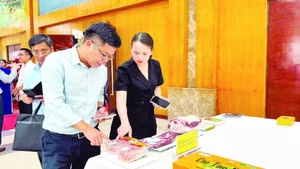
According to Ca Mau authorities, the fisheries sector continues to serve as the cornerstone of the local economy. Output of shrimp and other aquatic products has continued to rise, while high-tech and ecological shrimp farming models have expanded further, reinforcing the Ca Mau shrimp brand in both domestic and international markets.
Over the past year, the province recorded economic growth of around 8%, while budget revenue increased by nearly 17%.
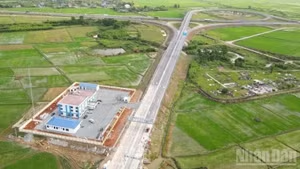
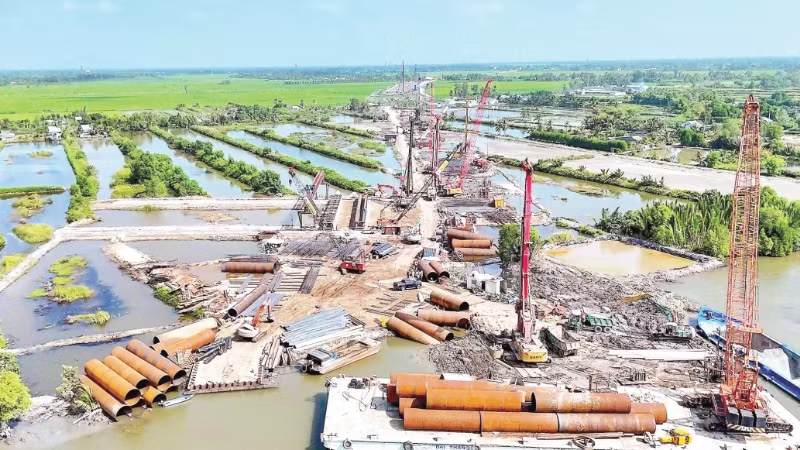
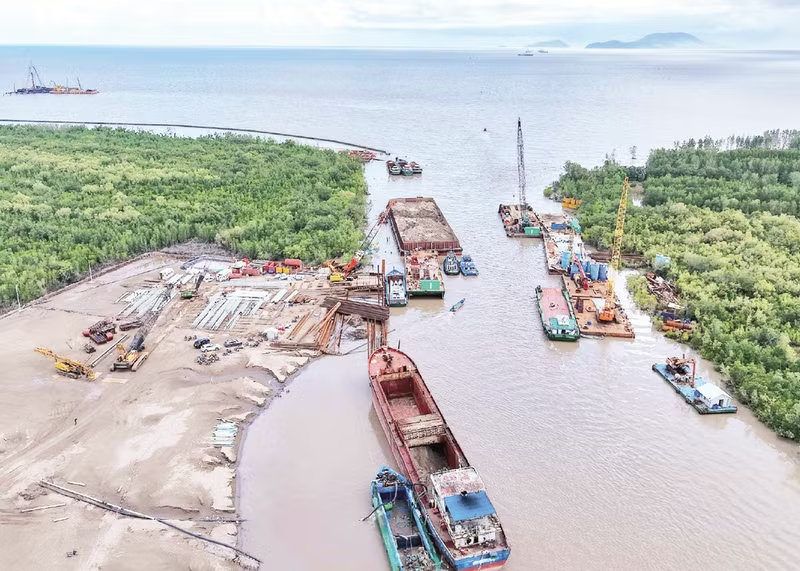
Transport infrastructure has also seen historic breakthroughs. A series of strategic projects is being accelerated, including the upgrade and expansion of Ca Mau Airport, the Ca Mau-Dat Mui Expressway, the road linking the mainland to Hon Khoai Island, and the Hon Khoai dual-use general port. This integrated transport network is creating strong momentum for investment in renewable energy, processing industries, and modern logistics.
Tran Doan Hung, a retired official living in Nam Can Commune, said: “Never before has Ca Mau received such significant central government investment in key infrastructure projects. In just a few years, once these major transport arteries are completed, the logistics bottlenecks will be removed, agricultural products from Ca Mau will have direct access to global markets, and more employment opportunities will be created for local people right here in their homeland.”
Measuring success through public satisfaction
Alongside economic growth and infrastructure development, one of Ca Mau's greatest achievements has been building a government that is closer to the people.
The wider application of information technology, along with digital transformation in governance and public administration, has enhanced transparency, improved efficiency, and optimised public services
Public Administrative Service Centres at all levels have continued to operate smoothly and efficiently, meeting the needs of both residents and businesses.
From the grassroots perspective, Ho Song Toan, Chairman of Khanh Hung Commune, said: “The essence of operating the new administrative system is not simply following procedures correctly, but changing our service mindset. Officials must be closer to the people, listen more attentively, provide dedicated guidance, and resolve issues for residents and businesses as quickly and accurately as possible.”
The achievements of this service-oriented administration have fostered broad public consensus.
In 2025, Ca Mau completed its programme to eliminate temporary and dilapidated housing ahead of schedule, providing nearly 10,000 secure homes for poor and disadvantaged households through community support.
Public participation has also been clearly demonstrated through patriotic emulation movements.
Huynh Xuan Dien, a member of the Provincial People’s Council and Chairman of the Tan Hung Shrimp Farming Cooperative in Tan Hung Commune, believes that the close engagement and responsiveness of local officials have strengthened the bond between the government and the people.
“Through oversight visits and meetings with voters, I have seen that local people have become far more proactive. Whether it is protecting the environment, collecting waste, planting trees, or building fences, everyone is willingly working together to create united and prosperous rural communities,” Dien said.
According to Ca Mau Chairman Lu Quang Ngoi, streamlining the administrative apparatus and reforming leadership methods have opened new opportunities for development. Above all, public support and consensus provide the strongest foundation for the government to realise its long-term ambitions.
“Every policy implemented over the past year has pursued a single objective: delivering tangible benefits to people and businesses. Once people see that their own interests are closely linked to the province’s development, they will actively work alongside the government,” Ngoi emphasised.
To achieve double-digit economic growth in 2026 and throughout the 2026-2030 period, Ca Mau will continue pursuing vigorous administrative reform, wide-ranging digital transformation, and full mobilisation of all available resources to complete key infrastructure projects
“We regard the satisfaction and well-being of our people as the highest measure of the effectiveness of the new administrative system. The strength of public support is an inexhaustible source of energy that will enable Ca Mau to confidently enter a new era and realise its aspiration of becoming one of the country’s more developed provinces,” Ngoi affirmed.