Viet Nam’s 54 ethnic groups form a diverse yet unified cultural mosaic that contributes significantly to the country’s sustainable development in the context of international integration. However, the exploitation of ethnic cultural heritage in various areas of life has revealed numerous shortcomings, particularly in commercial and entertainment activities.
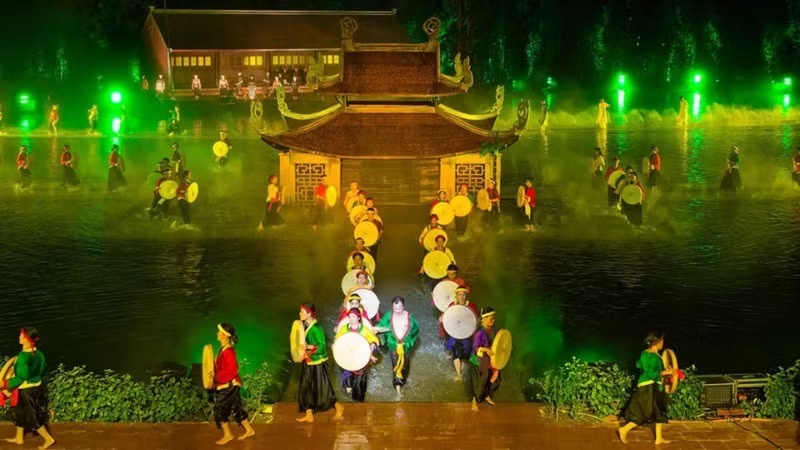
The most visible examples include advertisements or music videos that draw on heritage elements, such as landscapes, costumes and customs of ethnic minority communities, to create striking visuals and attract audiences.
Many such products have achieved success in terms of sound and imagery, while celebrating cultural identity and helping to promote tourism. Yet, alongside these successes are numerous cases in which traditional cultural elements are used arbitrarily and without respect, sparking strong public criticism.
In business, a well-known shoe brand once faced severe backlash after releasing a product marketed as being “inspired by Central Highlands brocade”, whereas the fabric used was, in fact, imported silk, with no clear indication of origin provided by the manufacturer.
Such incidents show that while individuals and businesses benefit from exploiting traditional values, the communities who own these cultural assets receive little or no consideration. According to experts, when individuals or organisations in culture, the arts or creative industries exploit another culture for personal gain without respecting the community of origin, such behaviour may constitute cultural appropriation.
Dr Le Thi Thanh Le, a lecturer at the University of Social Sciences and Humanities, Viet Nam National University-Ha Noi, noted that exploiting culture for benefits or profits is not wrong; it only becomes inappropriate when artists exploit culture carelessly or disrespectfully for personal gain. Someone who works with cultural materials with good intentions and respect is entirely different from those who appropriate culture with a profit-driven or disrespectful mindset.
Exploiting culture for benefits or profits is not wrong; it only becomes inappropriate when artists exploit culture carelessly or disrespectfully for personal gain.
Dr Le Thi Thanh Le
University of Social Sciences and Humanities, VNU-Ha Noi
This issue is becoming increasingly complex, especially on digital platforms. Short clips on TikTok or YouTube that use regional cultural material to create entertainment “trends” and attract huge view counts are easy to find; however, many lack depth or even misrepresent the essence of the culture.
Recently, “virtual tourism”, using virtual reality technology to recreate festivals or craft villages, has gained attention. From a positive perspective, this approach helps spread traditional values. However, without proper investment and research, it risks becoming commercialised and could lead to unpredictable consequences.
Associate Professor Nguyen Ngoc Tho at the University of Social Sciences and Humanities, Viet Nam National University-Ho Chi Minh City frankly pointed out: “Some creators mistakenly believe that creativity is limitless and without boundaries. In reality, if a creator merely uses a small part of cultural material as inspiration for their artistic expression, that is acceptable. But if they interfere with the traditions of ethnic communities, especially minority groups, the issue becomes more complex. They must exercise greater caution because they are dealing with the community’s intangible assets, including tangible and intangible cultural works that have been recognised or associated with religion or ethnicity.”
Internationally, this issue has also drawn significant attention. American singer Kacey Musgraves faced strong backlash from the Vietnamese American community after wearing a Vietnamese ao dai with skin-coloured tights during a performance in Dallas in 2019. Many criticised the outfit for disrespecting Viet Nam’s traditional attire. Similarly, some foreign designers have showcased Viet Nam’s ao dai on runways as an “ethnic creation” without clarifying its origins, causing confusion and potentially constituting cultural misappropriation.
The consequences of misusing or distorting cultural values are deeply concerning: such behaviour not only violates core cultural principles but also creates inequality in the exploitation of traditional values. Viral products generate profits for individuals or companies, yet the communities that own the culture receive no benefit. In the context of globalisation, such behaviour risks diluting national identity. The 2003 UNESCO Convention for the Safeguarding of the Intangible Cultural Heritage emphasises the need to ensure respect for community heritage, including the integrity of cultural expressions, and to avoid improper or harmful exploitation.
In 2017, during the 34th session of the Intergovernmental Committee on Intellectual Property and Genetic Resources, Traditional Knowledge and Folklore (IGC) under the World Intellectual Property Organisation, delegates from 189 member countries negotiated and promoted the completion of international legal instruments to protect traditional cultural expressions from appropriation.
Indigenous advocates and delegates stressed that such behaviour not only causes economic damage when individuals or businesses profit without sharing with the owning communities, but also cultural harm, including insulting cultural identity and weakening the pride of indigenous communities.
To address this issue, strategies must be developed using a community-centred approach, combining legal, technological and educational solutions.
According to Dr Lu Thi Thanh Le, principles promoting collaboration with communities and benefit-sharing can help foster sustainable and effective partnerships between artists and the communities whose cultural materials they use. Artists and businesses should proactively conduct in-depth research, engage in real-life experiences and co-create with communities to ensure sustainable cultural value.
At the same time, education in schools and society should raise young people’s awareness of the meaning and role of heritage, helping cultivate a sense of responsibility in cultural engagement.
When communities participate in co-creation and deepen shared understanding, national cultural heritage will continue to flourish in the long term, forming a bridge between generations and laying the foundation for sustainable development.